It's common to ask client or server as if it's about choosing where code runs. That's the wrong first question. The essential choice is where trust ends, because a browser can collect signals, but only a server can decide whether a signup, login, or checkout request is fresh, bound to the right session, and safe to honor.
| Responsibility | Client-Side Verification | Server-Side Verification |
|---|---|---|
| Signal collection | Gathers browser evidence and interaction data | Receives the evidence and checks it against authoritative state |
| Decision authority | Can hint, score, or package proof | Makes the final allow, flag, step-up, or block decision |
| Enforcement | Cannot reliably enforce on its own | Can reject, throttle, or require more proof |
| Replay resistance | Weak if the proof can be copied or reused | Stronger when the proof is bound to session and freshness |
| State ownership | Lives in the user-controlled browser | Lives in backend session, token, and policy stores |
| Risk profile | Easier to tamper with or bypass | Better positioned to detect misuse before the action completes |
The browser is good at producing evidence. It is bad at being the judge of that evidence. Once you frame the problem this way, the debate stops being about where the JavaScript runs and starts being about where trust is granted.
Client-server systems have long been a measurable operating model built around latency, throughput, and service monitoring, not just a network shape. IBM's documentation on history tables shows that these systems are tracked by response time, queue depth, and server timing because the decision boundary matters operationally, not just architecturally. IBM history table metrics
Table of Contents
- Why Client or Server Is the Wrong First Question
- What Client-Side and Server-Side Verification Actually Do
- Side-by-Side Comparison of Client and Server Responsibilities
- What Goes Wrong When Verification Stays in the Browser
- Why Browser Proof Needs Server State
- Collecting Proof in the Browser and Verifying It on the Server
- Observe Before Enforce and Picking the Right Mix
- Practical Guidance and Common Questions
Why Client or Server Is the Wrong First Question
The first security question is not whether the client or server handles verification. It is where the system grants trust. A browser request can come from a real user, an automated script, or a modified application. Because the user controls the client, its code and signals can be altered, replayed, or replaced.
Trust belongs at the action boundary
In signup, login, and checkout flows, the browser can collect evidence of normal behavior, device consistency, or challenge completion. The server must determine whether that evidence is fresh, tied to the current session, and sufficient for the requested action. It should own the keys, session state, replay checks, and final allow, step-up, or reject decision.
Practical rule: if the user can alter it, don't let it decide.
This boundary matters in browser applications that distribute logic and state across the client, edge, and origin. “The client initiates and the server responds” describes message flow, not security ownership. Production designs must specify which component verifies signatures, records proof usage, enforces rate limits, and blocks a reused artifact.
The architecture is established. Client-server computing became mainstream in the late 1980s, while the adoption figures cited in the USPTO technical overview show how quickly the model spread through business applications. Its history explains the communication pattern, not where modern applications should place trust.
For high-value actions, collect browser proof, send it to the backend, and verify it there. A staged rollout can observe signals first, expose false positives, and enforce only after the team understands replay and tampering behavior.
What Client-Side and Server-Side Verification Actually Do
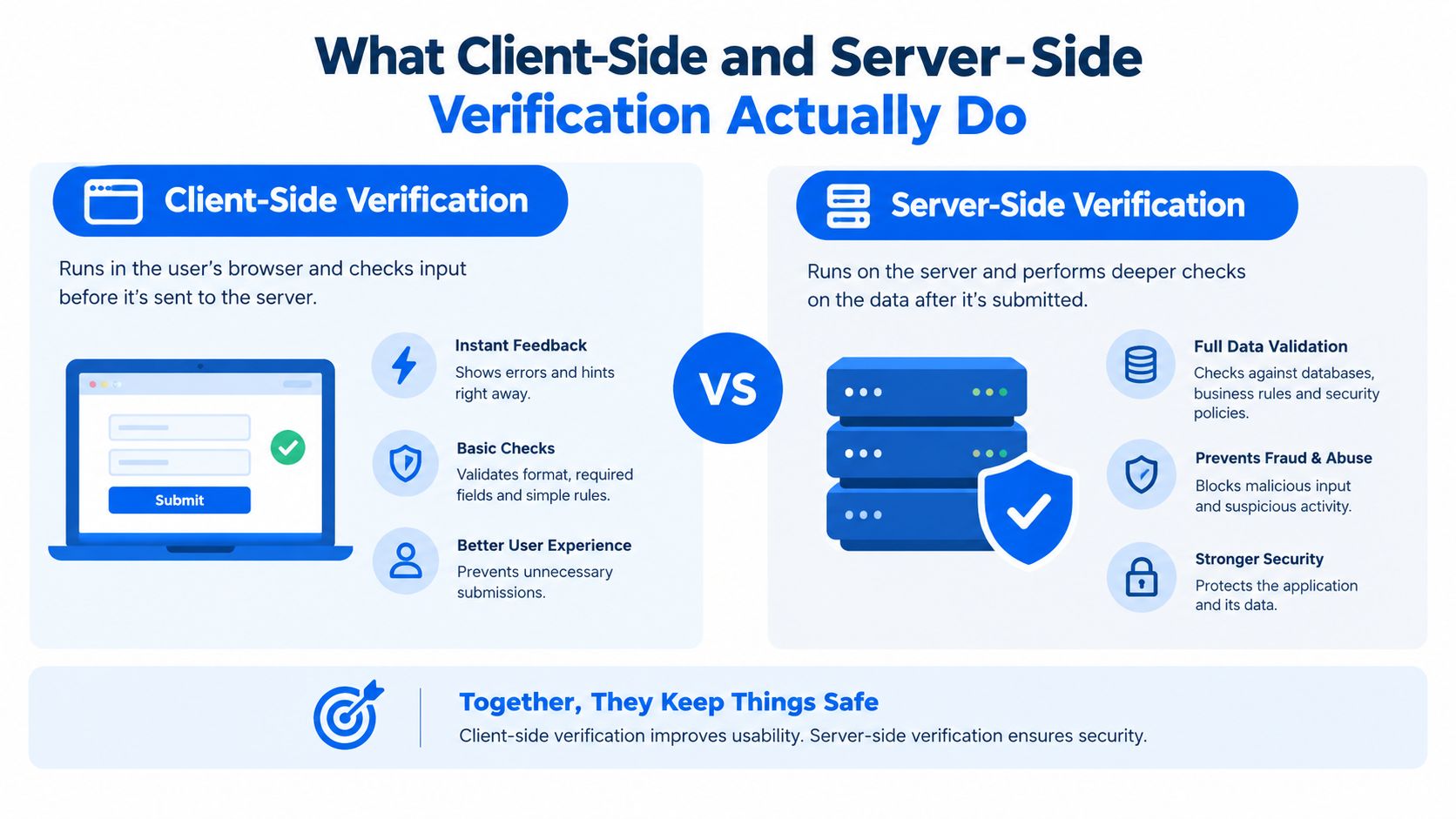
Client-side verification runs in the browser. It can collect telemetry such as canvas fingerprints, WebGL behavior, timing patterns, and interactive responses, then package that into an attestation. That's useful evidence, but it's still evidence produced inside an environment the attacker can influence.
What the browser can and cannot prove
A browser check can say, “this session looked normal when the script ran.” It cannot say, “this session stayed normal after the page loaded,” because scripts can be stubbed, pages can be altered, and network calls can be intercepted before validation reaches the backend. Security guidance for browser-based verification keeps returning to the same point, client-side signals alone aren't trustworthy when the attacker can manipulate the page or replay the artifact before server validation occurs browser tampering guidance.
Server-side verification is different. It evaluates the request against authoritative state, things like token signatures, rate limits, session continuity, and prior request context. That's why server-side enforcement can reject, slow, or step up a flow. The browser can hint. The server can decide.
A browser proof becomes meaningful only after the server binds it to a session and checks that it hasn't already been spent.
That distinction is the whole point of invisible verification. It can run in the background and return a short-lived token or score, then let the application verify that token server-side before signup, login, checkout, or another protected action proceeds invisible CAPTCHA-style checks. If you want a deeper implementation view, see this anti-bot verification guide.
Side-by-Side Comparison of Client and Server Responsibilities
The useful comparison is not who sends and who replies. It is where trust belongs when a request can create an account, move money, consume credits, or change access.
| Responsibility | Client-Side Verification | Server-Side Verification |
|---|---|---|
| Signal collection | Browser JavaScript and its runtime gather signals | Backend receives the result and correlates it |
| Decision | Browser suggests confidence | Server makes the authorization decision |
| Enforcement | Modified client code can bypass local checks | Backend can block, delay, or request more proof |
| Replay resistance | Weak when output can be copied or reused | Stronger when freshness and one-time use are checked |
| Token theft | Copied browser artifacts offer little protection | Server can reject stale, reused, or mismatched proof |
| State | Stored in a user-controlled environment | Stored in session, policy, and audit systems |
Why the table leans server-side
The browser is useful for collecting low-friction signals, but the user controls its runtime. A script can report a clean result while the request is altered afterward. The server owns the state needed to judge whether that result still applies: session continuity, request context, policy, and a record of previously accepted proofs.
Operational visibility also affects the design. Client-server monitoring commonly separates client time, network time, server time, transaction time, and response time in historical records, as described in IBM's history table metrics. Apply the same discipline to verification. Record which signal arrived, which policy evaluated it, whether the proof was fresh, and what action followed. Without those records, teams cannot distinguish a bad client signal from a replay, network delay, or an overly strict rule.
Client checks still earn their place. They can collect context cheaply, give legitimate users a quiet first pass, and reduce unnecessary challenges. They should inform server policy, not replace it.
For high-value actions, the practical split is clear: collect browser proof, send it with the transaction, and let the backend bind it to the session and action before enforcement. Start in observation mode, compare outcomes with existing controls, then enforce gradually. That rollout limits disruption while keeping the trust decision where attackers have less control.
What Goes Wrong When Verification Stays in the Browser
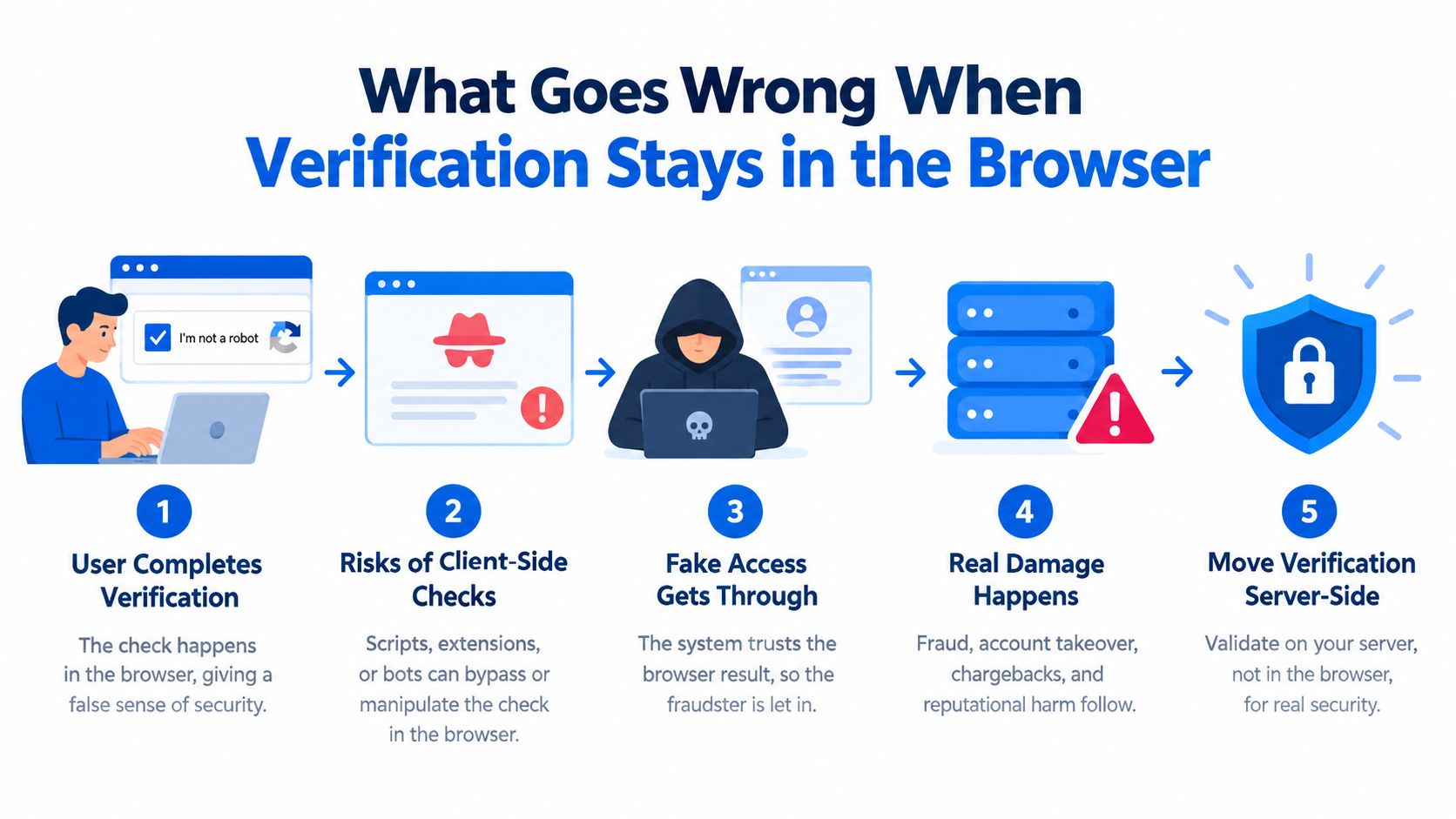
A headless bot doesn't need to “win” the browser to cause damage. It only needs to reach the endpoint with something that looks acceptable to a weak client-side check.
A signup flow that looks fine until it isn't
Start with a /signup POST. A headless bot can skip JavaScript entirely, submit the form directly, and never trigger the browser challenge that a human would see. If the app only checks a client-returned green status, the request can sail through with no meaningful server validation.
A tampered fingerprint script is just as bad. If the attacker stubs the script to return a success value, the browser layer reports “good,” even though the page was never verified. If the system accepts a captured challenge token later, the replay looks legitimate to the browser layer because the browser doesn't know the token has already been used.
Silent abuse is the real failure mode
These failures usually don't surface as obvious exceptions. They show up as fake accounts, drained promo credits, and card-testing storms that still look normal to the browser code. A stolen token can be replayed across accounts, a malicious extension can lift a proof out of the page, and a captured request can be resent unchanged until the backend notices, if it notices at all.
Replay attacks are a specific risk in transactional web flows because a captured browser request can be resent unchanged and still look legitimate if freshness isn't enforced replay hardening guidance. That's why the security boundary has to end somewhere the user can't edit. If the attacker can influence the verdict, the verdict isn't secure.
Why Browser Proof Needs Server State
A fingerprint, a challenge response, or a behavioral score is a snapshot. Snapshots rot. Once proof is disconnected from server state, the same artifact can be reused against a new session, a different account, or a later endpoint.
Freshness is what turns evidence into a decision
The server needs a nonce, which is a one-time value, and a short validity window. It should bind the proof to the session ID, the action context, and the request that triggered it. If the proof is old, reused, or inconsistent with the current request, the backend should treat it as stale.
That binding can also use rotating salts, monotonic counters, and correlation IDs. Those don't make browser proof magical. They make it traceable. A static token says, “something happened once.” A server-anchored proof says, “this event happened for this session, for this action, at this time, and it hasn't been spent already.”
| Property | Static Browser Proof | Server-Anchored Proof |
|---|---|---|
| Freshness | Can age out silently | Checked against server-side lifetime rules |
| Replay resistance | Weak if copied | Stronger when bound to one-time use |
| Session continuity | Often missing | Explicitly tied to the live session |
| Action context | Easy to reuse elsewhere | Bound to the exact operation |
| Auditability | Limited | Clear backend trail |
The server is the court, not the witness
The browser can present evidence. The server weighs it against state the user can't alter. That's why modern verification stacks treat browser proof as input, not verdict. Without backend binding, the same token can be replayed after a stolen session cookie, reused across accounts, or submitted after a challenge has gone stale.
The oldest trap in this space is trusting the artifact more than the context. The browser can't enforce one-time use on its own, and it can't know whether a proof has already been accepted somewhere else. The backend can, if you give it the state to do so.
Collecting Proof in the Browser and Verifying It on the Server
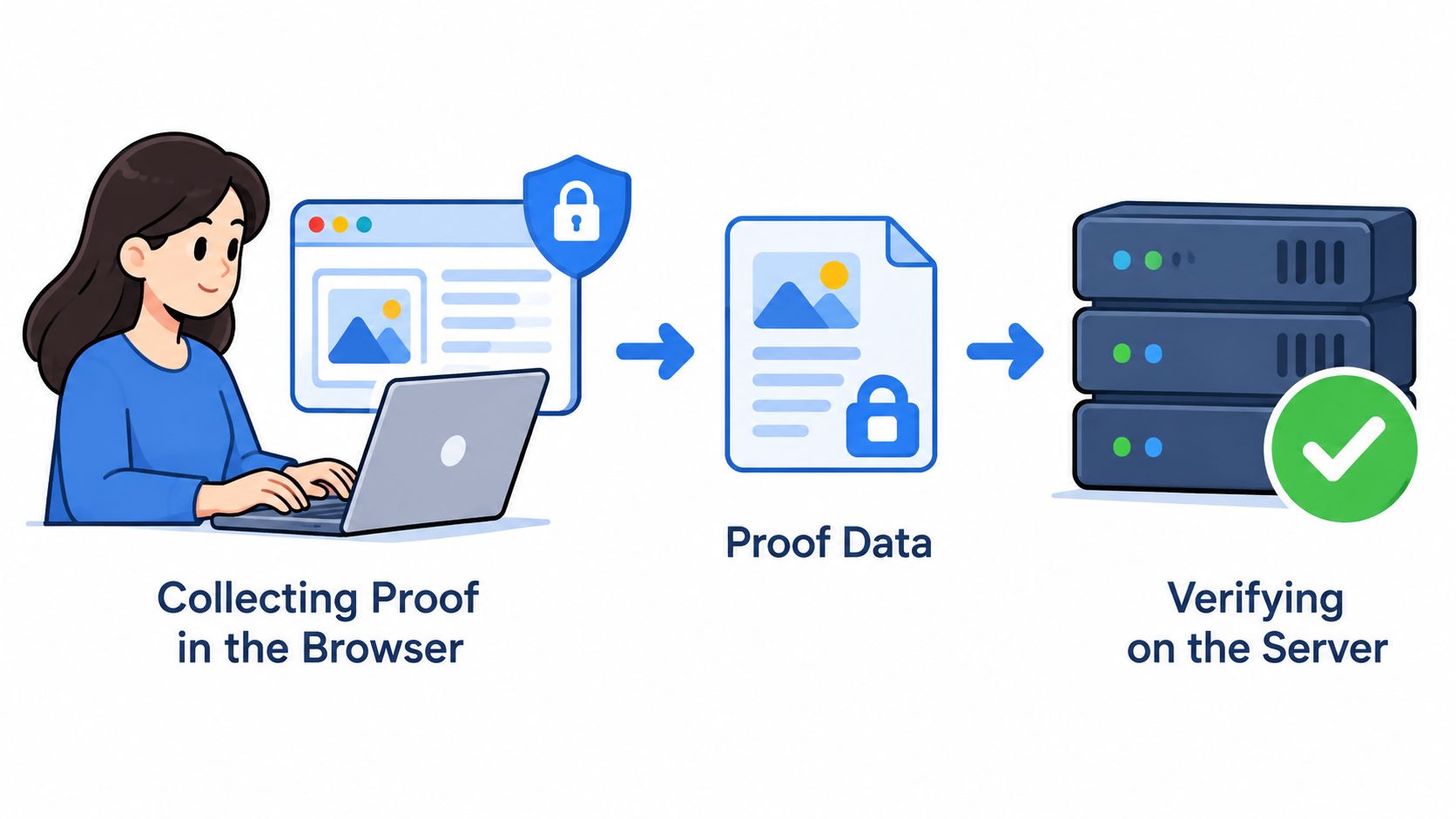
The clean integration pattern is simple. The browser collects proof. The server verifies it. Anything else is a convenience layer, not a security control.
A practical flow
A JavaScript SDK loads on the protected route and collects device and behavioral signals. If a challenge is triggered, it solves it invisibly and posts a signed token to a backend endpoint. The backend validates the signature, checks the nonce against the issuing service, confirms TTL and one-time use, and binds the result to the current user session before the action completes.
Where to place the verifier
There are three practical placements. An edge function is useful when you want low-latency gating close to the request. A cloud function gives you richer rules and easier integration with surrounding services. The origin server is the right place for the most sensitive transactional checks, because it already owns the session and the action state.
The decision is less about speed than about authority. If the edge can make a preliminary call, fine. If the origin must make the final call, even better. The important part is that the backend, wherever it lives, owns the yes or no.
MANDATE's verification integration path fits that pattern because it's built around collecting browser proof and validating it on the server. It also supports the operational split between observe and enforce, which matters when you're protecting important actions without putting friction in front of legitimate users.
What to log
Log the token ID, the action type, the server verdict, the session binding, and whether the request was retried. If you don't log the reject path, you won't know whether a false positive came from a stale token, a network retry, or a real abuse attempt. Keep the audit trail close to the decision.
Observe Before Enforce and Picking the Right Mix
The safest rollout is to observe first. If you start with blocking, you'll break legitimate traffic before you know what normal looks like.
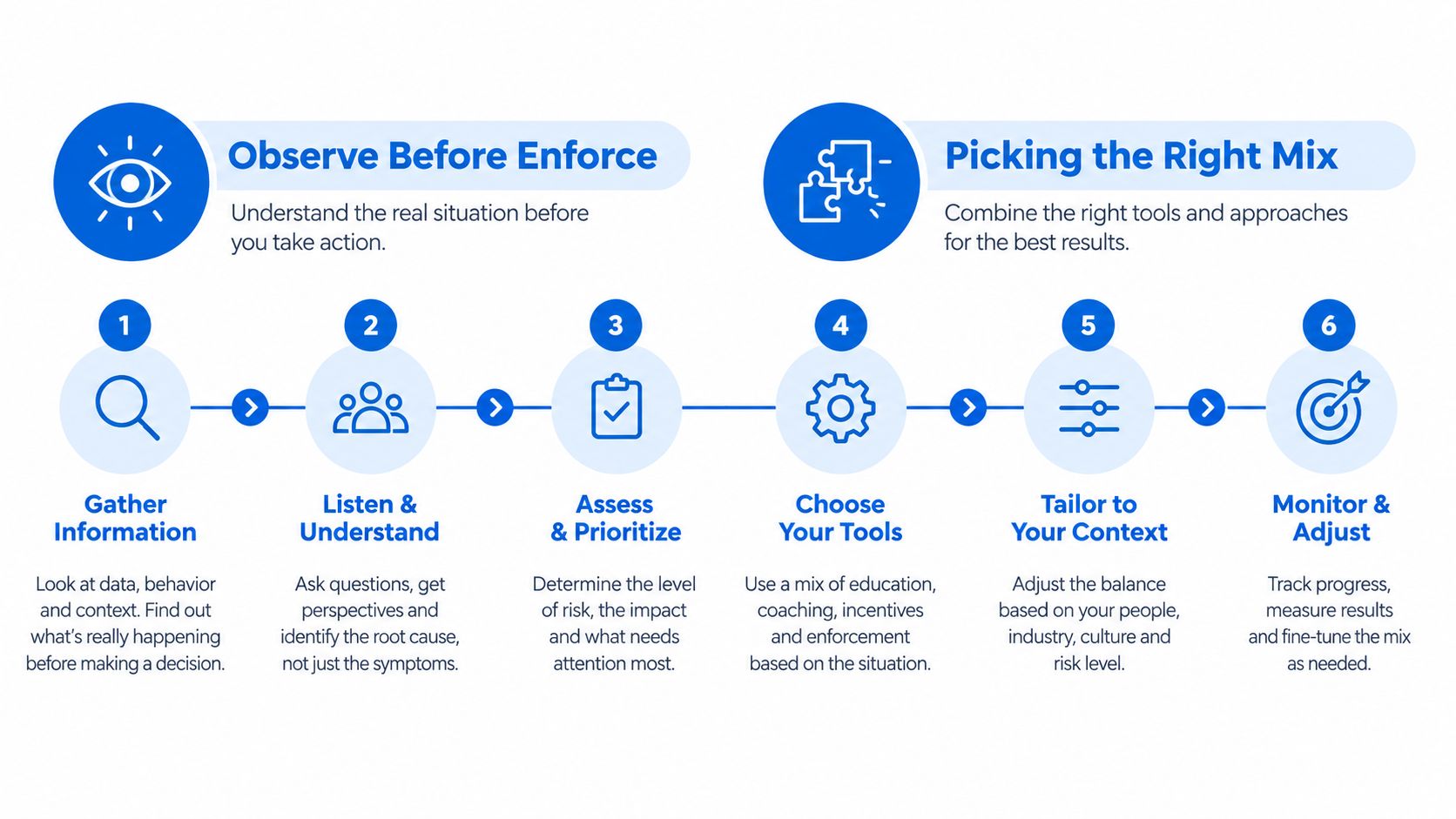
A staged rollout works better than a hard switch
Week one should log accept, challenge, and deny decisions without rejecting traffic. Week two should correlate those decisions with abuse signals such as chargebacks and account-takeover indicators. Week three can introduce blocking rules with a low false-positive budget. Week four can tighten thresholds based on observed traffic behavior, not the expected behavior outlined in the policy.
That approach fits observe-before-enforce guidance. It's also the only sane way to avoid blocking paying customers while you tune the rules.
Match the placement to the action
Use lightweight client-only fingerprint checks on marketing-page form views where the cost of a mistake is low. Require server-verified browser proof on signup, login from a new device, password reset, gift card purchase, and any checkout tied to an order or lifetime-value check. For small teams without fraud analysts, server-only enforcement on the highest-risk actions is usually the safest default.
High-traffic consumer apps often do better with a hybrid model. Risk scoring can happen at the edge, while final adjudication stays at the origin. Regulated flows should lean harder toward backend enforcement, because the audit trail and the binding matter more than shaving a few milliseconds.
Operational rule: observe first, enforce later, and keep the final decision where the state already lives.
Client-side submission alone is fine for low-risk interactions, but it isn't enough for transactional flows. The moment the action has real value, the server has to own the outcome.
Practical Guidance and Common Questions
The rule is straightforward. Collect proof in the browser, verify it on the server, never trust a token without a freshness window, and never enforce without prior observation. That's the safest default for signups, logins, and checkout flows that matter.
How long should a verification token stay valid? Short enough that replay gets expensive, and always short-lived relative to the action it protects. If the request is delayed, the server should demand fresh proof rather than extending trust indefinitely.
Can you detect cached or replayed tokens without storing every request? Yes, if you keep a one-time-use ledger, a nonce registry, or a bounded history keyed to the issuing event. You don't need to retain everything forever, but you do need enough state to reject duplicates and stale proofs.
What if a legitimate user fails the check on a slow connection? Don't hard-block immediately. Step up the request, retry safely, or send the flow through a fallback path that preserves the user session while the backend revalidates freshness and context.
Where should rate limiting live, at the edge or the origin? Put coarse rate limiting at the edge and authoritative decisions at the origin. The edge can cut noise early, but the origin should decide on the actions that move money or create accounts.
What about token leakage through browser extensions or malicious scripts? Assume leakage can happen and make the backend reject anything that doesn't match the original session, action, and freshness window. A stolen proof that isn't bound to the live request should be useless.
Can a WAF or CDN rule replace browser verification? No. A WAF can reduce noise, but it can't replace session-bound browser proof when the attacker can bypass JavaScript, replay a captured artifact, or submit directly to the endpoint. The policy belongs to security, the endpoint belongs to the application team, and the edge placement belongs to infra.
If you're protecting signups, logins, checkouts, or other high-value actions, MANDATE gives you invisible browser verification with server-side validation and an Observe mode for tuning before enforcement. Visit MANDATE to see how it fits into a browser-proof workflow that keeps legitimate users moving.