A familiar pattern plays out in online stores every day. The payments team sees more chargebacks. Support sees odd refund requests. Security sees login spikes from automation. Product sees signup funnels wobble after adding more friction. Each team is looking at a different symptom of the same problem.
That's why e-commerce fraud detection no longer means “score the card transaction and move on.” It now means protecting the high-value actions that fraudsters target first: account creation, login, checkout, rewards redemption, refunds, and account changes. If you only defend the payment step, attackers will just move one click earlier or later in the flow.
Table of Contents
- Introduction Why E-commerce Fraud Detection Now Covers More Than Payments
- How E-commerce Fraud Detection Works From Signal to Decision
- Behavioral Signals Device Proof and Browser Verification Explained
- Rules Engines Versus Machine Learning for Fraud Scoring
- Orchestrating Detection Across Signup Login and Checkout
- Operational Workflows Tuning Thresholds and Reducing False Positives
- Putting Your E-commerce Fraud Detection Plan Into Action
Introduction Why E-commerce Fraud Detection Now Covers More Than Payments
A customer creates an account during a promotion, logs in from a familiar browser, fills a cart, and checks out in under a minute. On the surface, it looks clean. Underneath, it may be a fake signup, a credential-stuffing success, or a stolen card tested through a real account. By the time a payment model scores the order, the attack has already touched several earlier steps.
That shift is why fraud detection now starts before the card authorization. Teams need to protect the actions that give attackers access: signup, login, checkout, stored payment use, loyalty redemption, refunds, and account changes. Each step is a gate. If one gate is weak, attackers route around the stronger one.
The cost trend explains why this broader view matters. Signifyd's roundup of Juniper Research and merchant fraud cost data cites industry estimates that place global e-commerce fraud losses on a steep upward path through the next several years. The exact forecast varies by model, but the operational takeaway is the same. Fraud is growing fast enough that point defenses at checkout are no longer enough.
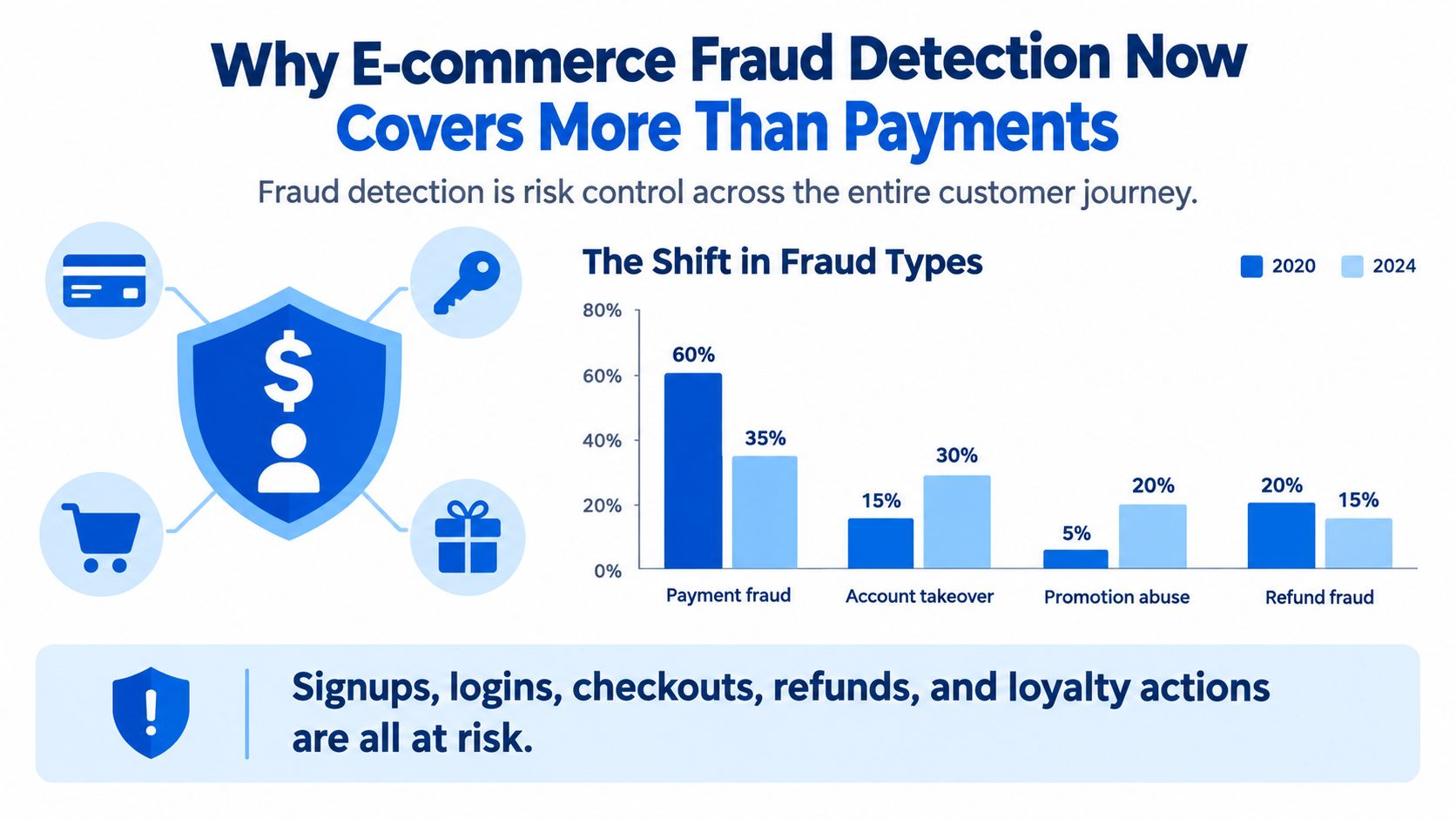
Fraud now spans the customer journey
The economics are broader than chargebacks. A bad signup can lead to promo abuse. A bad login can expose stored cards, saved addresses, and loyalty balances. A bad checkout can trigger fulfillment loss, manual review cost, and customer support work all at once.
This is why strong programs treat fraud detection less like a payment filter and more like access control for high-value actions.
- Signup: decide whether a new account looks like a real customer or a staged identity.
- Login: check whether the browser and device behave like the returning user, not just whether the password is correct.
- Checkout: verify that the session, account, and payment activity make sense together.
- Post-purchase actions: watch for abuse in refunds, returns, redemptions, and account edits.
For teams building these flows, e-commerce fraud protection across signup, login, and checkout is a more useful frame than payment scoring alone. It puts attention on where attackers gain access, create synthetic accounts, or cash out value.
What modern detection needs to prove
A payment score answers one question late in the flow. A stronger system answers several questions earlier.
Is this browser likely controlled by a real human? Does this device look consistent with the account history? Does the session behavior match normal use, or does it look scripted? Can the server verify the proof it received, rather than trusting whatever the client sends?
That combination matters because single signals are easy to misread. A new device may be a customer replacing a phone. Fast form fills may come from autofill. A risky IP may belong to a traveler. Good detection works like airport security with multiple checkpoints. One clue rarely decides the outcome. Several consistent clues, checked together, support a reliable decision with less friction for legitimate users.
The practical shift is simple. E-commerce fraud detection now protects important web actions with invisible browser proof, server-side verification, and decision logic that connects behavioral, device, and orchestration layers into one workflow. Payments still matter. They are just no longer the whole job.
How E-commerce Fraud Detection Works From Signal to Decision
Most systems follow the same basic loop. They collect signals, score risk, make a decision, and feed outcomes back into review. The details vary, but the mental model holds across signups, logins, and checkout.
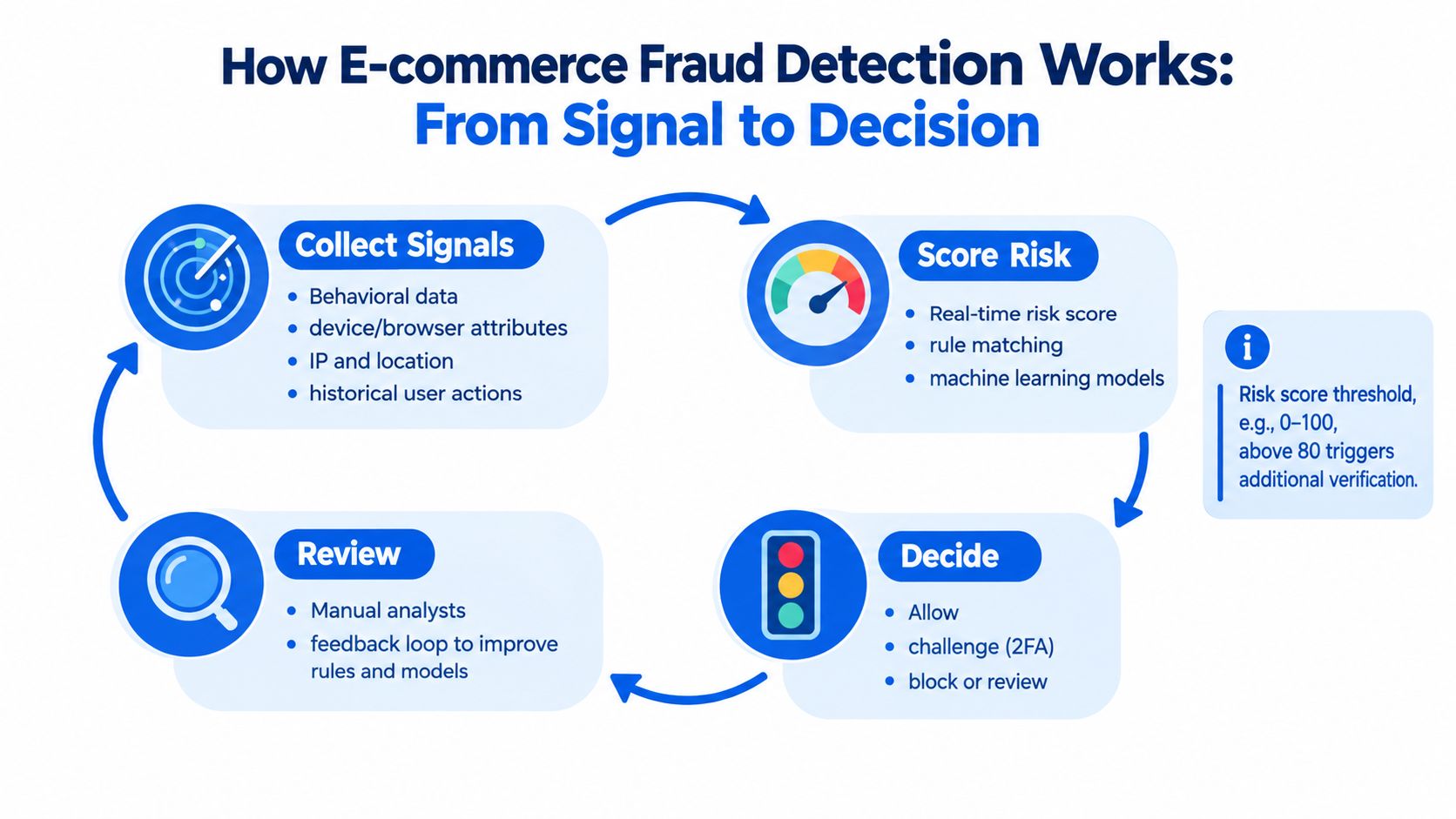
Collect signals
Signals are the raw evidence attached to an event. A signup request might include browser characteristics, device consistency, IP and location clues, navigation behavior, and what the account has done before. A login adds credential use patterns, session continuity, and account history. A checkout adds cart context, payment attempts, and shipping changes.
One signal rarely proves much on its own. A new device could be fraud, or it could be a customer replacing a laptop. A fast checkout could be a bot, or it could be a repeat buyer using autofill.
Score risk
Risk scoring combines the evidence into a usable decision input. Some teams do this with deterministic rules. Others use machine learning. Most mature teams use both.
The point of the score isn't mathematical elegance. It's operational clarity. It helps answer a simple question: should this request pass, be stepped up, be queued for review, or be blocked?
Decide at the right point in the flow
Decisioning works best when it's close to the protected action. If the risky action is login, make the decision during login. If it's rewards redemption, decide there.
Typical actions include:
- Allow: the request looks consistent with a legitimate user.
- Challenge: the request needs another proof point, such as 2FA.
- Review: the request isn't clean enough to auto-approve but not bad enough to block.
- Block: the evidence is strong enough to stop the action.
A fraud stack is less like a lock and more like airport screening. No single checkpoint catches everything, but layered checks catch more with less disruption.
Review and learn
Review closes the loop. Analysts inspect false positives, confirmed fraud, new attack patterns, and edge cases. That feedback updates rules, thresholds, and model features.
Fraud pressure doesn't stay fixed. The Merchant Risk Council findings summarized by Capital One Shopping report that merchants dealt with an average of 3.7 different fraud attacks in 2025, down from 4.2 the year before, while still reporting that 3.2% of total annual e-commerce revenue is lost globally to payment fraud. The same source notes that nearly 45% of EU consumers encountered fraud or scams online in 2024.
That mix explains why a detection pipeline has to be layered. Attackers shift methods. Systems have to adapt without forcing every customer through visible friction.
Behavioral Signals Device Proof and Browser Verification Explained
A lot of confusion starts here because teams group very different signals under the same label. Behavioral signals, device attributes, and browser verification all help, but they answer different questions.
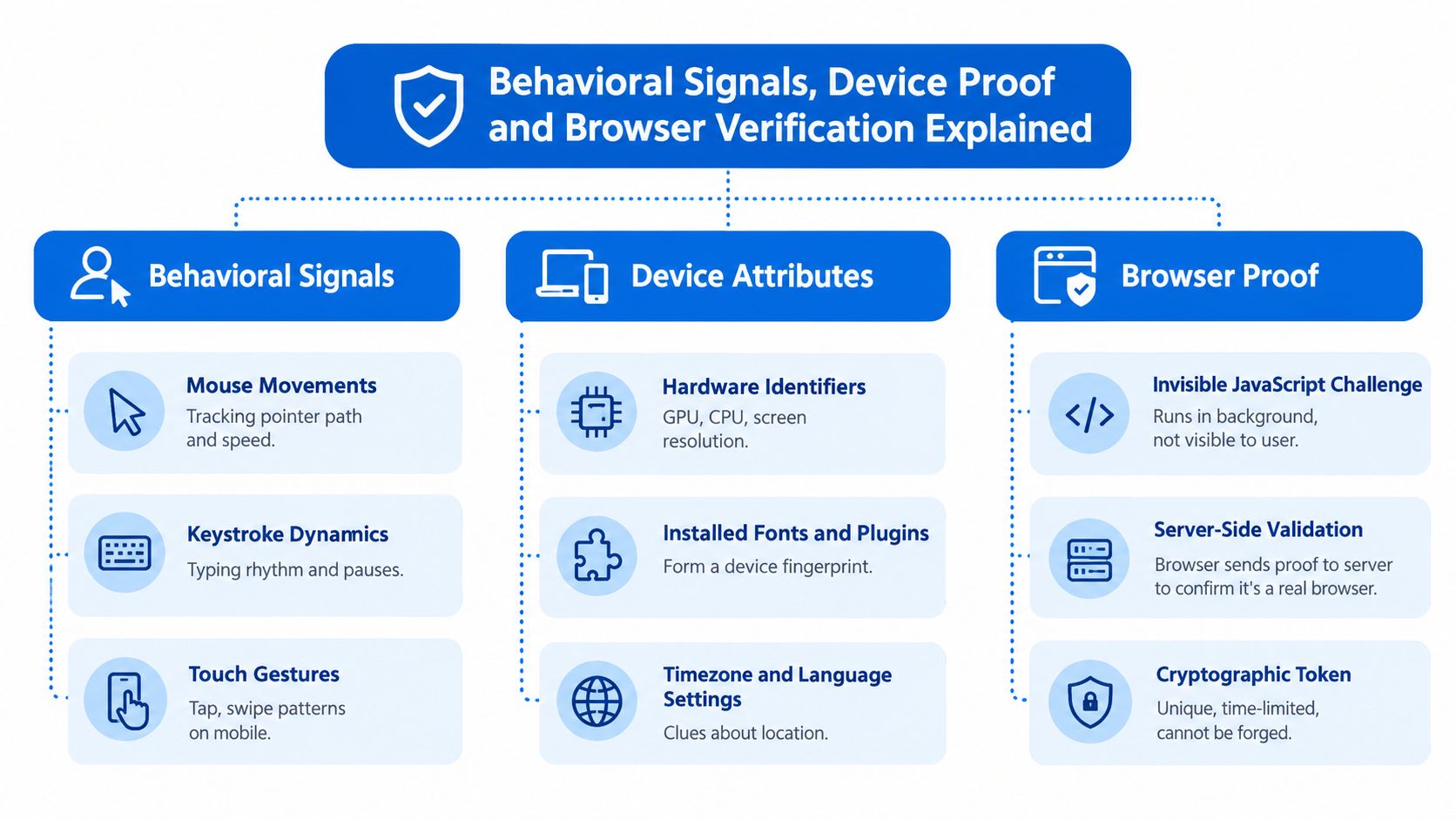
Behavioral signals show how the action happens
Behavioral signals describe interaction patterns. On web flows, that can include pointer movement, timing between clicks, typing rhythm, and navigation order. On mobile-heavy experiences, it can include touch behavior and how the user moves across screens.
These signals are useful because automation often behaves differently from a real person. Scripts move too cleanly, too fast, or too consistently. Human behavior has noise.
Behavioral data is strongest when it adds context to a specific action. A login after a normal session path feels different from a login fired directly at an endpoint with no meaningful page interaction.
Device attributes show continuity
Device and browser attributes help answer a different question. Have we seen this environment before, and does it look internally consistent? Teams often collect properties such as rendering behavior, environment settings, browser capabilities, and combinations of attributes that remain relatively stable across requests.
That's useful, but it has limits. Browser fingerprinting measures continuity rather than identity, as noted in this analysis of account takeover defenses that rely on fingerprinting alone. An attacker can still succeed through replay, cookie theft, proxy-assisted reuse, or profile mimicry if they already have a valid session path.
That distinction matters. Continuity helps ranking and correlation. It doesn't prove legitimacy by itself.
Browser proof needs server validation
Many teams stop too early. They collect browser data in the client and trust it as if collection alone proves the request came from a real browser in the right context.
It doesn't.
A better pattern is to pair client-side collection with server-side validation so the backend can verify freshness, consistency, and replay attempts before trusting the event, as described in guidance on defending against account takeover when attackers can clone browser signals. That shifts the control point from “did the browser send something plausible?” to “did the server verify fresh proof tied to this action?”
For implementation examples, teams evaluating browser proof with server-side verification usually look for three properties:
- Freshness: the proof should be recent enough that an intercepted payload can't be reused later.
- Consistency: the request should match the environment that produced the proof.
- Replay resistance: repeated reuse of the same proof should fail.
One empirical paper on browser fingerprint replay attacks describes how an attacker can collect a user's fingerprint, for example through phishing, and submit the same fingerprint later to impersonate that user. The same paper notes that dynamic client attributes such as HTML5 canvas can support challenge-response designs that make replay harder, as discussed in the empirical browser fingerprinting paper.
Practical rule: treat browser data as evidence to verify, not identity to trust.
Why teams want this to stay invisible
Visible anti-bot gates can stop some abuse, but they also interrupt normal users. A paper on CAPTCHA usability reports that these tests interrupt browsing and cites studies showing website bounce rates can rise by up to 30%, according to the CAPTCHA usability paper.
That's why many teams reserve visible challenges for narrow cases and prefer invisible verification on standard paths such as signup, login, and checkout. The goal isn't zero friction everywhere. The goal is to spend friction only where the risk justifies it.
Rules Engines Versus Machine Learning for Fraud Scoring
A familiar fraud meeting goes like this. One team wants a model because checkout abuse is slipping through. Another wants more rules because analysts need something they can edit before the next attack wave hits. Both are pointing at real problems, but they are talking about different jobs inside the same system.
In e-commerce, scoring is not just a payment question. The same stack often protects signup, login, and checkout, using browser proof, device signals, behavior, and server-side verification. That changes the design choice. You are not picking one winner. You are deciding which layer should catch known abuse, which layer should find hidden patterns, and which layer should enforce business policy.
Where rules engines fit
Rules engines work like a checklist used by an experienced reviewer. If a request breaks a known condition, you can act on it immediately.
That makes rules useful for high-value actions where the policy is explicit. A signup from infrastructure you already block. A login attempt that fails browser verification. A checkout that combines a risky device with a shipping pattern your team has already seen in refund abuse. In cases like these, rules give product, fraud, and engineering teams shared language for the decision.
They also help when speed matters. If analysts spot a new abuse pattern in the morning, they can often ship a rule the same day. No retraining cycle required.
Where machine learning helps
Machine learning helps when risk comes from combinations that are hard to describe one rule at a time. A device signal may look normal by itself. So might timing, account age, and purchase history. Together, they can form a pattern that repeats across fraudulent sessions.
Fraud datasets are usually imbalanced. The Amazon Fraud Dataset Benchmark describes e-commerce fraud data where fraudulent cases are a minority, including a transaction subset with 150,000 records and a 10.6% fraud class. In that setting, accuracy is a weak guide. A model can score well overall while still missing too many bad events or sending too many good customers to review.
For fraud teams, the better questions are simple. How many bad actions did we catch. How many good users did we interrupt. Are the scores calibrated well enough that a threshold of 0.8 means roughly the same thing this week as it did last week.
Rules Engines vs Machine Learning for E-commerce Fraud Scoring
| Criterion | Rules Engine | Machine Learning |
|---|---|---|
| Best use case | Known patterns and clear business policies | Subtle patterns across many signals |
| Explainability | High. Easy to inspect and justify | Lower. Often needs tooling and analyst interpretation |
| Speed to deploy | Fast for urgent controls | Slower because data prep and evaluation matter |
| Adaptation | Manual updates | Can adapt better when retrained well |
| Failure mode | Misses novel attacks | Looks good on paper if evaluated with the wrong metric |
| Operational need | Analyst tuning | Data pipeline, feature quality, threshold management |
The tradeoff is cost, not elegance
Fraud scoring decisions carry uneven costs.
A false positive can block a legitimate login, stop a good signup, or push a real buyer out of checkout. A false negative can let account takeover, promo abuse, or payment fraud pass into later systems where the loss is harder to recover. The scoring method matters less than whether the system reflects that asymmetry.
That is why strong teams combine the two approaches. Rules handle explicit controls and policy exceptions. Models rank risk across messy signal combinations. A policy layer sits above both and answers the business question: what should happen for this protected action, at this score, with this evidence.
A practical operating model usually looks like this:
- Start with rules for immediate controls, auditability, and action-specific policy.
- Add machine learning once you have enough labeled outcomes, stable features, and a team that can evaluate precision, recall, and threshold behavior.
- Keep policy separate from scoring so signup, login, and checkout can use the same evidence differently.
For teams that want analysts and engineers editing those decisions in one place, a policy studio for protected web actions helps turn scores into clear operational outcomes.
Orchestrating Detection Across Signup Login and Checkout
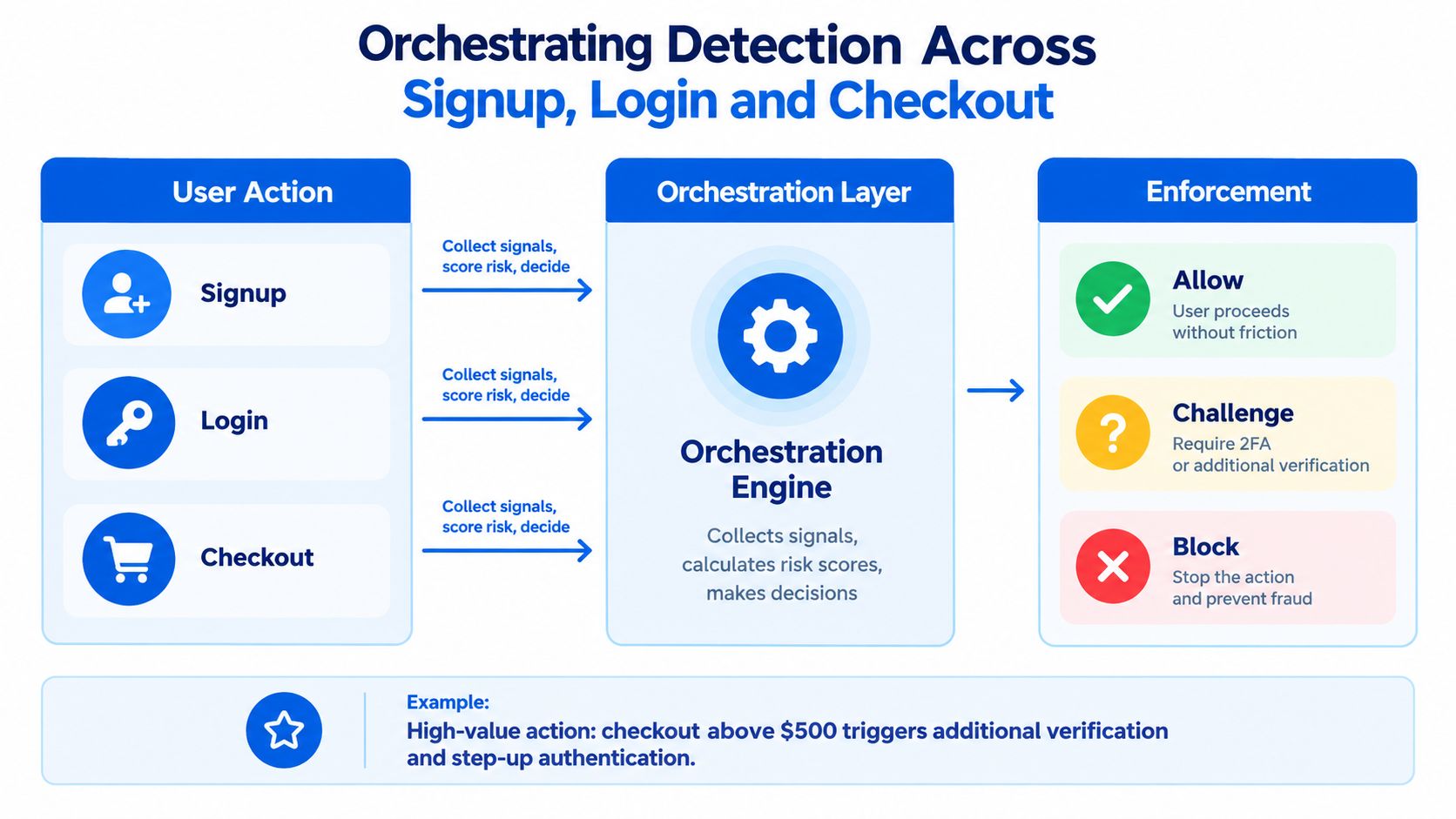
A fraud stack becomes useful when it acts like one system instead of three disconnected checks. Signup, login, and checkout share signals, but they don't need the same enforcement.
Different actions need different evidence
Signup is mostly about abuse prevention and account quality. Login is about account protection and session legitimacy. Checkout is about purchase risk, payment abuse, and fulfillment loss. The core orchestration job is to route each action through the right checks without forcing one universal policy.
A strong pattern is to collect browser proof in the client, validate it on the server, and bind the result to the protected action. Then the application can make an allow, challenge, review, or block decision close to the request path.
Why orchestration matters operationally
The threat mix now spans more than stolen cards. Independent reporting on payment fraud priorities says 98% of merchants experienced at least one fraud type and 30% to 50% were affected by the top five threats across regions, with 2025 risk leaders including refund and policy abuse, first-party misuse, phishing, real-time payment fraud, and card testing, according to The Paypers retrospective on 2025 payment fraud lessons.
That means the orchestration layer has to support action-specific workflows, not just payment authorization checks.
A simple action map
Consider three common paths:
- Signup path: collect environment proof, watch for automation patterns, and slow or block account creation when evidence looks reused or scripted.
- Login path: verify continuity, check for replay or stolen session artifacts, and step up only when the request breaks expected patterns.
- Checkout path: combine user history, browser proof, account state, and transaction context before approval or review.
The best fraud control often isn't “more blocking.” It's putting the right check at the exact moment a high-value action happens.
Roll out in stages
Many teams should stage deployment instead of flipping hard enforcement on day one.
- Observe first. Run collection and scoring without blocking so teams can inspect what would happen.
- Review edge cases. Look for employee traffic, QA flows, power users, and accessibility edge conditions.
- Enforce on a narrow path. Start with one action, such as signup or high-risk login.
- Expand gradually. Add checkout or account changes once thresholds hold up under real traffic.
This staged model works whether the controls live at the edge, in cloud middleware, or in the application itself. The architecture matters less than placing verification close enough to the request that the decision still protects the action.
Operational Workflows Tuning Thresholds and Reducing False Positives
The hardest part of e-commerce fraud detection usually isn't collecting signals. It's running the program week after week without blocking too many good users or letting obvious abuse pile up.
Tuning starts with ownership
A threshold without an owner drifts. Someone has to decide what “review,” “challenge,” and “block” mean for each action. That usually spans fraud operations, product, security, and engineering.
Use separate thresholds for separate actions. Signup tolerance isn't the same as checkout tolerance. Loyalty redemption isn't the same as password reset.
Watch the newer abuse mix
A lot of teams still over-index on card fraud and under-invest in account and policy abuse. That misses where attackers are moving.
Recent reporting highlighted a mix that includes remote access attacks, fake accounts, and loyalty abuse. It says remote access attacks rose 8% during Black Friday/Cyber Monday 2024 versus 2023, QSR fraud surged 45% from 2023 to 2024, and loyalty-program accounts face four to seven times higher attack rates than regular accounts, according to the Forter and PwC risk summary covered by Retail Tech Innovation Hub.
That should change queue design. Analysts need views for account abuse, loyalty actions, refund patterns, and repeated browser or session reuse, not just payment declines.
A practical rollout checklist
- Define protected actions: choose the flows that create the most business risk if abused.
- Set action-specific outcomes: don't use one universal threshold for every endpoint.
- Review friction points: visible challenges should be rare and deliberate.
- Build analyst feedback loops: every confirmed false positive should teach the system something.
- Track replay and reuse patterns: repeated proof reuse often matters more than one suspicious event.
Reduce false positives by narrowing enforcement
False positives often come from broad rules attached to weak evidence. “New device equals challenge” is a classic example. Better logic combines several clues before taking action.
Use narrower policies such as these:
- For signups: focus on repeated environment reuse, obvious automation sequences, or clustered account creation patterns.
- For logins: care more about stolen-session behavior, replay attempts, and abrupt context breaks than simple novelty.
- For checkout: add transaction context and account history before escalating.
Good fraud operations teams don't ask, “How do we block more?” They ask, “Which users are we disrupting, and is the evidence strong enough to justify it?”
Manual review should also stay focused. If analysts become a catch-all layer for uncertain automation, queue quality degrades fast. Review works best when the system sends fewer, better cases.
Putting Your E-commerce Fraud Detection Plan Into Action
A useful fraud plan starts with one blunt question. Which website actions would hurt your business most if attackers automated or replayed them today?
For some teams that's signup because promo abuse and fake accounts poison the funnel. For others it's login because stored value, saved cards, or sensitive data sit behind the session. For many merchants it's checkout, but only when connected to the account and browser context that came before it.
A sensible sequence
Start with a short list of high-value actions. Then match each one to the evidence it needs.
- Choose the action first. Don't begin with a tool category.
- Collect signals that fit the action. Behavioral clues, device continuity, and browser proof each answer different questions.
- Verify on the server. Especially for login and checkout, trust server validation over client appearance.
- Use rules early. They're easier to govern when you're still learning.
- Add models carefully. Only after you can evaluate precision, recall, and business cost together.
The winning design is usually the least dramatic one. Quiet, layered checks. Narrow enforcement. Good feedback loops. Friction reserved for cases where the evidence supports it.
That's what “works” in e-commerce fraud detection. Not one magic score. Not one challenge page. A system that protects important actions with enough proof to act, and enough restraint to preserve conversion.
MANDATE offers invisible browser verification for teams that need to protect signups, logins, checkout, and other high-value web actions without CAPTCHAs. It collects browser proof in the client, validates it on the server, and supports staged rollout with Observe mode before enforcement. If that matches the problems you're solving, visit MANDATE.