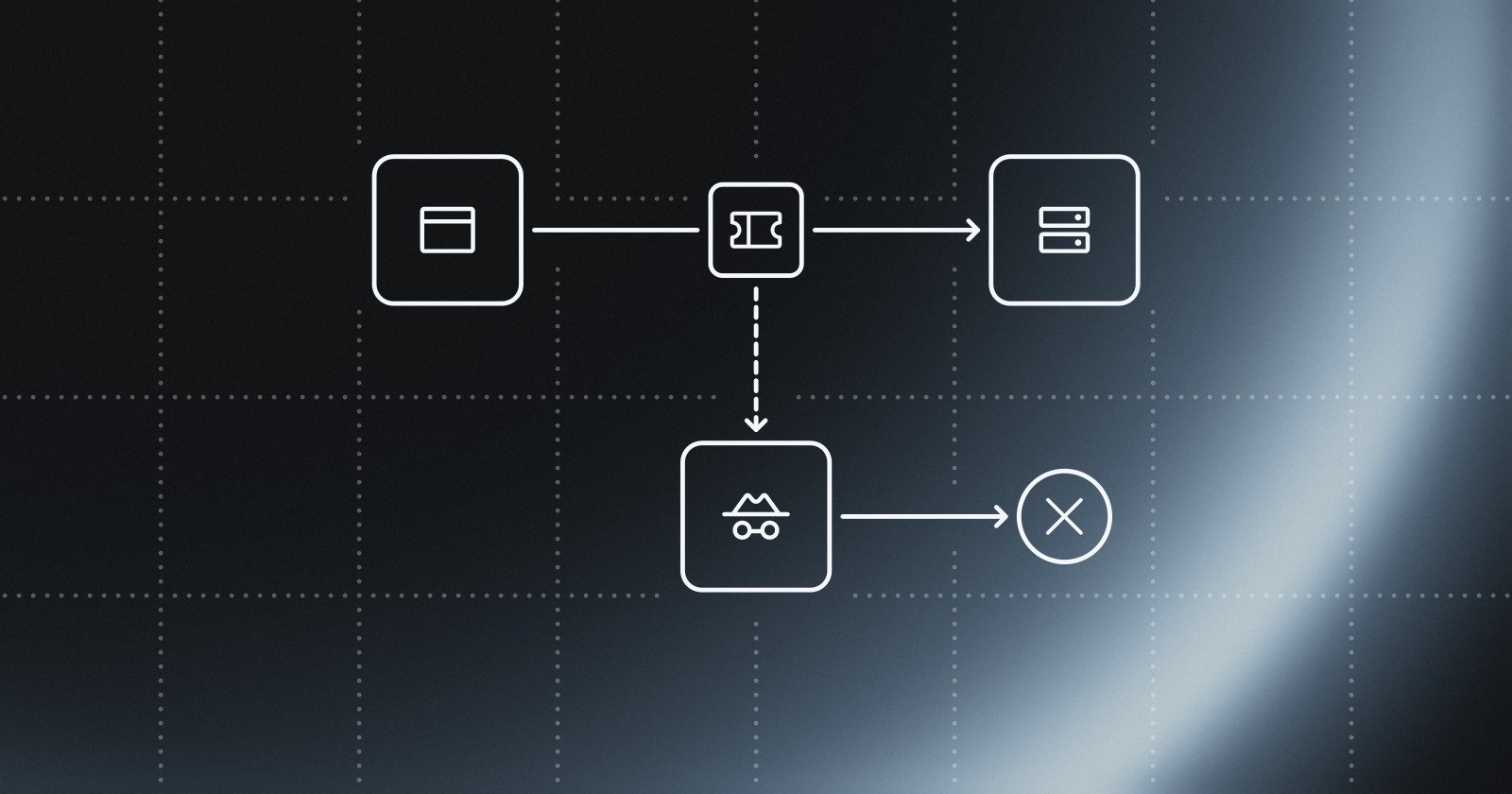
A replay attack reuses a previously valid captured request to trigger the same action again, and it succeeds when the server checks authenticity but not freshness. The message can be old, but if the server still trusts it, the action can run twice.
That's the problem a developer might miss when a login, checkout, or webhook looks “correct” in logs. The request was real, the signature may still validate, and the server still accepts it because nothing in the flow proves the message is new.
Table of Contents
- Introduction What a Replay Attack Really Does
- How Replay Attacks Work in Plain English
- Why Encryption and Strong Login Do Not Stop Replays Alone
- Where Replay Attacks Show Up in Web and App Flows
- Core Defenses That Make Requests Single Use
- Practical Mitigation for High Value Website Actions
- Key Takeaways and Next Steps for Replay Protection
Introduction What a Replay Attack Really Does
A replay attack is what happens when someone grabs a legitimate request and sends it again as if nothing happened. That request might be a login assertion, a payment approval, or an API callback, and if the backend doesn't check for freshness, it can accept the same action twice. In plain English, the attacker isn't guessing a password, they're reusing something that already worked once.
That distinction matters for teams protecting signups, logins, checkouts, and webhooks. A password or MFA challenge can be strong and still not stop reuse of a captured request, because replay is about message reuse, not secret guessing. The server sees a valid artifact and, without the right anti-replay checks, treats it like a brand-new request.
This is why freshness keeps showing up in security guidance. NIST's authentication guidance treats replay resistance as a core property, and it ties that property to nonces or challenges, which give the server proof that a request belongs to the current session, not an old one. When the request lacks that current freshness data, the server should reject it [NIST Electronic Authentication Guidelines].
For product teams, the practical takeaway is simple. If an important action can be repeated by resending the same payload, you don't just have an authentication problem, you have a freshness and context-binding problem. That's the lens this guide uses for modern web apps, APIs, and request-based automation.
Practical rule: if the action matters, the request should be single-use.
When teams want to protect those actions without adding CAPTCHAs, they usually look for server-verified browser proof and other frictionless controls. MANDATE fits that model by focusing on important website actions and automated abuse without interactive challenges, which is useful when you need protection but can't afford to interrupt legitimate users.
How Replay Attacks Work in Plain English
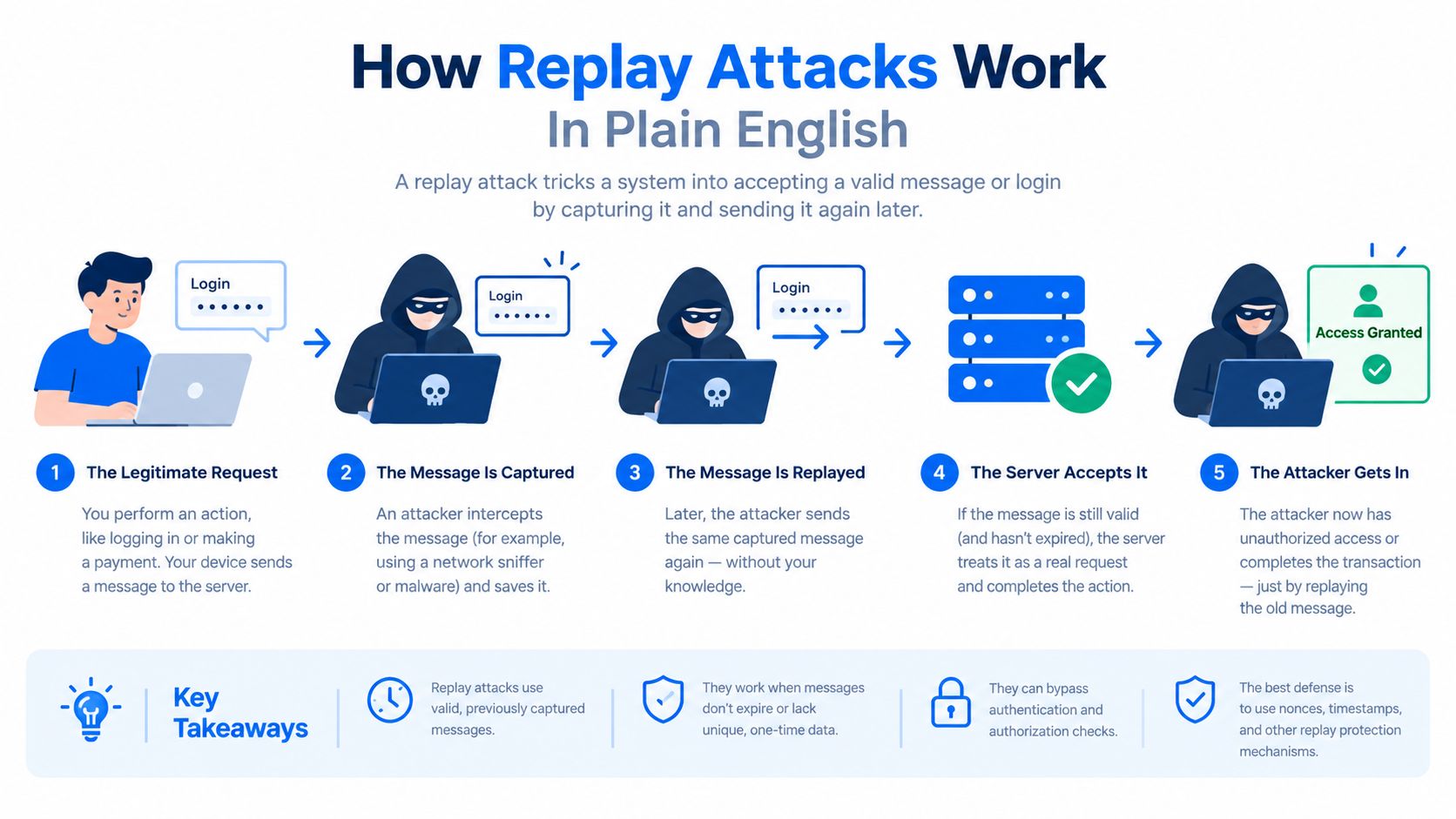
A replay attack is easier to understand if you think about a photocopied entry ticket. The original ticket gets you in once because it's valid, but if the venue doesn't check whether it has already been used, the copy can get in too. The difference isn't the authenticity of the ticket, it's whether the scanner can tell it's old.
The basic flow
First, the attacker captures a legitimate message. That message might travel over a network, sit in a browser session, or move between services in a webhook flow. Then the attacker resends it later, hoping the server still accepts it as if it were new.
The key roles are straightforward. The claimant is the legitimate user or system sending the original request, the verifier is the server that checks it, and the attacker is the person replaying the captured message. NIST's older and newer guidance describes replay as reusing previously captured messages to masquerade as the claimant, and it keeps freshness at the center of the defense [NIST Electronic Authentication Guidelines] [NIST SP 800-63B].
Why freshness changes the outcome
A server that checks only integrity asks, “Was this message altered?” A server that checks freshness asks, “Is this message still the one I'm expecting right now?” That's where nonces and challenges come in, because they give the verifier a one-time or session-specific marker that the attacker can't reuse forever.
A replay-resistant protocol doesn't just trust the message, it trusts the message only if it proves it belongs to the current moment.
OWASP's guidance on replay attacks follows the same idea. It recommends nonces and timestamp validation so a captured request can't be accepted later, and it points out that the message has to be valid for a limited time, not just valid in the abstract [OWASP SCWE-022].
The important mental model is this. Authenticity tells you who made the message. Freshness tells you whether the message should still count. If your system only checks the first part, a copied request can still work.
Why Encryption and Strong Login Do Not Stop Replays Alone
A lot of teams assume HTTPS, passwords, or MFA closes the door on replay attacks. It doesn't. Those controls protect the login ceremony and the transport channel, but replay attacks use a message that was already accepted once, then send it again later when the server no longer has any reason to trust that it's current.
Protected channel security is not the same thing as replay resistance
NIST makes this distinction explicitly. Even if traffic is going through HTTPS, an authenticator output can still be stolen before it enters the protected channel, which is why replay defense has to exist at the authentication protocol layer too [NIST SP 800-63B]. In other words, encryption helps in transit, but it doesn't automatically make a token or signed request single-use.
That's the confusion many developers run into. If the browser used TLS and the user passed MFA, it feels like the request should be safe. But a replay attacker doesn't need to break encryption or guess a password, they just need to reuse the credential or signed message before it expires or is invalidated.
Why strong authentication can still be bypassed
A token, assertion, or signed request can be perfectly valid and still be dangerous if it's reusable. That's why NIST calls out replay-resistant authenticators, including OTP authenticators and cryptographic authenticators, and why its guidance says protocols using nonces or challenges resist replay because old protocol messages won't contain the current freshness data [NIST SP 800-63B]. The server isn't asking whether the message was ever true, it's asking whether it's true for this exact moment.
The distinction matters for browser-based logins, step-up authentication, and APIs because those flows often mix identity, sessions, and transaction state. A session might be secured, but a specific action inside that session can still be replayable if the backend doesn't bind it to a live transaction or a one-time proof.
Practical rule: HTTPS protects the pipe, not the lifetime of a request.
MANDATE's model is relevant here because it focuses on server-verified browser proof for important website actions, which helps tie acceptance to fresh evidence rather than just trusting that the request arrived over an encrypted channel. That's the kind of protocol-level thinking replay defense needs, especially when you want to avoid CAPTCHAs and still keep abuse out.
Where Replay Attacks Show Up in Web and App Flows
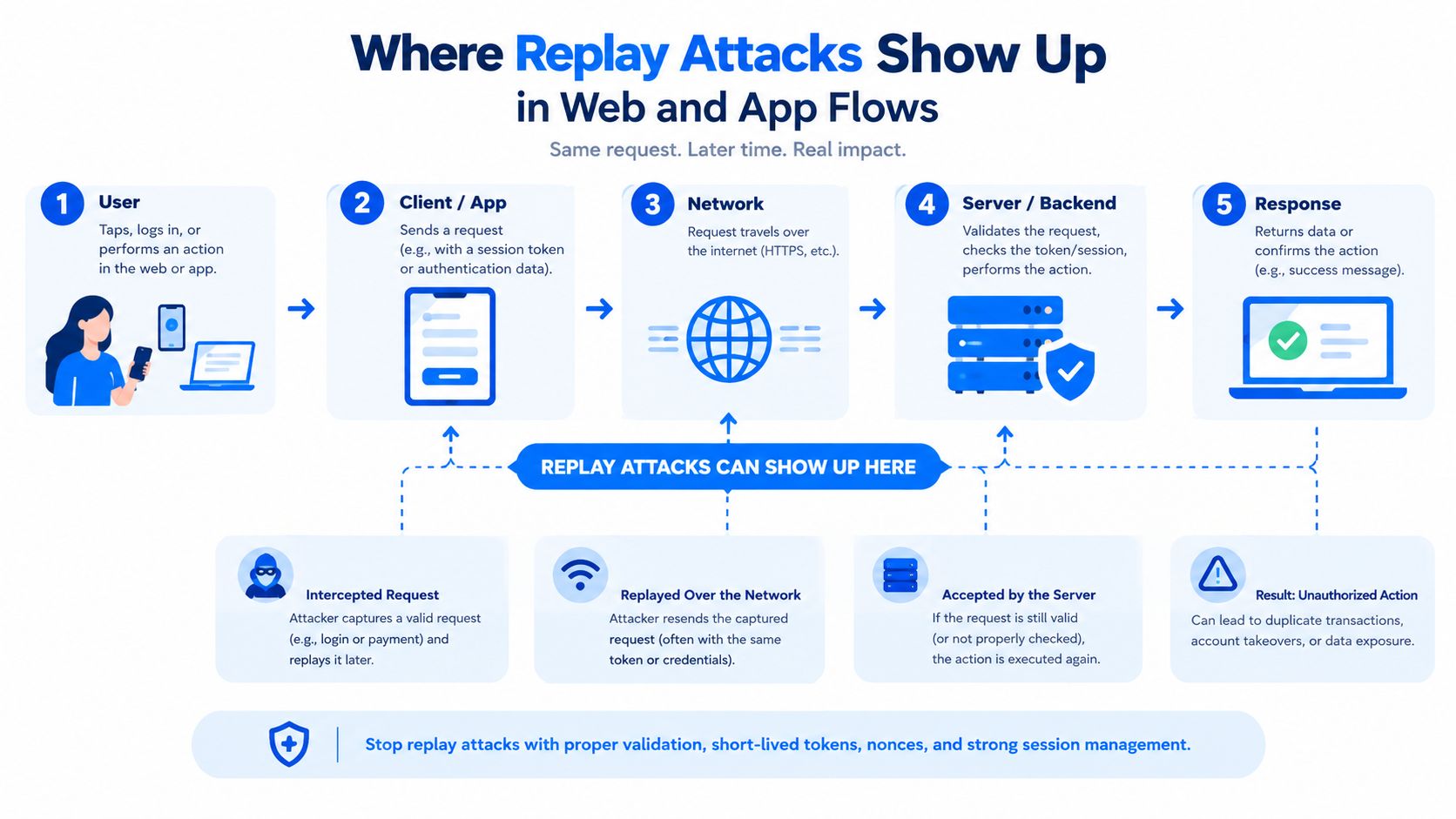
Replay problems show up anywhere a request has real-world consequences. That includes sign-in flows, payment approvals, webhook deliveries, and API automations that act on behalf of a user or service account. If the backend accepts the same signed or valid message twice, the business doesn't just see duplicate traffic, it sees duplicate action.
Logins and session artifacts
A replayed login assertion can look legitimate because it really was legitimate once. If the server doesn't reject reused identifiers or stale session artifacts, an attacker can reuse that proof to impersonate the user. OWASP's session handling guidance points to rejecting replayed session identifiers by tracking nonces, timestamps, or recently used identifiers [OWASP Cornucopia].
That's also why “it's behind login” isn't enough. The login may be strong, but the artifact created by that login still needs anti-replay rules. If the session token or assertion can be replayed, the attacker doesn't need to solve authentication again.
Checkouts, approvals, and webhooks
Checkout and payment flows are especially sensitive because a duplicated approval can translate into a duplicated charge or an unauthorized state change. Webhooks have the same risk profile, but with a twist, because the sender often assumes delivery should be retried, while the receiver still has to decide whether a delivery is a retry or a replay. The gap between those two decisions is where abuse slips in.
A helpful way to think about it is distributed systems, not just browsers. A signed payload can move across APIs, queues, and edge layers, and each hop can change the replay surface. That's why the operational question is not “Was the payload signed?” but “Can this exact message be used again somewhere else?” [Svix replay attack glossary]
For teams building request-based automation, that's the hard part. Encryption and signatures are necessary, but they don't solve deduplication by themselves. The backend has to remember what it already accepted, and it has to know when a message is too old to trust.
For a deeper look at the business side of retries and replay behavior, see why retries and replay affect business outcomes.
Core Defenses That Make Requests Single Use
The standard defenses work best together because each one blocks a different replay path. Nonces stop a captured request from being accepted twice. Timestamps narrow the time window. Cryptographic binding makes sure no one can change the freshness fields without breaking the signature or MAC.
Comparing the three layers
| Defense | What It Prevents | Tradeoff to Manage |
|---|---|---|
| Nonce-based uniqueness | Reusing the same request or token more than once | The server has to store and check recently seen values |
| Timestamp-based freshness windows | Old captures being accepted long after they were sent | Clock drift and narrow acceptance windows need careful tuning |
| Cryptographic binding | Tampering with nonce, timestamp, or transaction context | The message format has to include freshness fields from the start |
How they fit together
A nonce is a single-use identifier. The server stores it and rejects duplicates, which makes immediate replay fail. A timestamp is a freshness marker, which helps the server refuse a request once it falls outside the allowed window. Cryptographic binding, such as an HMAC or signature over both the payload and the freshness fields, prevents an attacker from editing the nonce or timestamp and trying again.
That combination matters because the layers solve different problems. Nonces catch reuse, timestamps shorten the lifetime of captured traffic, and binding prevents tampering with the anti-replay metadata. If you skip the binding step, an attacker may still alter the message in ways that make freshness checks meaningless.
OWASP's signed-request guidance follows the same pattern. It says the signature should be tied to a specific transaction or context, not just the user or session, and that adding a nonce, timestamp, or unique transaction hash helps stop a valid signature from being reused in a different request [OWASP SCWE-055].
Practical rule: acceptance should depend on both correctness and freshness, not one or the other.
If you're reviewing an internal API or a browser-facing workflow, start by asking one question. Can this request be accepted twice if someone replays it verbatim? If the answer is yes, the current design still treats a one-time action like a reusable one.
For browser-heavy flows, why browser proof needs server state is the right design question to ask when you're deciding how much trust the client should get.
Practical Mitigation for High Value Website Actions
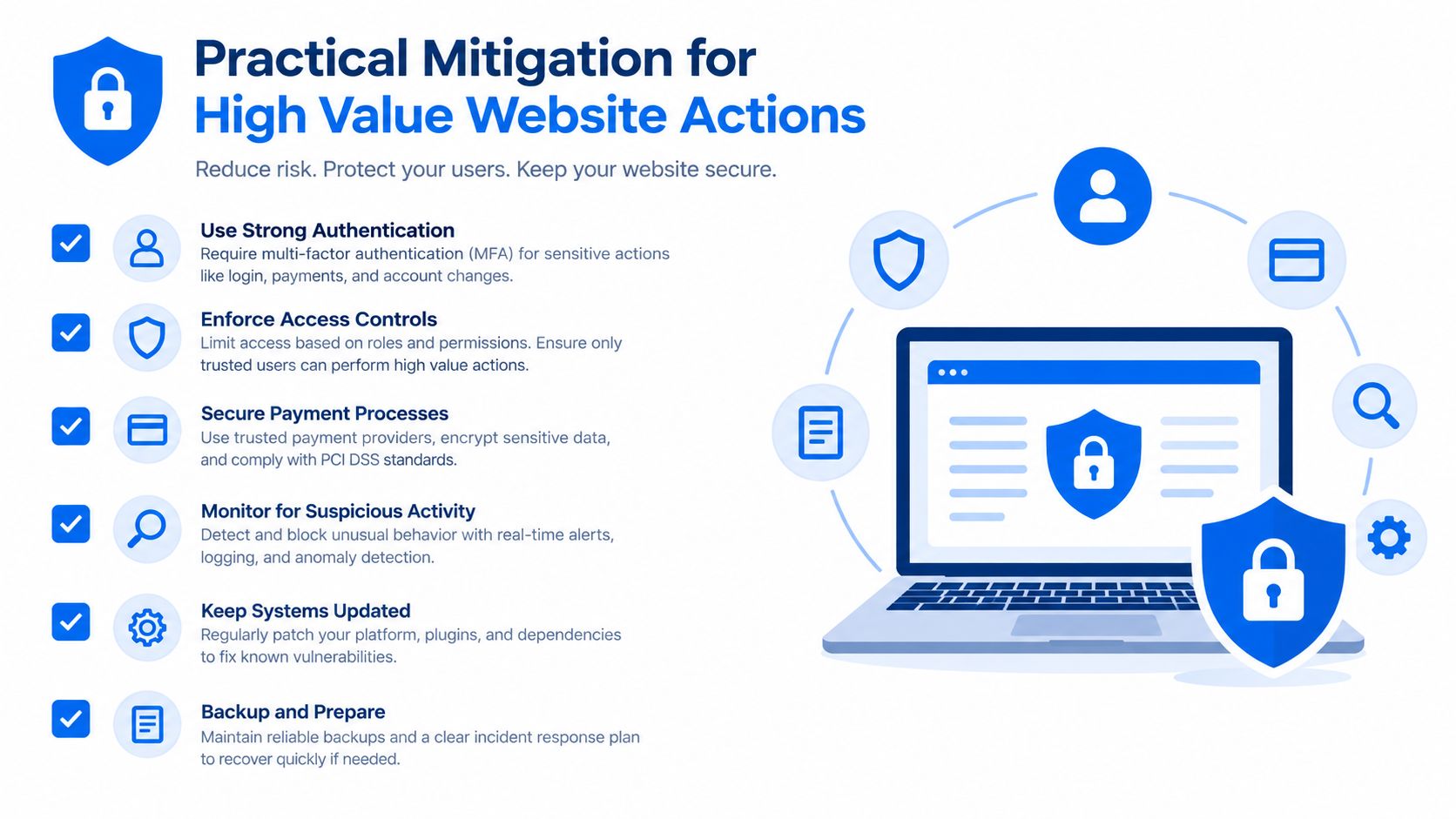
The cleanest mitigation is to make the request hard to reuse and easy to reject. That starts with server-side state and ends with explicit context binding, because replay defense is only real when the server can verify that a message is both authentic and new.
A practical implementation checklist
- Generate a nonce for each sensitive request. The server should mint a unique value, then store recently used values so duplicates fail immediately.
- Validate a short timestamp window. Stale messages should stop working quickly, which limits the value of an intercepted payload.
- Bind the signature to the transaction. A signed request should cover the payload plus the nonce, timestamp, and any transaction-specific fields.
- Track reused identifiers server-side. If the same session token, request ID, or one-time proof appears again, reject it.
- Reject replayed session artifacts. Session identifiers, login assertions, and token-like artifacts need explicit duplicate detection, not just expiration.
- Review the decision path before enforcement. A staged rollout makes it easier to tune what gets allowed, flagged, or blocked before you turn on hard enforcement.
The reason this works is simple. A replay attack depends on a backend that accepts old proof as if it were current. If the server checks freshness, context, and prior use, the replay stops being a successful attack path and becomes a rejected duplicate.
That's where server-verified browser proof fits naturally. A system like MANDATE is designed to collect browser proof invisibly, verify it on the server, and support allow, flag, or block decisions without CAPTCHAs. Its Observe mode is useful when you want to tune those decisions before enforcement, and its integration options across edge, cloud, and application layers matter when you're protecting signups, logins, and checkout flows.
For teams focused on abuse in transactional journeys, e-commerce fraud detection guidance is a useful companion when you're deciding where to place controls without adding user friction.
Key Takeaways and Next Steps for Replay Protection
A replay attack is not about breaking cryptography or guessing credentials. It's about resending a valid message after the system has forgotten to ask whether that message is still fresh and still tied to the current transaction. That's why freshness and context binding are the key design goals, not just authenticity.
The right control depends on the flow. Use nonces when you need single-use requests, use timestamps when you need to limit the lifetime of a request, and use cryptographic binding when you need to stop anyone from tampering with the anti-replay fields. For high-value website actions, combine those checks with server-side duplicate tracking and session-artifact rejection.
A simple audit question works well here. Can any login, signup, checkout, webhook, or approval request be accepted again if it's replayed verbatim? If yes, the flow still needs a freshness control, and the safest place to add it is at the server, where reuse can be detected before the action succeeds.
For engineering leaders, the next step is to prioritize the highest-impact actions first, then roll out detection and enforcement with monitoring. For developers, the next step is to make every sensitive request prove that it belongs to this moment, not just to some moment in the past.
If you're protecting signups, logins, checkouts, or webhook-driven actions, MANDATE can help you add invisible browser verification without CAPTCHAs and without forcing legitimate users through extra friction. Visit MANDATE to review how server-verified browser proof, Observe mode, and flexible deployment options can fit into your replay defense plan.