
Your checkout conversion is steady, but the abuse queue keeps growing. Signup endpoints receive scripted traffic, login attempts arrive in coordinated bursts, and payment requests look almost normal until an analyst connects activity across accounts, devices, and sessions. Meanwhile, every visible challenge adds friction for legitimate customers.
Effective fraud prevention and detection starts by separating two jobs. Prevention should stop unauthorized or automated requests before they reach sensitive application logic. Detection should identify suspicious activity that has already passed basic controls, then route the right cases to automated action or human review. The strongest systems combine both without forcing every user through a puzzle.
Table of Contents
- The Reality of Modern Web Fraud
- Separating Prevention Controls from Detection Signals
- Moving Beyond CAPTCHAs to Invisible Verification
- The Operational Bottleneck in Fraud Investigations
- Rolling Out Security Controls with Observe Mode
- Applying Defenses to High-Value Web Actions
- Building a Frictionless Security Architecture
The Reality of Modern Web Fraud
Modern web fraud isn't limited to one attacker submitting one bad transaction. Criminal operations can coordinate synthetic identities, stolen credentials, automated browsers, replayed requests, and multiple accounts across the same workflow. A synthetic identity combines real and fabricated information to create a persona that can pass parts of an onboarding process, while agentic traffic uses software that can perform increasingly human-like browsing and transaction steps.
The financial exposure is already material. TransUnion's H2 2025 global fraud reporting estimated that businesses worldwide lost an average of 7.7% of annual revenue to fraud, equivalent to about $534 billion across the 1,200 business leaders surveyed. The same reporting cycle found that 48% of consumers across 18 countries said they were targeted by digital fraud from February to May 2025, while 52% were unaware they had been targeted.
That invisibility changes the engineering problem. A system that blocks obvious bots but misses a compromised customer account, a replayed checkout request, or a coordinated group of low-volume accounts can still leave the business exposed. Consumers often discover the incident only after funds, access, or trust have been lost.
Fraud is now a business-systems problem
TransUnion's later reporting found that in H1 2026, 26% of consumers across 18 countries and regions said they'd lost money to digital fraud during the prior year. The global median loss was $1,671, rising to $2,307 in the United States. These figures are reported in the same TransUnion fraud research cycle.
For engineering leaders, the consequence is practical. Fraud controls affect revenue protection, account recovery, support workload, payment operations, compliance, and customer experience. A security decision that blocks a legitimate order is a business event. A decision that lets an automated account farm discounts or abuse refunds is also a business event.
Sumsub's global identity-fraud analysis found the average fraud rate across verifications increased from 1.1% in 2021 to 1.7% in 2022, 2.0% in 2023, and 2.6% in 2024. Its 2024 breakdown attributed 50% of fraud attempts to forged documents, 15% to chargebacks, 12% to account takeovers, 7% to deepfakes, and 4% to fraudulent networks.
Coordinated abuse needs coordinated evidence
The later Sumsub reporting cited a 2.2% global identity-fraud rate in verification attempts and a 180% year-on-year rise in multi-step fraud attacks. That shift matters because isolated transaction scoring has limited context. A single request may look acceptable, while the sequence of signup, login, address change, payment, and withdrawal reveals the attack.
Recent LexisNexis Risk Solutions reporting also cited a 450% rise in agentic traffic between January and December 2025, a 59% rise in malicious bot attacks, and synthetic identity involvement in 11% of frauds. These signals point to a control strategy based on fresh browser evidence, server-side decisioning, behavioral history, and investigation workflows, not a single model score.
Practical rule: Treat fraud controls as shared business infrastructure. Security owns the control design, but product, payments, support, data, and operations must agree on what the system should allow, review, or stop.
Separating Prevention Controls from Detection Signals
A request can be suspicious for two very different reasons. It may fail to prove that it came from an authorized browser, or it may come from a valid account whose behavior has become abnormal. Those cases need different controls.
Prevention establishes a boundary before sensitive application logic runs. It asks whether the request has fresh, valid evidence from the expected environment and whether it satisfies basic integrity requirements. If a script submits a captured checkout payload without the browser proof your server expects, prevention can reject it before order creation.
Detection evaluates context and behavior. It asks whether a known account is logging in at an unusual velocity, whether many accounts share suspicious infrastructure, or whether a customer's activity has changed sharply. Detection may flag the session, require stronger authentication, hold an order, or send the case to an investigator.
A side-by-side engineering view
| Job | Primary question | Useful signals | Typical response |
|---|---|---|---|
| Prevention | Can this request prove its origin and integrity? | Fresh browser proof, request state, server validation, replay resistance | Allow, challenge, or block before application processing |
| Detection | Does this activity fit expected behavior? | Login velocity, account history, device relationships, transaction patterns | Flag, step up, hold, investigate, or recover |
| Recovery | What should happen after compromise or confirmed abuse? | Confirmed incidents, customer reports, analyst findings, payment outcomes | Reset access, reverse action, restrict account, preserve evidence |
A captured session token illustrates the distinction. Prevention can limit the token's usefulness when acceptance depends on fresh server-verified evidence tied to the originating browser environment. Detection still matters because a valid session may be used by a compromised customer, an insider, or an attacker who gained access through another route.
Use the client to collect browser evidence, but don't let the client make the final security decision. The server, edge middleware, or application gateway should validate the evidence and apply the policy. The client or server integration guidance covers this boundary in practical terms.
Don't make one signal carry every decision
Browser proof isn't a replacement for account history, payment controls, or investigation. It addresses request integrity and automated abuse. A behavioral system addresses patterns over time. A recovery process addresses what happens after an account or transaction is confirmed as compromised.
Good architecture keeps those responsibilities explicit. That makes policies easier to tune and incidents easier to explain. It also prevents a common failure mode, where a model becomes the only gate and nobody can tell whether it blocked a bot, detected an account takeover, or reacted to a payment signal.
Moving Beyond CAPTCHAs to Invisible Verification
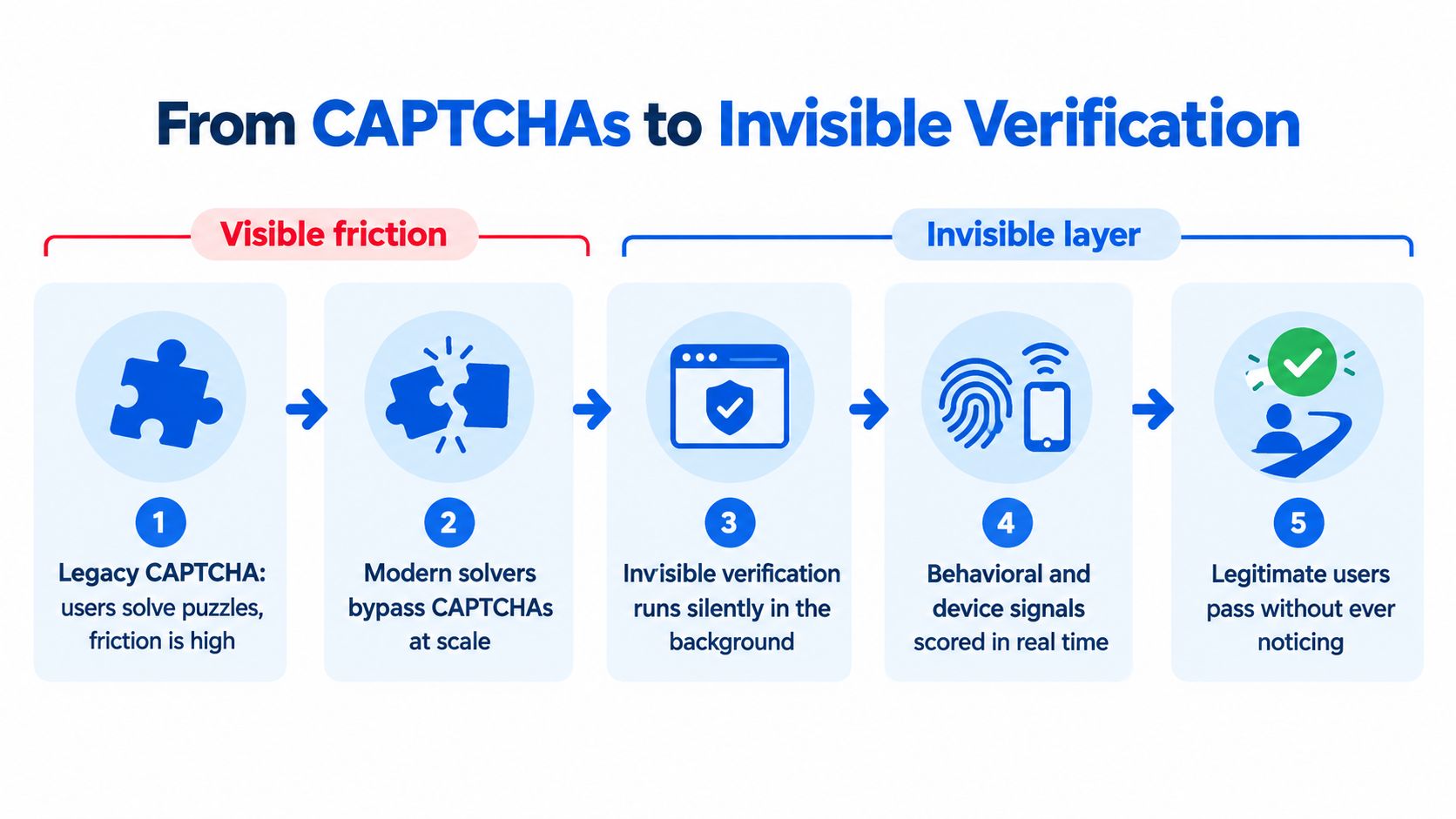
CAPTCHAs make the user prove they're human by solving a visible task. Invisible verification moves that work into the background by collecting browser telemetry and behavioral signals, then evaluating the request without asking a legitimate user to solve a puzzle. The purpose isn't to declare any product unbypassable. The purpose is to remove routine friction while making automated abuse harder to process.
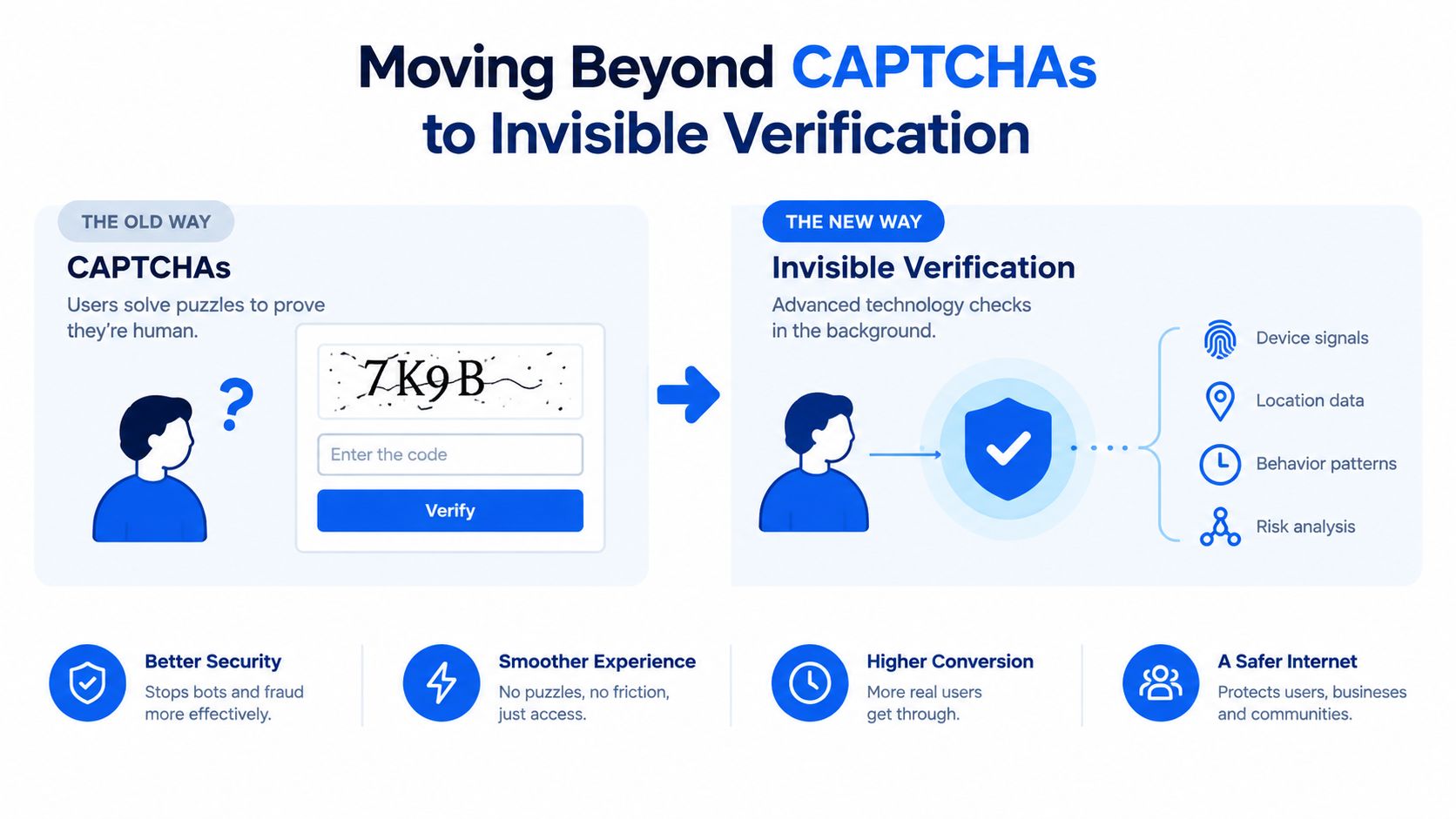
A production implementation should keep the trust decision on the server. The browser collects proof, the server validates it, and the policy engine decides what happens next. This avoids treating a client-side success message as authorization.
A practical request flow
Start at the action boundary. Protect a meaningful operation, such as account creation, login submission, order placement, or a reservation request. Don't begin by applying the same control to every page view.
Collect fresh browser proof. The client gathers the signals required by the verification system. The evidence should be generated for the current action rather than copied from an earlier request.
Validate server-side. The server checks the proof, its freshness, and its relationship to the request and expected environment. Invalid, missing, or replayed evidence shouldn't reach the sensitive handler.
Apply a graduated response. Low-risk traffic can proceed. Suspicious traffic can be flagged or sent through step-up authentication. Clearly abusive traffic can be blocked or rate-limited.
Record the decision context. Store enough information for operations and security teams to understand what happened, while respecting data-minimization and retention requirements.
Interactive challenges still have a place in some recovery or exceptional flows. They shouldn't be the default path for every customer, especially when the business action is frequent and the legitimate audience is broad. The anti-bot verification guidance provides a useful framework for thinking about invisible controls alongside other defenses.
The trade-off is that invisible verification needs careful deployment. Browser signals can be incomplete, privacy settings can change what a system observes, and attackers can adapt. A server-verified layer should therefore complement, not replace, authentication, rate controls, payment monitoring, account recovery, and analyst review.
The right question isn't whether a challenge exists. It's whether the system can make a proportionate decision without asking every legitimate user to absorb the cost of suspicious traffic.
The Operational Bottleneck in Fraud Investigations
A refined model doesn't create investigation capacity. If the system sends every uncertain event to a small fraud team, the queue becomes the control's failure point. Analysts start working the easiest cases, response times stretch, and coordinated abuse remains buried among low-value alerts.
The data problem is difficult before staffing enters the discussion. The European credit card fraud benchmark contains 284,807 transactions, with only 0.172% labeled as fraud, while the IEEE-CIS e-commerce benchmark contains more than 1 million records with about 3.5% fraud. These figures and the implications for evaluation are discussed in the MDPI review of fraud detection methods.
Accuracy hides the cost of missing rare events
A model can achieve high accuracy by predicting “legitimate” most of the time. That result may still be operationally useless if it misses the small number of expensive attacks that matter most.
Use evaluation measures that reflect the decision:
- Precision measures how many flagged events are actually suspicious, which helps estimate analyst workload.
- Recall measures how much relevant fraud the system catches, which matters when missed abuse is expensive.
- PR-AUC focuses on the precision and recall trade-off in imbalanced data.
- Cost-sensitive thresholds let teams assign different consequences to a missed fraud event and a false positive.
- Calibration checks whether a risk score behaves like a trustworthy probability rather than an arbitrary ranking.
Amazon's Fraud Dataset Benchmark reflects this broader view by covering card-not-present fraud, bot attacks, malicious traffic, loan risk, and content moderation. Its IEEE-CIS split includes 561,013 training rows, 28,527 test rows, 67 features, and a 3.50% fraud class ratio. Production teams should expect to combine tabular transaction data with behavioral and relationship signals rather than rely on one event in isolation.
Design the queue before tuning the model
ACFE-based benchmarking cited in the 2025 fraud investigation benchmark report indicates that organizations typically employ 3 fraud investigators per 1,000 employees. Only 26% of in-house investigation teams report to the CEO or senior management, while staffing and technology are the top stated needs.
That makes routing a first-class design problem. Send clear low-risk cases through automatically, stop requests that fail basic integrity checks, and reserve human review for ambiguous or coordinated activity. Give analysts related events, decision reasons, account relationships, and the recommended next action instead of a raw score.
Investigation design matters as much as model design. A useful alert is one an analyst can understand, prioritize, and resolve without reconstructing the entire customer journey by hand.
Rolling Out Security Controls with Observe Mode
A proposed rejection isn't an enforced rejection. Teams that deploy a new fraud rule directly into a checkout or signup path can damage legitimate conversion before they understand the rule's false-positive pattern.
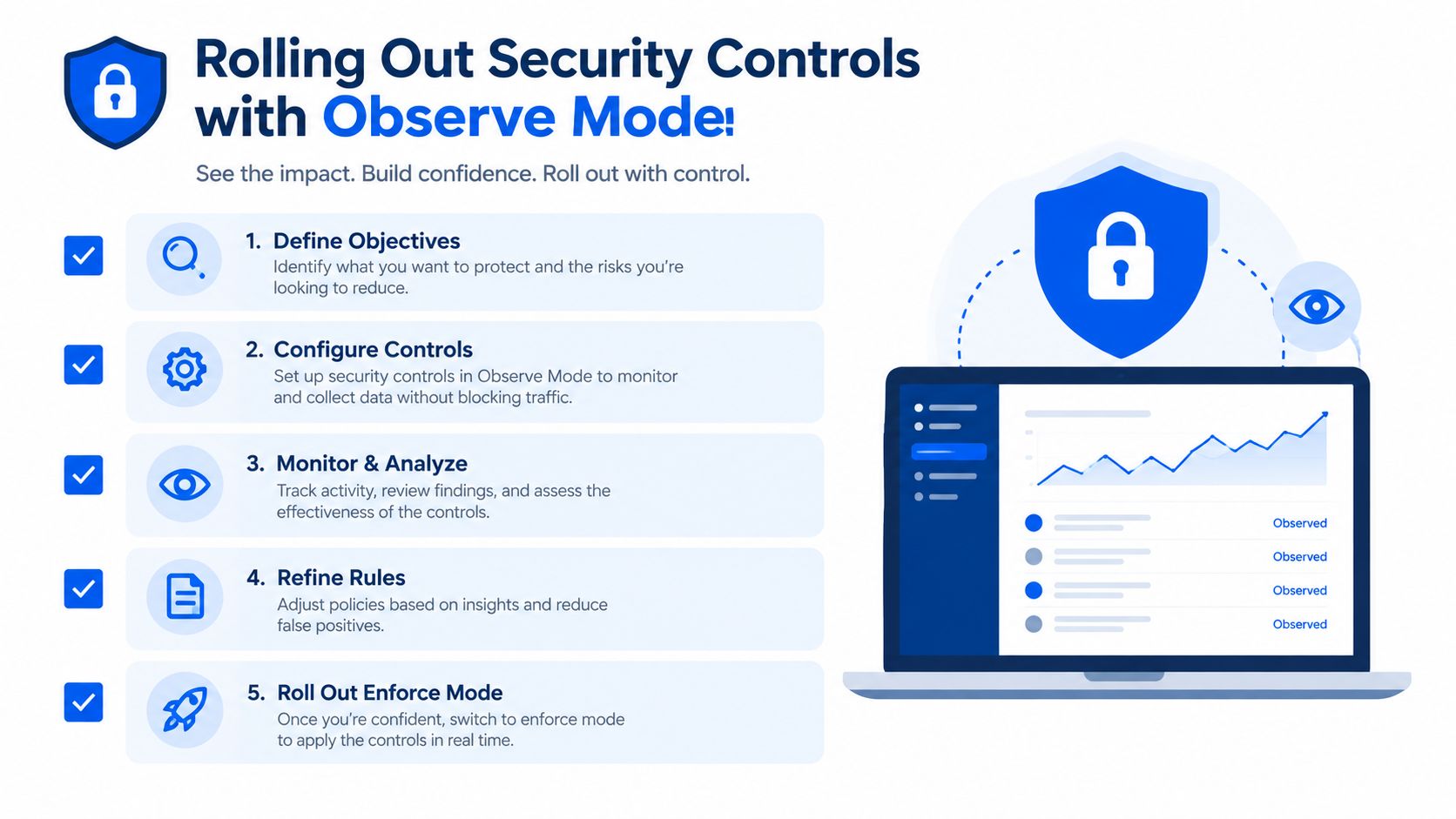
Observe mode reduces that risk by recording what a control would have done without applying the intervention. The organization can compare proposed decisions with business outcomes, tune criteria, and prepare a rollback before strict enforcement begins. Observe-before-enforce guidance captures this staged approach.
Start with one action
Choose a single high-value action with a clear success condition. “Submit an order” is more useful than “protect the website” because the team can measure completed orders, payment outcomes, support contacts, and downstream reversals.
Then follow a disciplined rollout:
Define the event. Record the action, account or session context, verification outcome, proposed decision, and relevant downstream result.
Run without detection. Let the control observe real traffic without rejecting requests. Separate the proposed outcome from the action the application took.
Review business completion. Count completed signups, successful logins, paid orders, and fulfilled reservations, not only raw requests. A lower request count can hide a serious customer-impact problem.
Inspect edge cases. Review mobile users, returning customers, privacy-restricted browsers, accessibility paths, support-assisted flows, and legitimate automation such as internal testing.
Enforce narrowly. Start with the clearest abuse pattern. Route uncertain events to a flag, hold, or step-up path instead of applying a hard block.
Keep rollback simple. Store policy versions, preserve decision logs, and make the previous behavior easy to restore.
Measure the intervention, not just the detector
A detector may improve its alert quality while the business experiences more abandoned checkouts. Track security outcomes beside product outcomes. Useful review fields include the percentage of proposed blocks later associated with confirmed abuse, the number of legitimate completions affected, analyst queue size, recovery volume, and time to resolution. Quantitative values should come from your own system and be segmented by action, customer type, browser conditions, and policy version.
Observe mode also creates a safer collaboration point. Security can explain the proposed decision, product can assess user impact, and operations can confirm whether the review queue is manageable. Enforcement should follow that shared review, not precede it.
Applying Defenses to High-Value Web Actions
Different actions carry different consequences, so they shouldn't share one undifferentiated risk policy. A public content view may need basic abuse controls. Account creation, login, checkout, payout changes, and reservation confirmation deserve stronger request integrity and more deliberate escalation.
Signup and account creation
At signup, validate browser proof before creating the account or issuing durable credentials. Combine that result with disposable-email controls, velocity limits, device and account relationships, and duplicate identity checks where appropriate. A suspicious request can be flagged or delayed rather than forcing every new customer through an interactive test.
The operational goal is to stop automated account creation without blocking a legitimate person who happens to use a less common browser setup. That requires observe-first tuning and a recovery path for false positives.
Login and session use
Login protection should address both automated credential attacks and legitimate accounts that have been compromised. Server-side request verification can filter scripted browser abuse before authentication logic handles the request. After authentication, detection should examine unusual login velocity, changed device context, session behavior, and sensitive follow-on actions.
Step-up authentication belongs on risky sessions, not as a blanket requirement. Industry guidance on ecommerce fraud prevention recommends combining browser-level signals with server-side decisioning and using stronger authentication selectively so legitimate users don't absorb unnecessary friction.
Checkout and payment actions
Checkout is where prevention and detection need to cooperate. Validate fresh browser evidence before order creation, then evaluate payment, account, address, fulfillment, and transaction history before final authorization. A request that fails integrity checks should not consume payment or inventory workflows.
A request that passes browser verification may still deserve review because a real browser can be controlled by an attacker or used by a compromised account. Use a graduated policy:
- Allow traffic with valid proof and expected context.
- Flag or hold activity with conflicting signals or unusual account history.
- Step up only when the additional verification can resolve meaningful uncertainty.
- Block requests that fail proof validation or match a well-supported abuse pattern.
This layered approach protects the action rather than trying to classify the entire person permanently. Risk changes by session, action, and evidence.
Building a Frictionless Security Architecture
A reliable architecture places verification close to the action and keeps the final decision on infrastructure the user can't modify. The browser supplies proof. The edge or application middleware validates it. The policy layer decides whether to allow, flag, challenge, or block. Detection and investigation systems then add context without forcing every request through the same path.
For an engineering review, check whether your stack can answer these questions:
- Action boundaries: Are signup, login, checkout, and other sensitive operations identified explicitly?
- Server authority: Does the server validate browser proof instead of trusting a client-side result?
- Fresh evidence: Can the system distinguish current proof from reused payloads or intercepted session artifacts?
- Graduated responses: Can policy allow, flag, hold, step up, or block without treating every anomaly as a hard rejection?
- Observe mode: Can teams review proposed decisions before enforcement?
- Operational visibility: Can analysts inspect events, decisions, policy versions, and related activity in one place?
- Recovery: Can the team reset access, reverse an action, preserve evidence, and explain the decision after an incident?
MANDATE is one option for this architecture. Its public materials describe invisible browser verification, browser proof collection with server-side verification, Observe mode, allow or flag or block enforcement, edge and application integration, APIs and SDKs, and dashboard-based decision review. It's designed for protecting important website actions from automated abuse without CAPTCHAs, but it should be evaluated alongside your authentication, payment, rate-control, and investigation systems.
Modern fraud prevention and detection is a control loop, not a one-time model launch. Observe traffic, review outcomes, tune policies, enforce narrowly, and keep recovery available as attackers change tactics.
Protect signup, login, checkout, and other sensitive actions with MANDATE's invisible browser verification and server-side decisioning, without putting CAPTCHAs in the normal user path. Review MANDATE to see how Observe mode and graduated enforcement can fit into your fraud prevention and detection architecture.