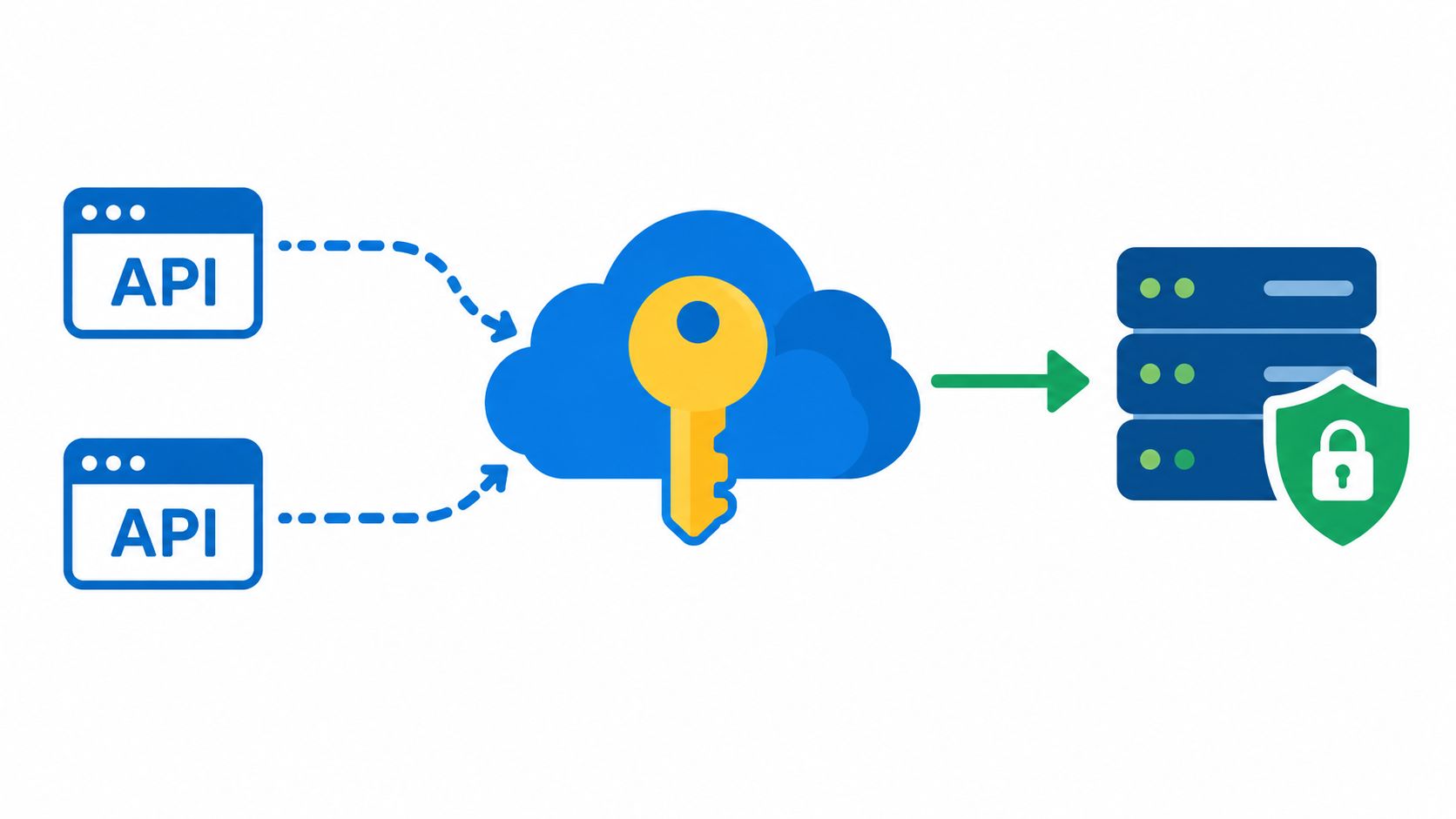
You're in the middle of a checkout or signup flow, the network blips, and the button spins long enough for someone on your team to say, “Don't click it again.” That warning is exactly where trouble starts, because the user, the SDK, or the browser often retries anyway. If the server can't tell a retry from a brand-new request, you can end up with a duplicate charge, a duplicate account, or two workflow runs that were only supposed to happen once.
An idempotency key is the contract that makes that retry safe. The client sends a unique value with a write request, the server remembers the first outcome for that key, and later retries get the same result instead of re-running the side effect. Stripe's public API docs describe this pattern clearly, including replay handling and retention windows for POST requests, and the same idea has become a standard design choice for modern APIs that need reliability under flaky networks Stripe idempotent request behavior MDN reference for the Idempotency-Key header.
Table of Contents
- The Duplicate Charge That Started With a Timeout
- What an Idempotency Key Actually Does
- Designing the Key, Its Scope, and Its Lifetime
- Implementing Idempotency Keys in Node.js and Next.js
- Comparing Real-World Idempotency Policies
- Where Idempotency Ends and Browser Proof Begins
- Testing and Monitoring Retry Behavior in Production
- Rolling Out Idempotency Safely and Common Mistakes
The Duplicate Charge That Started With a Timeout
A customer reaches the payment step, enters card details, and clicks pay. The first request goes out, the connection stalls, and the SDK retries because it can't tell whether the server already processed the charge. Seconds later, two identical POST /charges requests have hit the backend, and both look valid from the server's point of view.
That's the whole trap. The client is doing the right thing by retrying after a timeout, but the server only sees two separate writes unless you give it a way to recognize the second one as a repeat. In practice, that leads to the support ticket nobody wants, a refund to clean up the duplicate, and a backend engineer trying to reconstruct which layer failed first.
Why retries are necessary
Networks fail in boring ways. The server may have completed the write, but the response never made it back. The browser may submit twice after a slow page load. A mobile app may reconnect and resend because the connection dropped at the worst possible moment.
Practical rule: if a write can happen twice without a real user intent to repeat it, you need a duplicate-safe contract.
That contract is what the idempotency key gives you. It doesn't stop retries. It makes retries safe by telling the server, “this is the same action again, not a new one.”
If you also need browser-side abuse control for signups, logins, or checkout, browser proof and replay protection covers a different problem. It helps distinguish legitimate browser sessions from automated abuse, while the idempotency key keeps a legitimate retry from becoming a second side effect.
What an Idempotency Key Actually Does
An idempotency key is a client-generated unique identifier attached to a write request. The server uses it to recognize a retry of the same logical operation and return the original outcome instead of executing the operation again. The HTTP convention is the Idempotency-Key header, and the key should identify one business action, not just one HTTP attempt.
The basic contract
The flow is simple when you strip away the jargon.
- The client sends a write request with an
Idempotency-Key. - The server checks whether it has already seen that key for the same scope.
- If it has, the server returns the first response.
- If it hasn't, the server processes the request, stores the outcome, and treats later retries as replays.
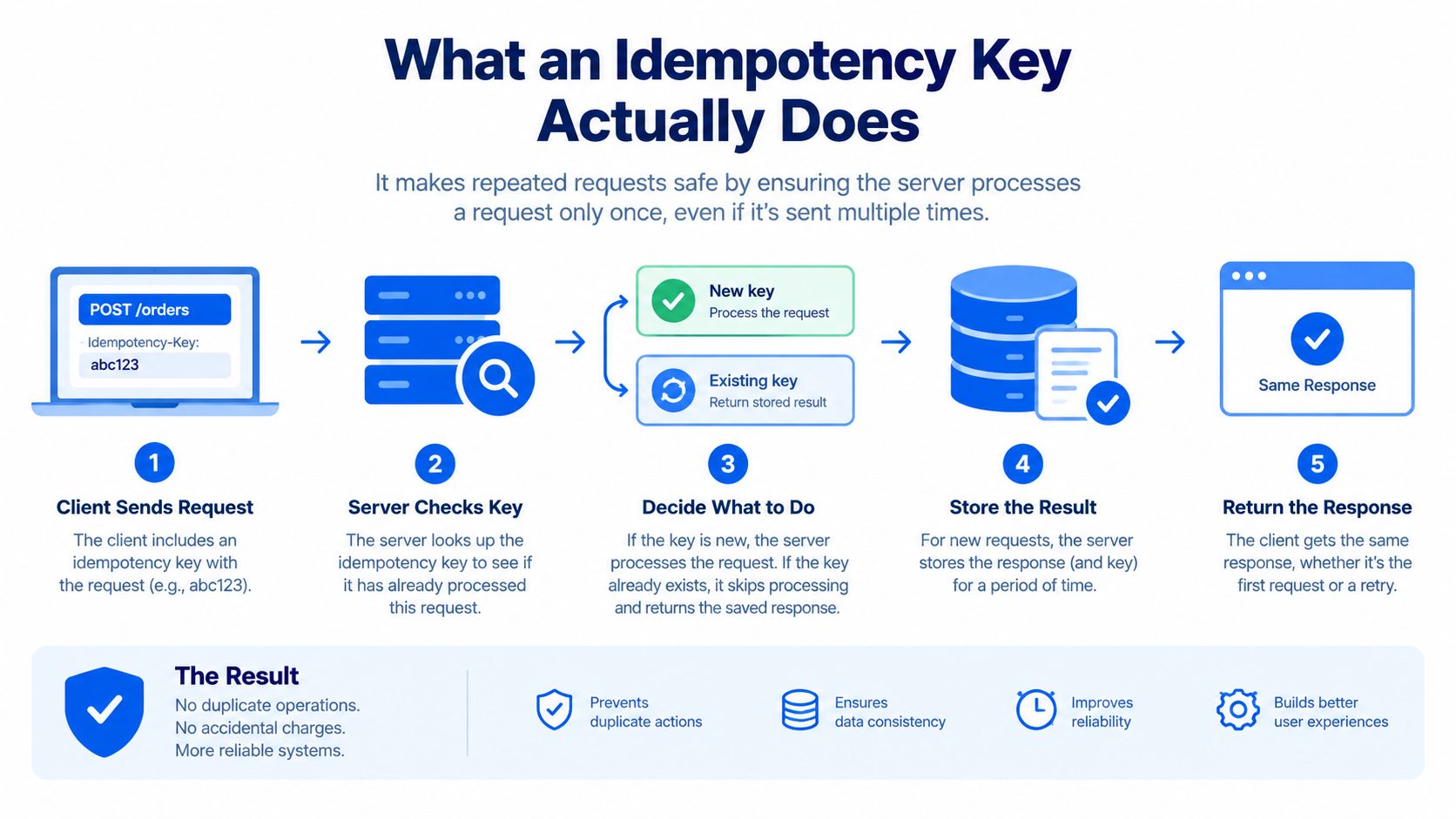
The key point is that the same key means the same logical mutation. That's why it's a contract between the retry behavior on the client and the server state on the backend. If a request times out after the server has already completed it, the client can safely retry and still get the same result back.
Safe retries versus unsafe reuse
A safe retry is the same action, same payload, same intended business outcome, just sent again because the first attempt was uncertain. Unsafe reuse is when someone sends a different payload with the same key. That should not merge without issue, because the server can't know which payload was intended.
The key is not a magic “don't duplicate me” sticker. It's a claim about one specific operation, and the server has to enforce that claim.
A good implementation also treats the replayed response as a real response, not a second-class one. The original status code and body should come back unchanged, because idempotency guarantees repeatability of outcome, not success-only behavior. That distinction matters when a first request fails in a way the server already recorded.
Designing the Key, Its Scope, and Its Lifetime
A payment request times out after the client sends it. The customer clicks again, and the server receives both attempts. Whether those attempts become one charge or two depends less on how the key was generated than on the boundary around it, the time the server remembers it, and the way collisions are handled.
Scope comes before storage
An idempotency key should be unique within a defined boundary. That boundary might be a tenant, authenticated user, endpoint, merchant account, or payment attempt. Scoping prevents one customer's retry from colliding with another customer's operation, while also defining what the server means by “the same request.”
Generation is usually straightforward. A UUID-style value works for many APIs, while a structured identifier can carry workflow meaning. The key might represent one payment attempt, one signup action, or a broader business transaction. Choose the business operation first, then generate a value that identifies that operation.
A key scoped too broadly can cause unrelated requests to collide. One scoped too narrowly can fail to recognize a legitimate retry. Document the scope alongside the API contract so clients know when they must create a new key.
Retention and collision handling
Stripe's public documentation describes automatic removal after keys are at least 24 hours old Stripe idempotent request behavior. Use that as a reference point, then publish a retention window based on your retry patterns and the risk of repeating the operation. A shorter window reduces storage requirements. A longer window gives late retries less opportunity to start a duplicate operation after the original record has disappeared.
Three implementation decisions deserve explicit answers:
- Where is the first response stored? Redis, Postgres, DynamoDB, or another shared store can hold the status, headers, and body needed for replay.
- What happens on concurrent duplicates? The system can return the response from the winning request, serialize the first writer, or reject the later request while the first is in progress.
- What happens when the payload changes under the same key? Reject it as a key conflict. Do not merge the two payloads or choose one without notice.
| Idempotency Key Storage Tradeoffs | Atomic Claim | Durability | TTL Handling | Best Fit |
|---|---|---|---|---|
| Redis | Strong with SETNX-style claims |
Lower if restarted without persistence | Natural TTL support | Fast replay path and short-lived keys |
| Postgres | Strong with unique constraints and transactions | High | Cleanup job needed | Durable audit trail and strict write safety |
| DynamoDB | Strong with conditional writes | High | Native expiry patterns available | Distributed services with managed storage |
| In-memory cache | Weak across restarts | Low | Simple, but fragile | Only for temporary experiments |
Storage is an operational tradeoff. Redis offers speed and direct TTL control, Postgres preserves durable records and transaction boundaries, and an in-memory cache loses protection when the process restarts. Select the store by asking what happens if its record disappears while the client retries. A duplicate charge may justify durable storage, while a temporary, low-risk operation may accept a shorter-lived record.
Implementing Idempotency Keys in Node.js and Next.js
A customer clicks “Pay,” sees a timeout, and tries again. The first request may have created the order even though the client never received the response. Your implementation needs a contract between that retrying client and the server's state: the client reuses the same key, and the server records enough information to decide whether to replay, reject, or process the request.
Put the logic in middleware or a route wrapper. Read Idempotency-Key, reject malformed values, normalize and hash the request body, then scope the lookup to the route and authenticated principal. A key that is unique only globally can collide across tenants or operations. A matching key and payload should replay the saved response. A changed payload should fail closed with a conflict.
A practical request flow
Store the first status, relevant headers, and body in a small record. Replaying that snapshot gives the client the same result, including headers it may rely on, after the original request has already performed its side effect.
For a Next.js route handler, the sequence is:
- Read
Idempotency-Keyfrom the headers. - Build a fingerprint from the route, authenticated principal, and normalized body.
- Atomically claim the scoped key.
- If the claim succeeds, run the business logic and save the response.
- If the key exists, compare fingerprints, then replay or reject.
// Pseudocode for a Next.js route handler
export async function POST(req: Request) {
  const key = req.headers.get('Idempotency-Key')
  if (!key) return new Response('Missing Idempotency-Key', { status: 400 })

  const body = await req.json()
  const payloadHash = stableHash(body)
  const scope = await currentUserScope(req)

  const existing = await db.idempotency.findUnique({
    where: { scope_key: { scope, key } }
  })

  if (existing) {
    if (existing.payloadHash !== payloadHash) {
      return new Response('Payload changed for same key', { status: 409 })
    }
    return replay(existing)
  }

  const result = await db.$transaction(async (tx) => {
    await tx.idempotency.create({
      data: { scope, key, payloadHash, status: 'in_flight' }
    })

    const response = await createOrder(body)

    await tx.idempotency.update({
      where: { scope_key: { scope, key } },
      data: { status: response.status, responseBody: response.body }
    })

    return response
  })

  return result
}
Implementation note: simultaneous requests must be arbitrated by an atomic claim, such as a unique constraint. If the business operation calls an external service, persist and manage the idempotency state separately so a transaction rollback cannot make the side effect invisible.
Node.js middleware follows the same sequence. Framework choice matters less than claim, execute once, persist the result, and replay later. Define what happens to an in_flight record, and make its expiration match the retry window chosen for the operation.
For checkout, signup, or login protected by invisible browser verification, MANDATE can collect browser proof on the client and let the server verify it before processing. It complements idempotency: browser proof addresses whether a request appears legitimate, while the key controls what happens when a legitimate client retries.
Comparing Real-World Idempotency Policies
Different APIs choose different policies because they protect against different failure modes. Stripe applies idempotency to POST requests, stores the first result, and may remove keys once they are at least 24 hours old Stripe idempotent request behavior. monday.com documents replay behavior, concurrent-request handling, and a short cache window for its supported mutation flow monday.com idempotency policy.
These choices define a contract between client retries and server state. A client needs to know whether sending the same key again will replay a result, receive a conflict, or encounter an expired record. The key also needs a clear scope. A key such as order_123 may be safe within one account and operation, but ambiguous if another endpoint or tenant can see it.
What those differences mean in practice
A long retention window suits payment retries and slow recovery after a timeout. A 409 Conflict response makes an in-flight collision visible instead of pretending that both requests completed. Payload hashing protects against a different mistake: reusing a key with changed data and attaching a new request to the old result without warning.
| Idempotency Policy Comparison Across Major APIs | Header Required | TTL | Payload Mismatch | Concurrent Request |
|---|---|---|---|---|
| Stripe-style payment API | Required on write requests | At least 24 hours in the documented example | Replays the original outcome for the same key | Stores the first result and reuses it |
| monday.com-style API | Required for the supported mutation flow | Short cache window in the documented example | Replays can preserve the first status, even on error | Returns 409 Conflict for concurrent duplicates |
| Generic REST service with hashing | Usually required on important writes | Team-defined | Rejects changed payloads under the same key | Serializes first writer, then replays |
| Loose REST service | Optional or inconsistently enforced | Undefined | Often underspecified | Often underspecified |
Match the policy to the consequence of a duplicate. Payment, onboarding, and mandate creation require tighter scope, longer retention, and explicit mismatch handling than a preference save. Publish those rules for clients. Browser verification may help judge whether a request appears legitimate, but it does not define retry behavior. Idempotency still has to specify what the server does with the same key, payload, and operation.
Where Idempotency Ends and Browser Proof Begins
Idempotency keys protect against duplicate processing caused by retries. They don't prove that the caller is an actual browser, an actual person, or even the same session that started the action. A bot can bypass the whole contract by sending new keys every time, which is why you need another layer when the core problem is automated abuse.
Two different controls for two different failures
Idempotency answers, “Did we already process this exact logical action?” Browser proof answers, “Does this request look like it came from a legitimate browser session we already observed?” Those are related, but they are not interchangeable.
For high-value actions, the layers work together:
- Idempotency keys stop double processing when a legitimate request is retried.
- Browser proof helps block scripted abuse, replayed tokens, and headless automation.
- Rate limits and business rules still matter when a human or script keeps clicking.
Browser proof fits well when you need to protect signups, logins, and checkout from automated abuse without CAPTCHAs. The important distinction is that it doesn't replace retry safety, and idempotency doesn't replace abuse detection. You still need both if your action is valuable enough to attract retries and abuse at the same time.
A retry is not the same thing as abuse, and a browser check is not the same thing as duplicate prevention.
The honest limit is that neither layer can fully stop a determined user from attempting the action twice. What they do give you is a clearer server-side contract, better evidence about the request source, and fewer accidental duplicates in the path that matters most. Why browser proof needs server state explains why the server has to validate that evidence instead of trusting the client alone.
Testing and Monitoring Retry Behavior in Production
Treat idempotency like a distributed-systems feature, because that's what it is. Test retries before you ship, not after the first customer report. Simulate timeouts, duplicate submits, middleware retries, and concurrent requests with the same key so you can see whether the server returns one outcome consistently.
What to test before launch
A good unit test should prove that the second call returns the cached response and that the business write only happens once. A good integration test should send a deterministic key through your staging endpoint and confirm that the replay comes back the same way across transport retries. If you support both HTTP/1.1 and HTTP/2, test both paths, because middleware behavior can differ.
What to watch after launch
- Replay traffic: track how often responses are marked as replays so you can determine whether clients are retrying.
- Concurrent collisions: watch for
409 Conflictspikes, because those often point to client bugs or overly aggressive retries. - Lookup latency: keep an eye on the store that resolves keys, since a slow lookup path becomes user-visible fast.
- Payload mismatches: count rejected requests that reused a key with different data, because those usually signal client-side misuse.
A rollout that feels boring in staging can still turn messy in production if the key store evicts too early or if the client library retries too aggressively. Retries, replay, and business outcomes is a useful reference point for thinking about how retry behavior changes actual request outcomes.
Rolling Out Idempotency Safely and Common Mistakes
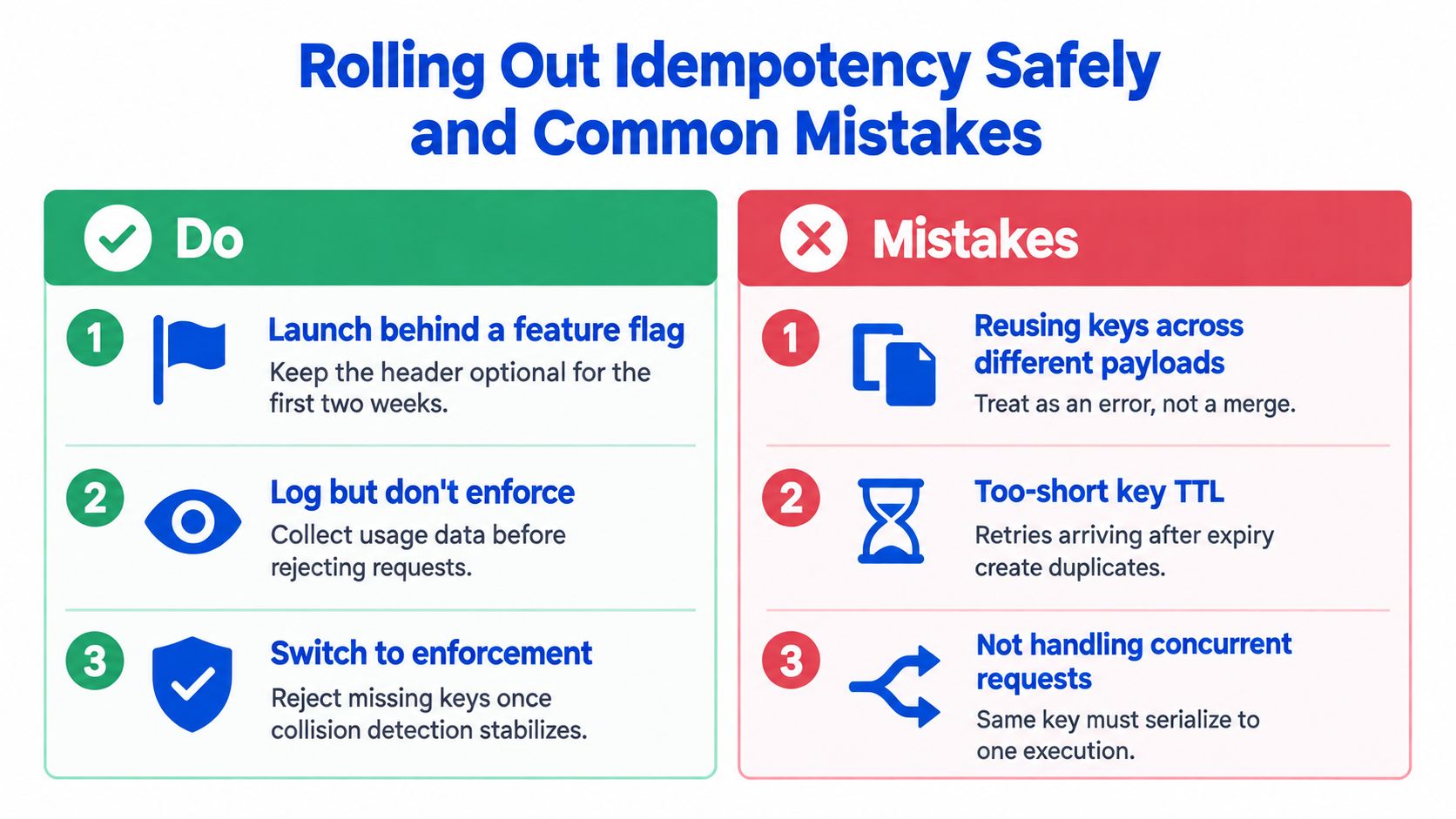
Roll the feature out behind a flag, and make the header optional at first so you can see real client behavior before you enforce anything. During that period, log missing keys, log collisions, and watch whether the same request pattern shows up across users or routes. Once the collision handling is stable, switch to enforcement and reject missing or mismatched keys on the endpoints that need protection.
A rollout checklist that holds up in production
- Publish the contract: document the
Idempotency-Keyheader, the retention window, and the maximum accepted key length in your API reference. - Enforce payload consistency: if the same key arrives with different data, reject it instead of guessing which one wins.
- Keep the first result durable: don't rely on an evictable cache for the only copy of a sensitive write result.
- Serialize concurrent duplicates: two in-flight requests with the same key should not both execute the side effect.
- Replay exactly: return the original response so the client sees the same outcome, not a homemade approximation.
The most common mistake is treating the UUID as the whole solution. A random key with no scope, no storage, and no payload fingerprint just moves the bug somewhere harder to see. Another mistake is letting the TTL be too short, because retries that arrive after expiry turn back into duplicate writes.
A third mistake is assuming idempotency handles abuse. It doesn't. It handles repeat delivery of the same intended action, which is a much narrower problem than hostile automation. If you want browser-level protection for those important website actions, use a separate control like MANDATE alongside the retry contract, then keep your server-side business rules strict enough to reject anything that doesn't fit the original intent.
If you're building signups, logins, checkout, or other sensitive flows, MANDATE adds invisible browser verification alongside server-side decisioning so you can separate real browser sessions from automated abuse without adding CAPTCHAs. If you want to see how that fits with idempotency keys, visit MANDATE and review the current integration options for your stack.