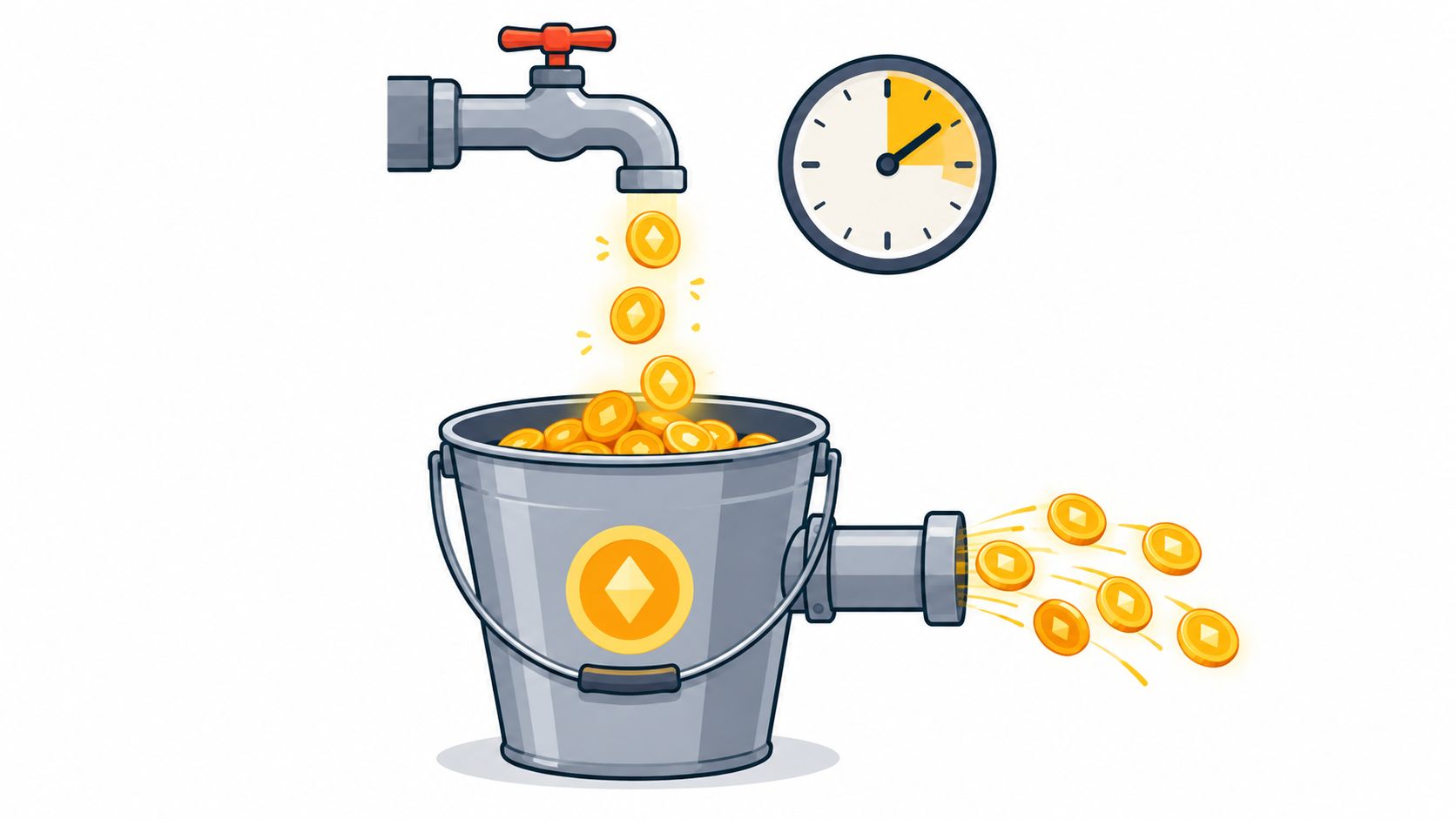
Can a rate limiter that protects your API from bursts still leave your login or checkout flow open to automation? Yes. That question exposes the gap in conventional token bucket tutorials. The algorithm controls request volume, but volume control isn't the same as proving that a request came from a legitimate browser or user.
The token bucket algorithm remains a practical foundation for traffic shaping and request admission. It becomes a security control only when you understand its burst behavior, identity model, shared state, and failure modes. Engineering leaders, backend developers, and security teams need to evaluate it against the action they're protecting, not just the throughput they want to permit.
Table of Contents
- Why Rate-Limiting Logic Is a Security Decision
- Core Mechanics of the Token Bucket Algorithm
- Token Bucket Versus Leaky Bucket Models
- Implementation Patterns and Distributed Constraints
- Applying Rate Limiting to High-Value Web Actions
- Common Pitfalls and Tuning for Effectiveness
Why Rate-Limiting Logic Is a Security Decision
A signup endpoint can look healthy while attackers steadily create accounts, test stolen credentials, or consume promotional resources. A login service can remain responsive while scripted clients distribute attempts across accounts and stay below a simple per-client threshold. A checkout endpoint can handle normal traffic while automation repeatedly probes payment and inventory workflows.
Those are not only capacity problems. They affect account integrity, fraud exposure, support load, and the reliability of important customer journeys. The limiter decides which requests receive an opportunity to continue, so its behavior becomes part of the security boundary.
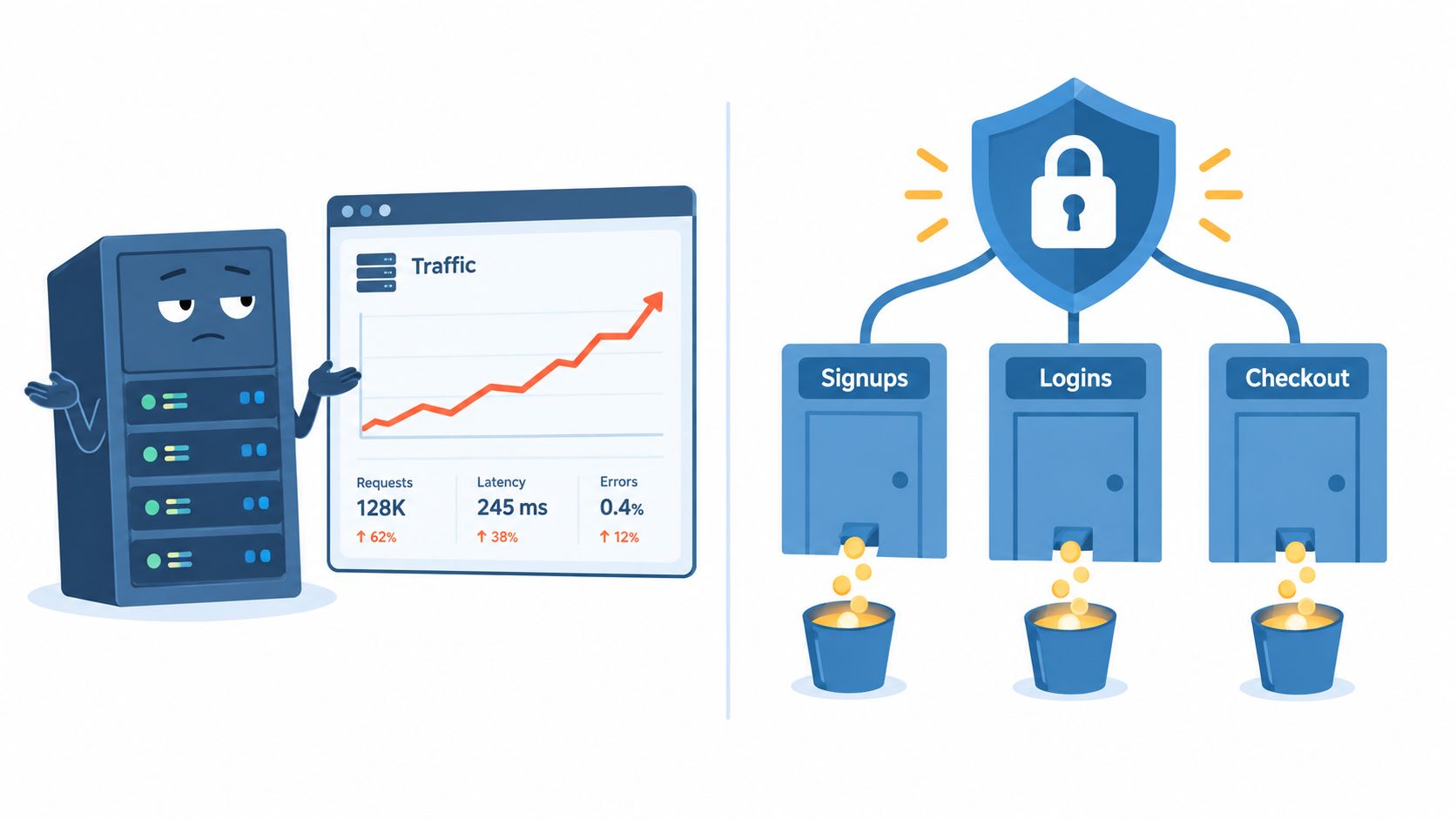
Attackers respond to enforcement behavior
A limiter that rejects every request after a hard threshold creates a visible pattern. A script can wait, send another batch, and measure the response. A token bucket creates a different pattern because it allows accumulated capacity to be spent in a burst before enforcing the refill rate.
That behavior can be useful for legitimate clients. A browser might load several related resources or retry a transient operation. It can also give an attacker room to concentrate activity around a valuable action. The relevant question isn't whether bursts are good or bad. It's whether the permitted burst matches the risk and cost of the operation.
Practical rule: Set rate limits around the consequence of an action, not only the number of requests your infrastructure can process.
Identity makes the decision harder. A limiter keyed only by IP address can penalize users behind shared networks and miss automation spread across many addresses. A limiter keyed only by account can be bypassed before authentication, or abused against multiple accounts. A useful policy often combines several signals, such as account, session, route, device context, and request outcome.
That's why the client-side versus server-side security trade-off matters. The server must make the final enforcement decision, but it may need evidence about the client environment to distinguish a normal browser flow from a scripted request.
Rate limiting is one layer, not a verdict
The token bucket algorithm can reject excess traffic, protect downstream dependencies, and create predictable admission behavior. It cannot independently establish that a request is human, fresh, authorized, or safe to replay. Treating it as a complete anti-abuse system creates false confidence.
For high-value actions, pair volume controls with authentication, authorization, replay defenses, request validation, and risk-aware browser verification. A request that stays below the token rate can still be abusive, so enforcement needs both how often the client acts and whether the action carries credible proof.
Core Mechanics of the Token Bucket Algorithm
The token bucket algorithm models permission as a stored supply of tokens. A request spends a token. Tokens return at a configured refill rate, and the bucket has a maximum capacity. This gives the system two separate controls, the long-term rate and the largest permitted burst.
Think of a tank connected to a narrow supply pipe. The pipe fills the tank steadily, but the tank can hold only a limited amount of water. A small cup can be filled immediately while the tank has water available. Once the tank is empty, the next request must be rejected, delayed, or handled by another policy.
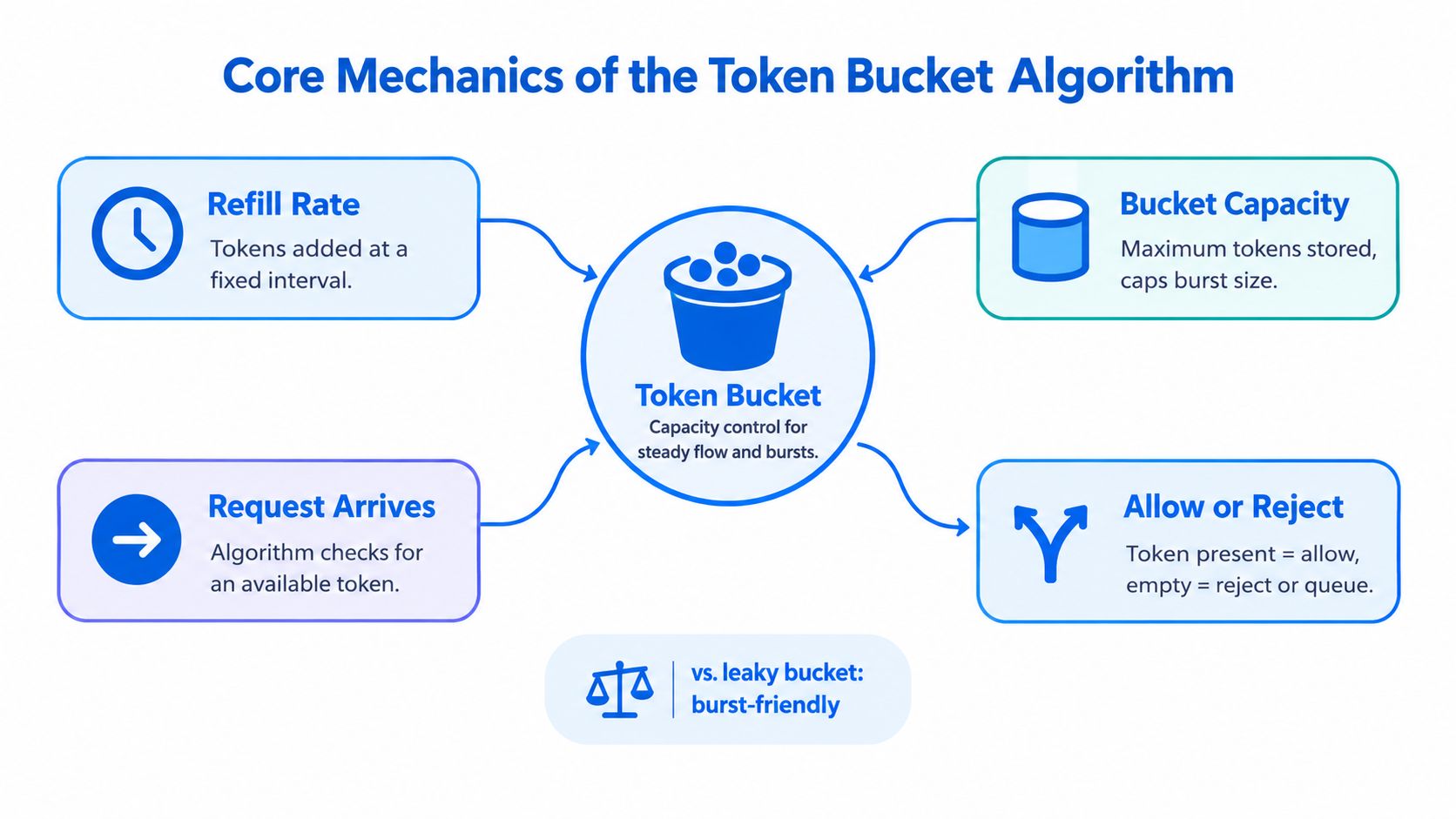
The three values that shape behavior
Refill rate controls how quickly permission returns. A higher rate supports more sustained traffic. A lower rate makes the limiter stricter over time.
Bucket capacity controls how much unused permission can accumulate. It sets the maximum burst that an idle client can spend, assuming requests have the same token cost.
Token cost determines how expensive each operation is to the limiter. A basic read may consume one token, while a sensitive write can consume more. Weighted costs let one bucket represent different operational risks, although the policy becomes harder to explain and tune.
The bucket starts with some token count, often at capacity or at a configured initial level. When a request arrives, the limiter first calculates how much time has passed since the previous update. It adds tokens according to the elapsed time and refill rate, but never stores more than the capacity.
The decision is then simple:
- Refresh the balance. Calculate elapsed time using a reliable clock and add the earned tokens.
- Check availability. Compare the balance with the request's token cost.
- Allow and consume. If enough tokens exist, subtract the cost and let the request proceed.
- Reject or defer. If the balance is insufficient, return a rate-limit response, queue the request, or apply a separate challenge or review path.
A useful conceptual formula is:
new_tokens = min(capacity, old_tokens + elapsed_time × refill_rate)
The limiter then evaluates whether new_tokens >= request_cost. This is not a request counter that resets at a boundary. It is a continuously replenished allowance, which avoids some abrupt window transitions but introduces timing and state-management concerns.
What the algorithm guarantees
A correctly implemented bucket limits the sustained average to its refill policy while permitting a burst bounded by stored capacity. Those are different guarantees. A capacity that is too generous can make a sensitive endpoint easy to hit in concentrated batches, even if the long-term rate looks conservative.
The algorithm also says nothing about fairness between identities unless the application defines the bucket key. One global bucket may protect the service while allowing one client to consume everyone's allowance. Per-user, per-session, per-route, and hierarchical buckets change the fairness and cost profile.
For a public API, a rejected request commonly receives a response that tells the client to slow down. For a browser workflow, dropping requests without notice may produce confusing failures. The right response depends on whether the caller is an honest client that can retry or an untrusted actor whose behavior should be recorded and blocked.
Token Bucket Versus Leaky Bucket Models
Token bucket and leaky bucket models solve related problems, but they make opposite choices about bursts. Token bucket stores permission for later use, while leaky bucket pushes work through a controlled output path. That difference affects latency, queueing, user experience, and abuse resistance.
A token bucket suits workloads where legitimate clients occasionally need to act quickly. An idle client can accumulate permission, then spend it in a short burst. The refill rate still limits sustained use, but it doesn't force every request into a constant output rhythm.
A leaky bucket suits systems where downstream processing must remain smooth. Incoming work enters a queue, and the service drains it at a controlled rate. If the queue fills, the system rejects additional work. This can protect fragile dependencies, but it may add delay to legitimate requests during a surge.
Token Bucket vs Leaky Bucket Comparison
| Characteristic | Token Bucket | Leaky Bucket |
|---|---|---|
| Burst handling | Permits bursts up to the available bucket capacity | Restricts output to a steady drain rate |
| Primary control | Stored permission plus refill rate | Queue size plus processing rate |
| User experience | Better for short legitimate bursts and low-latency actions | More predictable backend flow, but queueing can add latency |
| Sustained traffic | Limited by the refill rate | Limited by the drain rate |
| Excess traffic | Can be rejected, delayed, or classified separately | Waits in the queue or is rejected when the queue is full |
| Operational risk | Burst traffic can reach downstream systems quickly | Queue growth can consume memory and increase waiting time |
| Security implication | Burst tolerance may help normal clients and scripted attackers | Strict pacing reduces spikes but doesn't establish client legitimacy |
| Good fit | Interactive APIs, read-heavy services, and workflows with uneven demand | Stream processing, fragile backends, and systems requiring smooth output |
Choosing based on the protected action
For a product search endpoint, a controlled burst may be harmless and useful. For a login endpoint, the same burst can create a concentrated credential-testing opportunity. For checkout, queueing may preserve backend stability, but delaying a purchase request without clear idempotency rules can create duplicate or confusing outcomes.
The choice also depends on what failure means. Rejecting a request is visible and immediate. Queueing it can preserve work, but the caller may time out or retry, creating more traffic. A leaky bucket isn't automatically safer, and a token bucket isn't automatically more permissive in every configuration.
A smoother request stream can protect infrastructure, but it still doesn't answer whether the caller should be trusted.
Many production systems combine models or apply them at different layers. An edge control can shed obvious excess traffic, an application limiter can protect a route, and a queue can smooth expensive background work. Keep those responsibilities separate. A queue shouldn't become a hidden substitute for authorization, and a rate limiter shouldn't be treated as proof of browser legitimacy.
Implementation Patterns and Distributed Constraints
A local token bucket is easy to describe and easy to get subtly wrong. The state must include the current token balance and the timestamp of the last refill. Every request must update and decide against that state as one atomic operation.
Conceptually, the logic looks like this:
now = monotonic_time()
elapsed = now - bucket.last_update
bucket.tokens = min(capacity, bucket.tokens + elapsed * refill_rate)
bucket.last_update = now

if bucket.tokens >= request_cost:
    bucket.tokens -= request_cost
    allow
else:
    reject_or_defer
The pseudocode hides the main production problem. If two requests read the same balance before either writes the updated value, both can receive permission for the same tokens. The implementation needs a compare-and-swap operation, a transaction, a lock, or a datastore-side script that refreshes and consumes the balance without exposing an intermediate state.
Local state versus shared state
Per-process buckets have low latency and no network dependency, but they enforce only an approximate global policy when traffic reaches multiple instances. A client can receive separate allowances from separate gateways, and the combined result can exceed the intended limit.
A shared store provides a common view, but it adds coordination overhead and a new dependency on the request path. Redis is a common choice for atomic counters and scripts, while an edge platform may provide a distributed rate-limiting primitive. The correct choice depends on the required consistency, latency budget, failure behavior, and cost of an overage.
The important key design question is scope:
- Per account protects authenticated identities but doesn't help much before login.
- Per session contains behavior within a browser journey but can be bypassed by creating sessions.
- Per IP is simple, yet shared networks and rotating addresses make it an imperfect identity.
- Per route protects expensive operations independently from low-risk reads.
- Hierarchical keys combine global, tenant, account, and action limits, at the cost of more state and more tuning.
The rate-limiting controls for application traffic should be evaluated with the same discipline as any other shared dependency. Define what happens when the limiter is unavailable. Fail-open behavior preserves availability but may expose the action. Fail-closed behavior protects the action but can block legitimate users during an infrastructure incident. A route's business impact should determine the default, not a blanket platform preference.
Time and failure handling
Use a monotonic time source for elapsed intervals where the runtime supports it. Wall clocks can move because of synchronization adjustments, manual changes, or virtualization behavior. If one node calculates elapsed time differently from another, refill accuracy and enforcement consistency degrade.
Distributed deployments add more failure cases:
- Concurrent updates can overspend tokens unless the read, refill, and write happen atomically.
- Clock drift can cause nodes to refill too quickly or too slowly.
- Restart resets can empty or refill a local bucket unexpectedly when state isn't durable.
- Hot-key contention can make one popular identity a bottleneck in the shared store.
- Network partitions can force a choice between stale local decisions and unavailable global enforcement.
Recent implementation guidance highlights these exact operational concerns, including concurrent gateway decisions, clock drift, restart resets, and hot-key contention in distributed token bucket systems (production token bucket implementation strategies). The algorithm's mathematics is not enough. Shared state, monotonic time, and low-latency coordination determine whether the policy survives production conditions.
Test more than the happy path. Run concurrent requests against the same key, restart instances during active traffic, simulate datastore latency, and observe behavior during failover. Verify that metrics distinguish allowed requests, rejected requests, datastore errors, stale state, and policy changes. Without those signals, teams can't tell whether a limiter is defending the service or merely creating unexplained failures.
Applying Rate Limiting to High-Value Web Actions
High-value actions need more than a single request threshold. A login, signup, checkout, password reset, or account recovery flow has a different risk profile from a catalog read. The token bucket algorithm can control the pace, but the policy should reflect the action's cost and the evidence required before it proceeds.
Start by mapping the workflow rather than applying one limit to the whole site. A signup may have a modest allowance for page views but a stricter policy for account creation. A login flow may use separate controls for failed attempts, account discovery signals, session creation, and password reset requests. Checkout may need protection around cart mutation, payment initiation, order creation, and retry behavior.
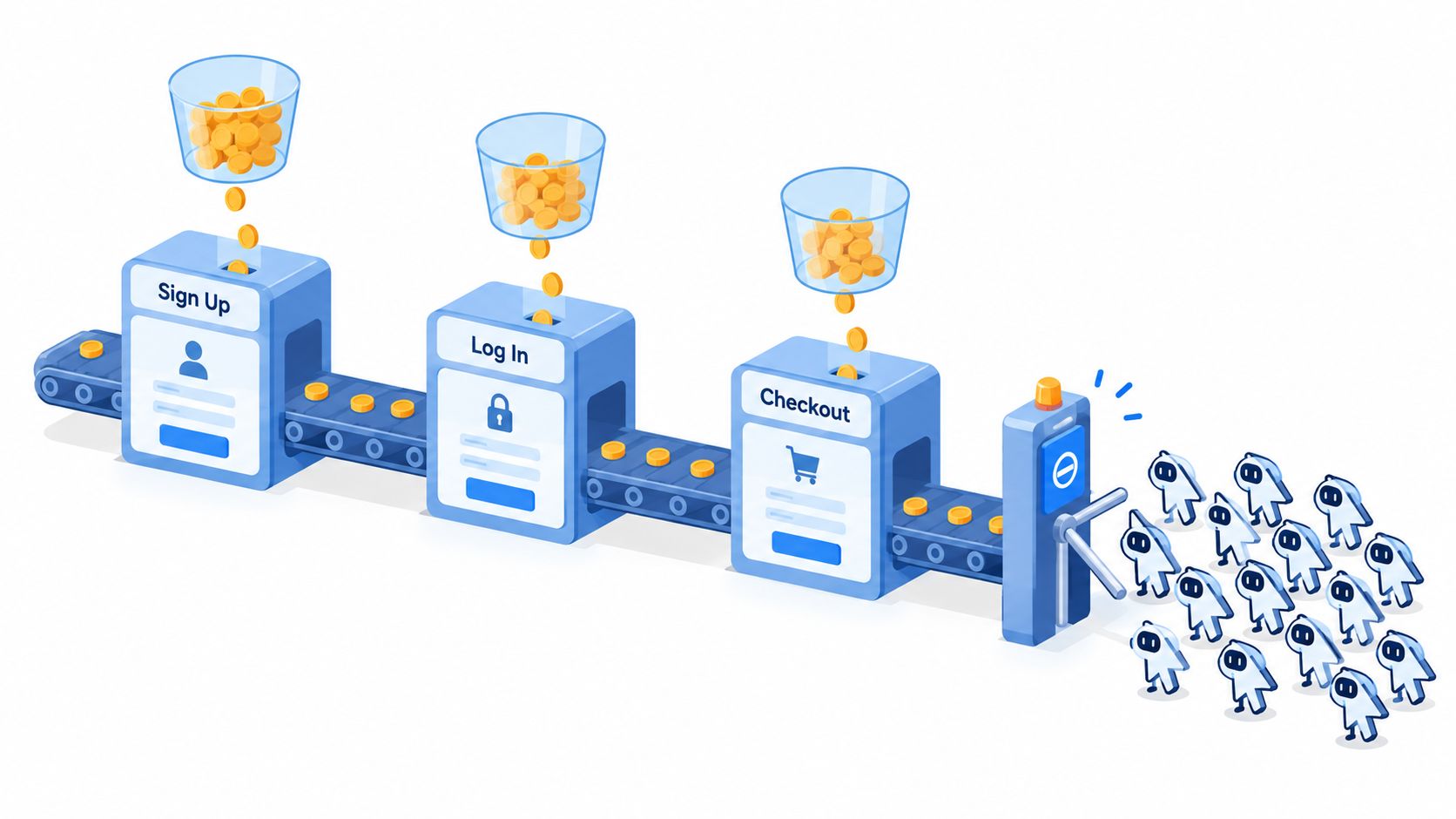
Match burst tolerance to business risk
A bucket capacity should answer a business question: how much short-term activity can a legitimate client perform before the system needs another signal? The refill rate should answer a different question: how much sustained activity can the service and downstream workflow tolerate?
Avoid tuning from infrastructure capacity alone. An endpoint may handle a burst technically while the underlying operation creates fraud, inventory, email, or database risk. Conversely, an overly strict policy on a harmless read can damage legitimate navigation without meaningfully stopping distributed automation.
Use separate dimensions where possible:
- Action key: Apply stricter handling to state-changing operations than to informational requests.
- Identity key: Combine account and session context with network signals rather than relying on one identifier.
- Outcome key: Treat repeated failures differently from successful, normal progression.
- Cost key: Charge expensive operations more heavily than lightweight requests.
- Freshness key: Require new evidence for actions that shouldn't be replayed.
Add proof when pacing isn't enough
A scripted client can often adapt to a rate threshold. It can wait between requests, rotate identities, and preserve a low enough volume to avoid exhausting a bucket. That is why rate limiting and invisible browser verification solve different problems.
Rate limiting asks, “How often has this identity or request path acted?” Browser verification asks, “Can the server validate credible browser evidence for this request?” Used together, the limiter can control resource consumption while verification informs whether the request should be allowed, flagged, or blocked.
The layered flow can remain practical:
- The edge or application receives the request.
- A token bucket checks the relevant action and identity scope.
- The server verifies browser proof for a protected workflow.
- The policy combines the result with authentication, session, replay, and business signals.
- The application allows, rejects, or routes the request for review.
This approach preserves a low-friction path for legitimate users without pretending that one control is sufficient. For a detailed example of protecting a transaction flow, see checkout abuse prevention with layered controls.
Protect the sequence, not only the final request
Attackers often study the workflow before targeting its final action. A limiter on order creation may miss abuse in cart updates, coupon validation, or payment retries. Apply controls at meaningful transition points and make sure the server owns the final state change.
Use idempotency for operations that clients may retry. Record enough context to connect a rejected request to the session and action without exposing sensitive data in logs. If verification fails, don't automatically assume every failure is malicious. Route ambiguous outcomes to a less destructive response when the business flow permits it, while preserving stronger enforcement for repeated or clearly invalid behavior.
The result is defense in depth. The token bucket limits pace, browser proof raises the cost of scripted interaction, authentication establishes identity, and application logic protects transaction integrity. None of those layers promises complete protection on its own, and each should have an explicit failure mode.
Common Pitfalls and Tuning for Effectiveness
The most dangerous token bucket mistake is treating it as a universal abuse solution. It is a bandwidth cap with burst credit. Standard explanations describe excess traffic as non-conformant and suitable for marking or dropping, which is useful for smoothing legitimate bursts but weaker against an attacker who can pace activity below the threshold (token bucket traffic-control fundamentals).
Static settings fail when traffic patterns change. A policy tuned for ordinary daytime use may behave badly during a product launch, a recovery event, or a targeted attack. Don't solve that by constantly raising the bucket. Review decisions by route, identity scope, response outcome, and customer impact, then change the policy deliberately.
Failure patterns to watch
- Oversized capacity: A client can spend too much permission in a concentrated burst against a sensitive endpoint.
- Wrong key: IP-only or account-only enforcement leaves predictable gaps and creates avoidable false positives.
- Unclear rejection behavior: Clients retry aggressively when responses don't explain whether they should slow down or stop.
- No atomicity: Concurrent requests consume the same apparent balance.
- No durable state: Restarts reset enforcement in ways attackers can exploit or legitimate users experience as random.
- No decision review: Teams can't tune what they don't observe.
Operational advice: Put new policies in an observation or shadow mode before enforcing them when the route supports that rollout pattern.
Monitor allowed and rejected decisions, latency added by the limiter, datastore failures, key cardinality, and the distribution of enforcement across legitimate cohorts. Pair those metrics with business outcomes such as completed signups, successful logins, abandoned checkouts, and support complaints. A low rejection rate doesn't prove that the policy works, and a high rejection rate doesn't prove that it is safe.
Use token buckets for pacing and capacity control. Add identity-aware controls, replay resistance, authentication, authorization, and browser verification when the threat involves scripted interaction rather than simple flooding. The strongest design is not the most aggressive limiter. It's the one whose behavior matches the action, remains observable under failure, and can be adjusted without surprising legitimate users.
MANDATE helps protect signups, logins, checkouts, and other high-value website actions with invisible browser verification, server-validated browser proof, and enforcement options that can allow, flag, or block traffic without CAPTCHAs. Review decisions in Observe mode before enforcement, then visit MANDATE to evaluate how it can complement your token bucket controls.