
76% of organizations reported attempted or actual payments fraud in 2025, and only 17% were using AI to fight it. Fraud is widespread, and many teams are still relying on controls that don't cover the whole payment journey.
Payments fraud prevention isn't just a checkout problem anymore. The teams that get hit hardest are the ones that leave gaps at signup, login, authorization, and post-purchase handling, then assume one control at the gateway will cover the rest.
Table of Contents
- The Current State of Payments Fraud
- Building a Layered Verification Strategy
- Securing the Authorization Stage
- Implementing Invisible Browser Verification
- Addressing Post Purchase and Social Engineering Fraud
- Rolling Out Protection with Observe Mode
- Key Takeaways and Next Steps
The Current State of Payments Fraud
The current fraud problem is broad enough to break single-layer defenses. In the 2026 AFP Payments Fraud and Control Survey, 76% of organizations reported attempted or actual payments fraud in 2025, 58% reported check fraud, and 74% said they were affected by business email compromise, while only 17% were using AI to combat payments fraud (AFP survey). That combination matters because it shows high attack pressure and uneven defensive maturity at the same time.
A lot of teams still talk about fraud as if it starts and ends at checkout. In practice, attackers move across the full user journey. They probe signups for automated abuse, hijack logins with stolen credentials, push fraudulent transactions through authorization, then come back later through refunds, policy abuse, and support channels.
Practical rule: if your controls only look at the payment rail, you're seeing the last step of the attack, not the attack itself.
The historical center of gravity was card-not-present abuse. The European Central Bank reported that card fraud on cards issued in SEPA and acquired worldwide totaled €1.80 billion in 2018, and 79% of the fraud value came from card-not-present payments. The same report said card-not-present fraud alone accounted for €1.43 billion in losses that year, up 17.7% from 2017 (ECB card fraud report). That's still useful context, but it's no longer the whole picture.
Engineering teams need a wider frame. Payments fraud prevention now overlaps with account security, bot management, device trust, customer service workflows, and payment operations. If a signup funnel is easy to automate, a login flow is easy to reuse, or a refund desk can be manipulated with weak policy checks, the payment gateway won't save you.
A practical way to think about this is simple. Protect important website actions before they become payment events, then watch for abuse after the transaction too. For a concise view of how merchants usually structure detection, see this e-commerce fraud detection guide, which aligns with the broader pattern here, layered controls beat isolated checks.
Building a Layered Verification Strategy
A layered strategy works because fraud rarely fails on only one signal. Attackers can spoof an email, but they may not look normal on a known device. They can replay a session, but they may not behave like a real customer. They can pass one step and still look wrong when you combine identity, device, and behavior.
Identity verification
Identity verification answers a basic question, who is acting right now? In signup flows, that can mean checking whether the email address is valid and whether the user can complete a real verification step before the account becomes useful. OWASP's Bot Management and Anti-Automation Cheat Sheet explicitly recommends gating account usability on email verification, not just sending a confirmation email, and it gives concrete velocity limits such as 3 signups per hour per IP, ASN, and device fingerprint (OWASP guidance summary).
That's a useful starting point because it separates a real account from a throwaway session. It also reduces the chance that your platform becomes a free relay for automated signup abuse.
Device verification
Device verification asks whether the browser or app session looks legitimate. That matters at login and checkout, where stolen credentials often appear normal until the device profile is checked. In practice, device trust means looking for consistent fingerprints, familiar sessions, and sane request patterns rather than treating every login as equally trustworthy.
Behavioral verification
Behavioral verification checks whether the action makes sense in context. A user who signs up, logs in, and checks out with a normal cadence is different from a script that hammers forms, retries with tiny edits, and jumps between pages too quickly. The point isn't to punish speed. It's to spot combinations of signals that don't fit human use.
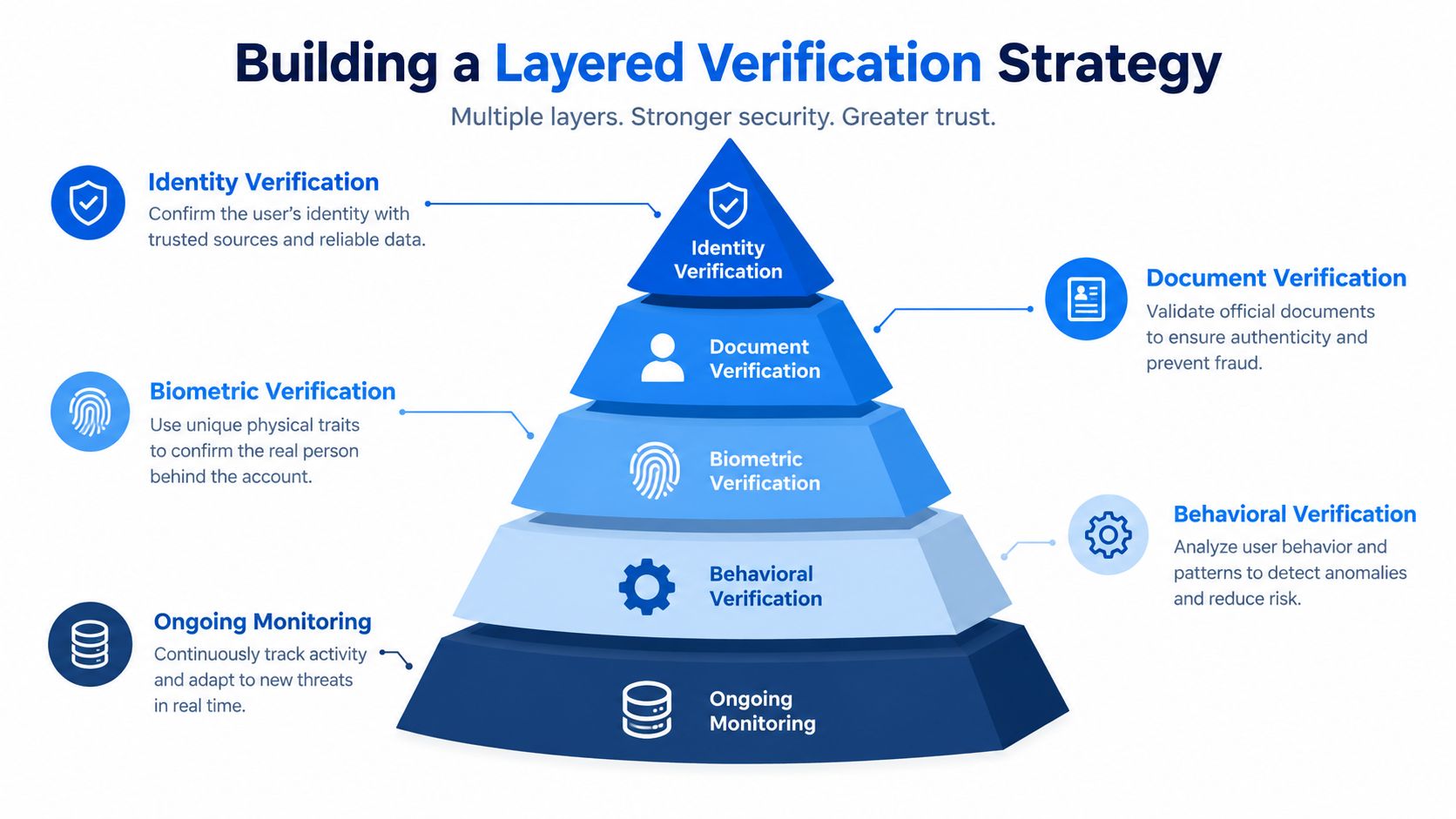
A simple flow helps teams apply this in code:
- Identity first. Let the request reach the app, but don't let it access meaningful capability until the identity signal clears.
- Device next. Compare the session against known-good browser or device traits.
- Behavior last. Add challenge or review only when the action looks risky enough to justify it.
That order matters because you don't want to block ordinary users with heavy friction just to catch low-risk traffic. You want cheap checks up front, then stronger scrutiny where the business risk is real.
Securing the Authorization Stage
The best place to stop payment fraud is still before money moves. In the European Banking Authority's work on payment fraud, fraud rates for credit transfers were 0.0008% of total value and direct debits were 0.0020% in 2022, while card-payment fraud was 0.029% of value, with an average fraudulent transaction of €80 versus €2,252 for credit transfers (EBA opinion). The same document noted that during the 2020-2021 migration to strong customer authentication, average card fraud rates in value fell by 40% to 60%.
That data points to a simple conclusion. Authorization-stage controls work. If you wait until after settlement or after a user has already authorized the transaction, you're doing incident response, not prevention.
When to step up and when to watch
Use strong customer authentication for high-risk or unusual moments, then let transaction monitoring handle the gray areas. The cleanest pattern is step-up authentication at risky entry points, background monitoring for behavioral anomalies, and stronger challenges only for the riskiest transactions. That approach keeps friction tied to risk instead of applying it everywhere.
Practical rule: broad friction is expensive. Use it where the loss potential is high, not as a default response to every payment.
This is also where teams often overfit on one control. SCA alone won't catch every fraud pattern, and monitoring alone won't stop funds from moving. The best result comes from combining them, because one control reduces weak authorization attempts while the other catches patterns that slip through.
A few implementation habits help in real systems:
- Challenge risky changes. New payees, new devices, and unusual transfer behavior deserve step-up controls.
- Keep monitoring cheap. Use background scoring for the majority of traffic, not every transaction as a blocking event.
- Review false positives quickly. If legitimate customers get challenged too often, they'll abandon the flow or route around the control.
The data here is clear. Fraud can be reduced substantially at authorization, but it doesn't disappear. That's why mature teams treat the payment moment as one checkpoint in a longer chain, not the only gate that matters.
Implementing Invisible Browser Verification
Browser verification works because it checks the request without putting a puzzle in front of the user. The client runs JavaScript to solve a computational problem, then the server validates the result to confirm the work was performed. That server-side validation model is important because it keeps the proof tied to the browser session instead of trusting whatever the client claims (W3C accessibility discussion of CAPTCHA mechanics).
Independent coverage of CAPTCHA alternatives describes the same low-friction pattern. A widget or background browser check produces a token, and the server verifies that token before accepting the request, typically on login, signup, and checkout flows (ALTCHA overview). That's the right shape for high-value actions, because you protect the action without forcing every user through an interactive challenge.
Where to place the check
Put browser verification as close to the request edge as you can, then enforce it in application middleware or a gateway layer. The reason is straightforward. The earlier you validate browser proof, the less junk traffic reaches expensive downstream logic. Server-side verification also helps reduce token replay, because the server can require fresh proof and reject reused artifacts.
A good deployment pattern looks like this:
- Signup. Verify the browser before account creation becomes useful.
- Login. Verify the browser before credential stuffing gets signal from your app.
- Checkout. Verify the browser before a bot can submit orders or abuse payment forms.
That doesn't mean every request needs the same friction. It means the high-value actions get a proof check that most users never notice.
How this reduces bot pressure
Invisible verification is effective because it changes the economics of scripted abuse. Bots can still hit the endpoint, but they don't get free access to the full workflow. If proof is missing or invalid, the request can be denied, flagged, or diverted before it creates account noise or payment waste.
For teams looking for a practical implementation path, this anti-bot verification guide is a useful companion because it focuses on the same browser-proof model used to protect sensitive web actions.
Addressing Post Purchase and Social Engineering Fraud
The biggest blind spot in many fraud programs is what happens after the customer pays. Merchant data shows the center of loss is shifting toward refund abuse, policy abuse, and first-party misuse, not just stolen cards. In the 2025 global eCommerce report, 47% of merchants said refund abuse was the top fraud attack overall, 62% reported rising first-party misuse disputes, and 57% said refund or policy abuse increased over the past year (MRC global payments and fraud report).
That changes how prevention teams need to think. Authorization controls don't solve a return fraud problem. Bot checks don't solve a customer-service abuse problem. You need controls at the order, return, and support layers, because the abuse often happens after the transaction looks legitimate.
Where classic tools fall short
Card-fraud tools are built to question the transaction. Refund abuse is about whether the return request, policy interpretation, or service interaction makes sense. A legit-looking order can still become a loss if a customer repeatedly exploits refunds, disputes, or policy exceptions. The right defense is a combination of policy design, risk scoring, and support-layer review.
The broader payments threat picture backs this up. The 2025 European payments threat report said total EU/EEA fraud reached EUR4.2 billion in 2024, up 17% year over year, driven mainly by fraudulent credit transfers and card payments, with remote transactions being the preferred fraud-initiation method (A&O Shearman summary of the report). That's a reminder that fraudsters keep moving toward channels where the victim, or the system, authorizes the payment.
Practical rule: if customer service can reverse money, replace goods, or alter payee data, treat that workflow like a payment surface.
Social engineering needs different controls
Real-time payment fraud makes the problem sharper because the funds can move immediately. In scam-driven flows, the user may be convinced to authorize the transfer themselves, which means classic authentication alone won't stop the loss. The prevention job is to detect manipulation early, before the customer approves the payment or changes payee details.
That's why post-purchase controls need help from operations, not just security. Train support teams to verify unusual requests through separate channels, watch for repeated return patterns, and treat policy exceptions as risk events rather than routine service tasks.
Rolling Out Protection with Observe Mode
The safest rollout starts with observation, not enforcement. Inventory the actions you want to protect first, then watch decisions before you block anything. That gives you real traffic data, not guesses, and it helps you see which callers, routes, and customer segments will feel the change.
The MANDATE deployment model is useful here because it fits the way teams ship controls. You can place verification at the edge, in cloud environments, or around application middleware, then use Observe mode to review outcomes before switching on enforcement. The point is to learn where the policy is too strict, too loose, or misaligned with business logic.
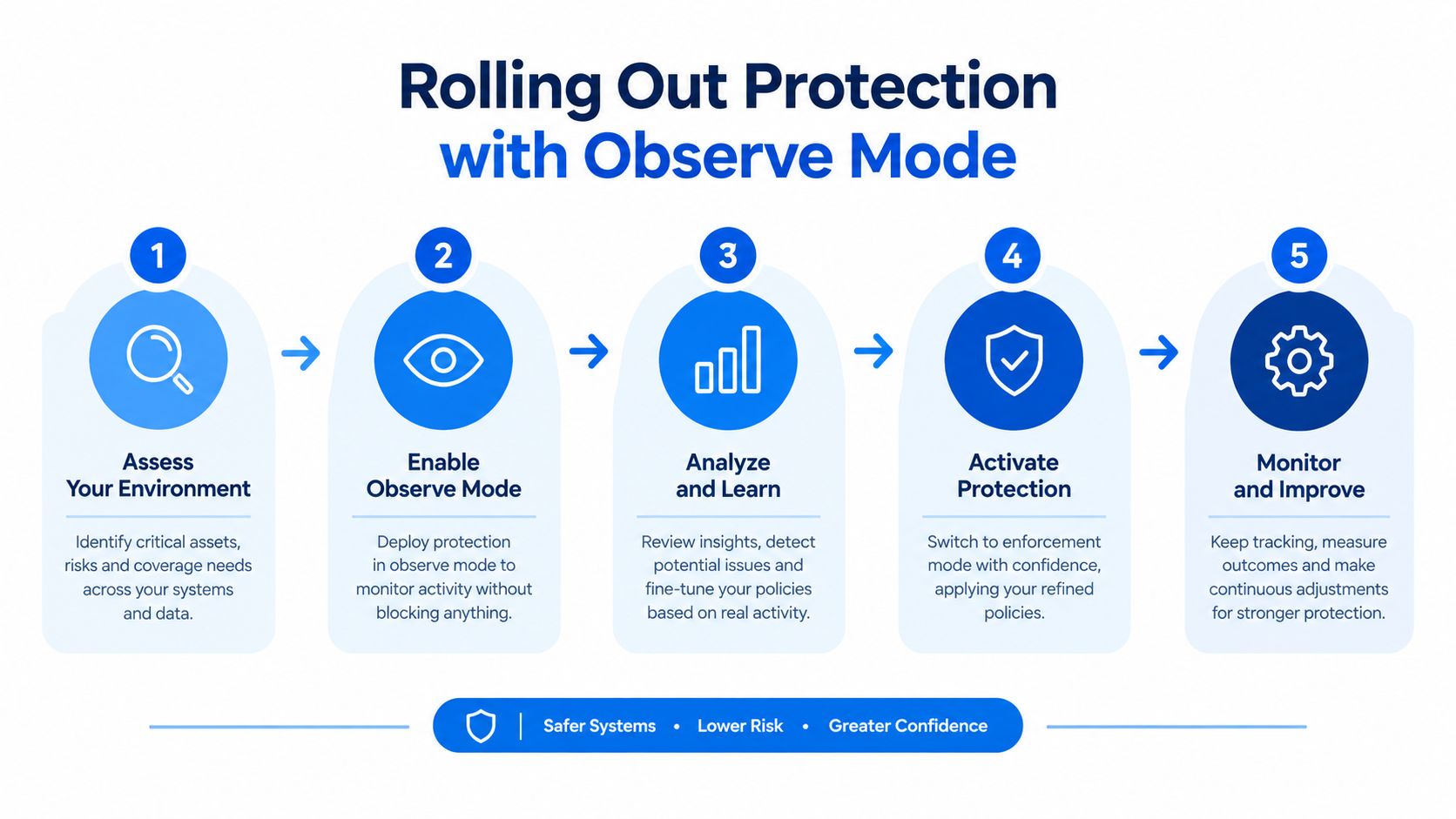
A rollout sequence that avoids surprises
Start with one route, not the whole platform. Choose a sensitive flow such as signup, login, or checkout, then map every caller that reaches it. That inventory matters because the same endpoint may serve browsers, mobile clients, internal tools, and partner integrations.
Then move in this order:
- Observe decisions. Record what would have been allowed, flagged, or blocked.
- Review false positives. Look for legitimate traffic that would have been hit.
- Tune policies. Adjust thresholds, routes, or exemptions based on actual behavior.
- Enable enforcement on one path. Roll out gradually instead of flipping everything at once.
- Expand only after stability. Add new flows once the first one is predictable.
The practical advantage is simple. You reduce the chance of breaking revenue paths while still putting real friction in front of automation.
For teams that want a deeper operational walkthrough, this observe-before-enforce guide is a good companion. It matches how low-risk rollouts should work, review first, enforce later.
Key Takeaways and Next Steps
Fraud prevention works best when it is layered. Use browser proof for signup and login, strong customer authentication at authorization, and post-purchase monitoring for refunds, support abuse, and other actions that happen after checkout. That broader view matters because attackers do not stay in one lane, and the weakest control often shifts with the customer journey.
The teams that get hurt usually treat fraud as a checkout problem. In practice, the better question is simpler: who is acting, what device or browser is involved, and does the behavior match the action? If those three signals line up, your controls can stay light. If they do not, you need friction.
A practical checklist looks like this:
- Audit the current flow. Map signup, login, checkout, refunds, and support actions separately.
- Find the weakest handoff. Look for places where a human can escalate, reverse, or approve value with too little scrutiny.
- Test in Observe mode first. Review real decisions before you enforce them.
- Tune for friction. Remove unnecessary challenge steps where risk is low.
- Watch emerging abuse. Real-time payment fraud and social engineering deserve the same attention as checkout fraud.
The main shift is operational. Payments fraud prevention is ongoing tuning, because attackers keep looking for the easiest path through the product, not the most obvious one.
If you want to protect important website actions without CAPTCHAs, MANDATE gives teams invisible browser verification, server-side proof validation, and an Observe mode for safe rollout. It fits the layered approach above for signup, login, checkout, and other high-value flows where friction and fraud both matter.