
A successful coupon campaign may be acquiring fewer new customers than your dashboard claims. The popular advice is to tighten coupon rules, block suspicious IP addresses, and revoke discounts after the order. Those controls can help, but they address the visible transaction rather than the mechanism creating the loss.
Promo abuse is often a customer-acquisition measurement failure. A customer can pass card authorization, create a valid account, and redeem a valid offer while still being a repeat beneficiary using a new identity. If your systems count that account as new, your signup rate, conversion rate, CAC, attribution, and LTV model all become less reliable.
The practical answer is to verify the browser and request state before important actions, then connect that evidence to promotion eligibility. Payment screening remains useful, but it shouldn't be your only line of defense. A good design protects legitimate throughput while making automated repetition expensive.
Table of Contents
- The Hidden Cost of Inflated Campaign Metrics
- How Automated Multi-Accounting Bypasses Standard Controls
- Implementing Server-Verified Browser Proof
- Staged Rollouts and Tuning Enforcement Rules
- Recalculating Campaign ROI After Filtering Abuse
- Monitoring Metrics and Incident Response Playbooks
The Hidden Cost of Inflated Campaign Metrics
Higher redemption counts can signal weaker measurement, not better acquisition. A promo campaign looks efficient when first orders rise, but that picture breaks fast if the same operator can appear as several "new" customers and keep qualifying for the same offer.
That is why promo abuse should be treated as both a fraud problem and a measurement problem. Visa Acceptance's ecommerce fraud analysis projects global ecommerce fraud losses rising from nearly $29 billion in 2024 to $43.6 billion in 2027 and ties a meaningful share of that pressure to automated account creation. In practice, the loss is not limited to the discount itself. The campaign also starts reporting demand that was never incremental.
A first order is an event. It is not proof of a new customer.
That distinction matters because marketing systems usually optimize on recorded events, signups, code redemptions, attributed conversions, and first purchases. If those events are inflated by repeated redeemers using fresh accounts, CAC falls on paper while actual acquisition quality stays flat. LTV models then inherit the same error because the starting cohort was misclassified at intake.
Why CAC and LTV become unreliable
Customer acquisition cost only works if the customer count is trustworthy. If one browser state, device pattern, or operator can cycle through several accounts, paid channels can look more efficient than they are. Attribution gets distorted too. Credit may go to the wrong affiliate, referral source, or campaign just because the account is new inside the application, even when the underlying participant is not.
The downstream effect is slower and more expensive than a single bad order. Teams may increase spend on a campaign that is mostly subsidizing repeat usage, or cut a campaign that actually brought in good customers but was buried inside an abused cohort. Both decisions come from the same root error: treating account creation and order completion as enough evidence of incrementality.
The same pattern shows up outside coupons. SMS pumping analysis shows how abuse can manufacture cost and fake growth signals before a legitimate customer even reaches checkout. Different channel, same operating lesson. Countable activity is not the same as verified demand.
Practical rule: Report gross redemptions separately from verified incremental customers. Never let the first number stand in for the second.
Treat the discount as a budgeted acquisition asset
Discounts come out of an acquisition budget, so they should be measured like any other spend with expected return and clear eligibility. Mastercard reported that organizations in Southeast Asia experiencing promotion abuse said losses equaled 31% of annual marketing spend. Mastercard's promotion-abuse guidance is useful here because it frames promo abuse as marketing waste, not just checkout fraud.
That framing changes system design. Transaction-only screening catches some abuse, but it arrives too late to protect measurement. The better control point is earlier, at the browser and request level, where eligibility can be tied to server-verified evidence about whether this "new customer" event looks independent or repeated.
Track each campaign with a filtered view that separates:
- Gross activity: Signups, redemptions, first orders, and attributed conversions before abuse filtering.
- Verified acquisition: Customers whose browser, account, offer, and transaction state do not indicate repeated or automated participation.
- Contribution margin: Revenue after discount cost, fulfillment, returns, payment costs, and identified abuse losses.
- Cohort quality: Repeat purchasing and retention for verified customers compared with the unfiltered redemption cohort.
Perfect certainty is not required. Consistent classification is. Once teams separate raw campaign activity from verified incremental acquisition, CAC and LTV start reflecting customer reality instead of account creation volume.
How Automated Multi-Accounting Bypasses Standard Controls
Automated multi-accounting succeeds because many promotion systems still decide eligibility one account at a time. That sounds reasonable in product logic and fails in abuse logic. If every signup, referral, and first-order discount is judged in isolation, the attacker only needs each account to look new for a few seconds. The result is not only fraud loss. It is measurement failure, because campaign dashboards count scripted redemptions as customer acquisition and push CAC and LTV in the wrong direction.
The bot pattern described earlier scales because eligibility is checked per account, not per environment. Automated browsers can register, pass verification steps, apply an offer, and place an order quickly enough that manual review becomes a cleanup function instead of a control. By the time payment screening runs, the marketing event has already been counted, the discount has already been issued, and the same operator may have queued the next batch.
The core application mistake is treating account-level eligibility as proof of customer uniqueness. A fresh email address proves very little on its own. The browser environment, device state, shipping details, payment instrument, network relationship, and event timing often show continuity even when account records do not. A valid authorization also does not prove that the offer use matches its intended terms.
Why IP blocking and payment screening have limits
IP controls still help with obvious bursts. They are weak as a primary control against distributed automation. OWASP uses credential stuffing to illustrate the same operational reality. Attackers spread requests across many addresses, so defenders need more than IP blocking and should add account-based protections such as rate limits, lockouts, and challenges OWASP's weak lockout guidance. The trade-off is familiar. Tight thresholds suppress abuse, but they also catch shared networks, mobile carrier NAT, and legitimate traffic spikes during a campaign launch.
Payment screening misses a different layer. A card can be valid, pass authorization, and still be part of promo abuse. The economic loss comes from repeated use of an incentive by related accounts, from incompatible promotions stacked together, or from accounts that look independent only because the system never joins browser, account, offer, and transaction state.
Industry reporting citing Incognia has described promo abuse as a large share of detected consumer fraud on gig platforms and noted that coupon activity and new-account creation often cluster around a small number of devices or shared attributes. Those patterns matter because they show why event relationships are more informative than any single field checked at checkout.
Signals that reveal the cluster
Look for relationships across the full lifecycle, not just a suspicious order:
- Creation velocity: Many accounts appear in a short window and converge on the same offer.
- Redemption repetition: First-order or referral benefits recur across accounts tied to one verified browser environment.
- Shared attributes: Shipping details, payment attributes, phone numbers, or email patterns recur across nominal customers.
- Offer traversal: One cluster tests several campaigns, referral credits, or free trials.
- Timing anomalies: Redemption follows registration almost immediately, with little normal browsing or purchase behavior.
A cluster is not proof of malicious intent by itself. Shared environments can represent households, offices, campuses, or carrier networks. The engineering goal is to combine signals, keep legitimate user throughput high, and apply graduated outcomes instead of blocking everyone who happens to share an address or use privacy tools.
Implementing Server-Verified Browser Proof
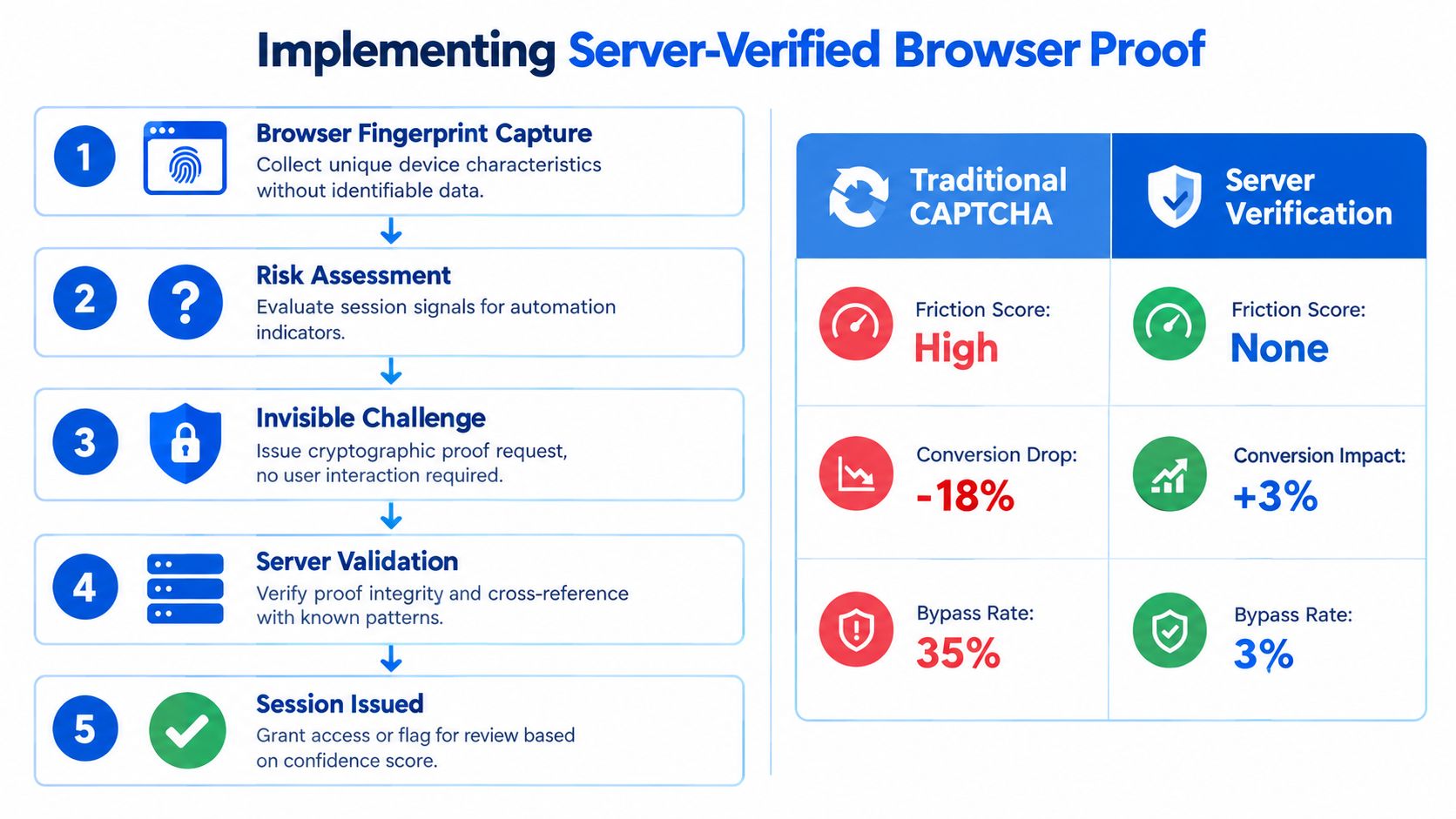
Browser proof is evidence that a request came through a browser environment that completed a fresh verification flow. Server-verified means the application, not the client alone, decides whether that evidence is valid, current, and associated with the action being attempted.
That distinction matters because a client-side token is only a value presented by the requester. If an attacker can copy it, replay it, or detach it from the original session, the token doesn't establish that the current request is trustworthy. OAuth guidance addresses the same replay problem by recommending limited token lifetimes, a defined audience, and sender-constrained access tokens that require proof tied to the original sender. The IETF OAuth bearer-token guidance provides the relevant security model.
Put verification at the action boundary
A practical flow looks like this:
- Collect browser evidence before signup, login, coupon issuance, referral credit, and checkout.
- Send proof to the server through the edge, cloud integration, middleware, or application endpoint.
- Validate freshness and integrity on the server, including replay markers and session continuity.
- Join the result to promotion state, account state, and transaction state.
- Choose an outcome such as allow, flag for review, or block when several independent policy violations align.
MANDATE can collect browser proof in the client, validate it with server-side libraries, and expose decisions through integrations at the edge, cloud platforms, or application middleware. It supports an Observe mode so teams can inspect decisions before enforcing them. In a promotion flow, the important design choice is to bind redemption eligibility to fresh verified evidence, rather than treating a new account as a new customer.
The application should store promotion state on the server. That state might include whether an offer has been issued, whether it has been redeemed, which account owns it, and whether the current browser proof is fresh for this attempt. The server should reject reused payloads and stale evidence, while preserving a clear error path for legitimate customers whose session has expired.
Avoid turning every shopper into a suspect
CAPTCHAs and puzzles can slow automation, but they also interrupt legitimate checkout traffic. OWASP notes that requiring a CAPTCHA or similar puzzle on every login attempt can help identify automated attacks, while sequentially requesting the username and password or requiring a random CSRF token can increase the requests an attacker must make without adding the same visible challenge. OWASP's credential stuffing prevention guidance makes the trade-off clear: stronger resistance can add friction.
Server-verified browser proof is not a guarantee that every attack fails. It is a way to make the decision with fresh evidence and reduce dependence on user-facing challenges. Teams evaluating the broader control set can also consult Refport's fraud prevention advice, particularly when combining identity, transaction, and operational controls.
For the browser-specific architecture, the server-state explanation for browser proof is relevant because replay resistance depends on current server knowledge. Without state, the application can't reliably tell whether proof has already been consumed or whether it belongs to the action now being processed.
Staged Rollouts and Tuning Enforcement Rules
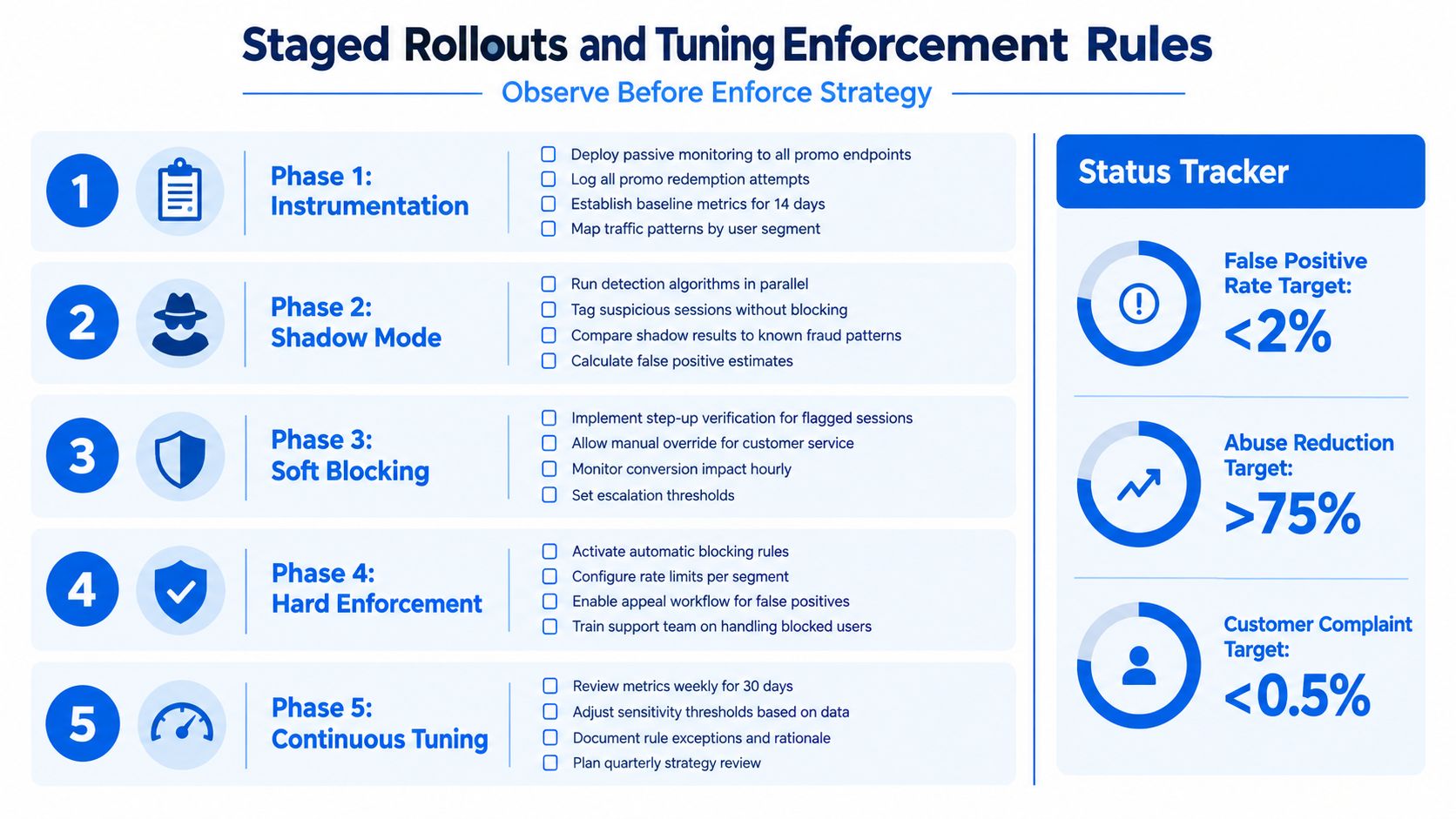
A new control on signup or checkout can create a security win and a revenue incident at the same time. The safest deployment starts with one business action, such as claiming a referral credit, and observes proposed decisions before it rejects anything.
Start with evidence, not a block rule
Instrument the selected endpoint and record the event context. Capture the account, offer, browser-proof result, session continuity, redemption state, and downstream outcome. Keep sensitive data minimized and define who can inspect the events.
Run detection in Observe mode first. A proposed block is not the same as a failed verification, and neither is the same as a business failure such as an expired offer or payment decline. Those outcomes need separate fields in logs and dashboards, or the team will misdiagnose a product bug as fraud prevention.
Use a review table like this:
| Decision | Meaning | Initial response |
|---|---|---|
| Allow | Fresh proof and no material policy conflict | Continue the normal flow |
| Flag | Suspicious relationship or velocity, but uncertainty remains | Request review or apply a step-up control |
| Block | Fresh proof failure combined with repeated abuse indicators | Reject the promotion or action |
| Error | Verification or application service failed | Fail safely, alert engineering, and preserve recovery |
The distinction protects legitimate users. A shared household browser shouldn't automatically lose an offer, while a cluster showing repeated first-order redemptions and rapid account creation deserves more scrutiny.
Move from passive review to graduated enforcement
After the baseline is understandable, introduce soft enforcement. Flag clusters for review, require a stronger account check for high-risk actions, or remove the discount while allowing a full-price order when policy permits. Avoid using a single weak signal, such as a VPN or shared network, as an automatic rejection reason.
Then define hard enforcement narrowly. A block should normally require multiple conditions, such as repeated redemption attempts tied to one verified browser, a fresh account created immediately before the attempt, and a server-side promotion-state violation. Keep an appeal or customer-support path, especially for high-value customers and time-sensitive campaigns.
The Observe-before-enforce rollout guidance is useful for structuring this transition. The operational sequence matters:
- Choose one action: Don't deploy a broad rule across every request path at once.
- Log proposed outcomes: Store allow, flag, block, and error separately.
- Compare with outcomes: Check redemption reversals, support complaints, completed orders, and contribution margin.
- Tune thresholds: Adjust for customer segments, campaign type, and known shared environments.
- Prepare rollback: Make the enforcement switch reversible without redeploying the entire application.
- Document exceptions: Record why a threshold or trusted path exists and who owns it.
OWASP's authentication guidance supports the same layered approach. It recommends multifactor authentication where possible, testing new passwords against the top 10,000 worst passwords, limiting or delaying failed attempts without creating denial-of-service conditions, and generating a new high-entropy session identifier after login. It also advises keeping session identifiers out of URLs and invalidating them after logout, idle timeouts, and absolute timeouts. OWASP's authentication failure guidance shows why promotion protection shouldn't be isolated from registration, login, session, and API security.
Recalculating Campaign ROI After Filtering Abuse
Promo abuse does more than burn discount budget. It corrupts acquisition measurement. If every redemption is counted as a new customer, CAC looks lower than it is, LTV projections inherit bad cohorts, and channel comparisons start rewarding the campaigns that are easiest to exploit.
The fix is analytical, not just defensive. Re-run campaign performance after filtering abuse and compare the reported outcome with a verified view built from server-side evidence.
Build two linked datasets. One should hold the commercial record: signups, redemptions, orders, discounts, returns, fulfillment costs, and channel attribution. The other should hold the verification record: proof status, repeated browser environments, rapid account creation patterns, reused attributes, prior offer consumption, and any server-side decision about promotion eligibility. Joining those datasets turns security events into finance inputs.
Separate activity from incrementality
A useful campaign report should show:
- Gross redemptions, including every successful code application.
- Likely repeat or automated redemptions, identified through event relationships and server-side promotion state.
- Verified incremental customers, the remaining cohort after applying documented filtering rules.
- Net contribution, calculated after discounts, fulfillment, returns, and abuse-related losses.
- Downstream quality, including repeat purchasing and retention by redemption cohort.
Many teams misread performance here. A campaign can generate a large number of first orders and still acquire few truly new customers. The reporting error is straightforward: spend is divided by an inflated customer count, so CAC appears healthy. Then the same polluted cohort is used to forecast LTV, even though some of those accounts existed only to capture an offer.
Once filtering is in place, reprocess the prior quarter through the verified view. Quantify how much apparent CAC improvement disappears after removing non-incremental redemptions. In practice, that exercise often changes budget decisions faster than any fraud-loss estimate, because it shows which channels were buying real demand and which were subsidizing repeated access to the same promotion.
Measure cohort quality after the campaign
Keep the raw dataset intact. Auditability matters, and product, finance, and support teams will need the gross view for reconciliation. Publish a filtered view beside it with clear rule definitions, versioning, and ownership so analysts can explain why a cohort changed from one reporting cycle to the next.
Then compare retention, margin, and repeat purchase behavior for verified customers against the full redemption cohort. If verified customers behave materially better, the promotion was not broadening demand. It was overcounting eligibility loopholes as acquisition.
That result should change campaign design. A referral offer may need stronger browser and account relationship checks. A free trial may need fresh proof at signup and again at conversion. A first-order discount may need server-side consumption tracking that survives email rotation and other low-cost account changes.
The goal is not prettier security metrics. It is budget decisions based on customers who are likely to stay, not accounts that were cheap to create.
Monitoring Metrics and Incident Response Playbooks
Promotion defense needs an operating rhythm. A dashboard should show whether fresh browser proof is being generated for redemption attempts, how often proof fails validation, and how many accounts are created per verified browser environment. Those signals should sit beside business outcomes, not in a security-only view.
Track the following measures:
- Proof freshness: The ratio of redemption attempts supported by newly generated, server-validated evidence.
- Browser velocity: Account creations and offer attempts associated with each verified browser environment.
- Redemption timing: The interval between signup, offer issuance, and redemption.
- Cluster density: Reuse of shipping, payment, phone, email-pattern, or network attributes across accounts.
- Decision quality: Allow, flag, block, verification error, support complaint, reversal, and completed-order outcomes.
- Commercial effect: Discount cost, contribution margin, returns, and verified customer retention.
A realistic incident starts when a holiday offer goes live and a coordinated botnet begins probing the eligibility rules. The first signal may not be a payment failure. It may be a burst of registrations followed by immediate first-order redemptions, with several accounts connected to a small set of browser environments.
Contain the pattern without stopping the campaign
First, preserve the raw events and identify the shared pattern. Don't respond by blocking an entire country, network provider, or customer segment unless the evidence supports that scope. Compare the suspicious cluster with ordinary verified traffic and confirm that the pattern includes promotion-policy violations rather than only a technical similarity.
Next, lower the threshold for flagging that specific offer and browser cluster. Require fresh proof again at redemption, apply a step-up path to the suspicious group, or remove the promotion while allowing an otherwise valid order to continue. Keep ordinary verified traffic on the normal path.
Communicate the incident in business terms. Marketing needs to know whether attributed redemptions, verified customers, and budget efficiency changed. Support needs a clear explanation for legitimate customers who encounter a verification error. Engineering needs the rule, event sample, rollback condition, and service-health signals.
For campaign planning and channel measurement, AdManage.ai's performance marketing playbook offers useful context for keeping acquisition reporting connected to operational decisions. The same discipline applies here: define the metric, identify its source, and document what changed.
A rollback should disable the new enforcement rule without deleting telemetry. After the incident, compare the proposed decisions with confirmed abuse, false positives, support complaints, and net margin. Then update the promotion policy and server-side state model before launching the next offer.
MANDATE provides invisible browser verification for signups, logins, checkouts, and other high-value actions, with server-side proof validation and Observe mode for tuning decisions before enforcement. Visit MANDATE to evaluate how fresh browser evidence can reduce automated promo abuse without putting CAPTCHAs in the normal customer path.