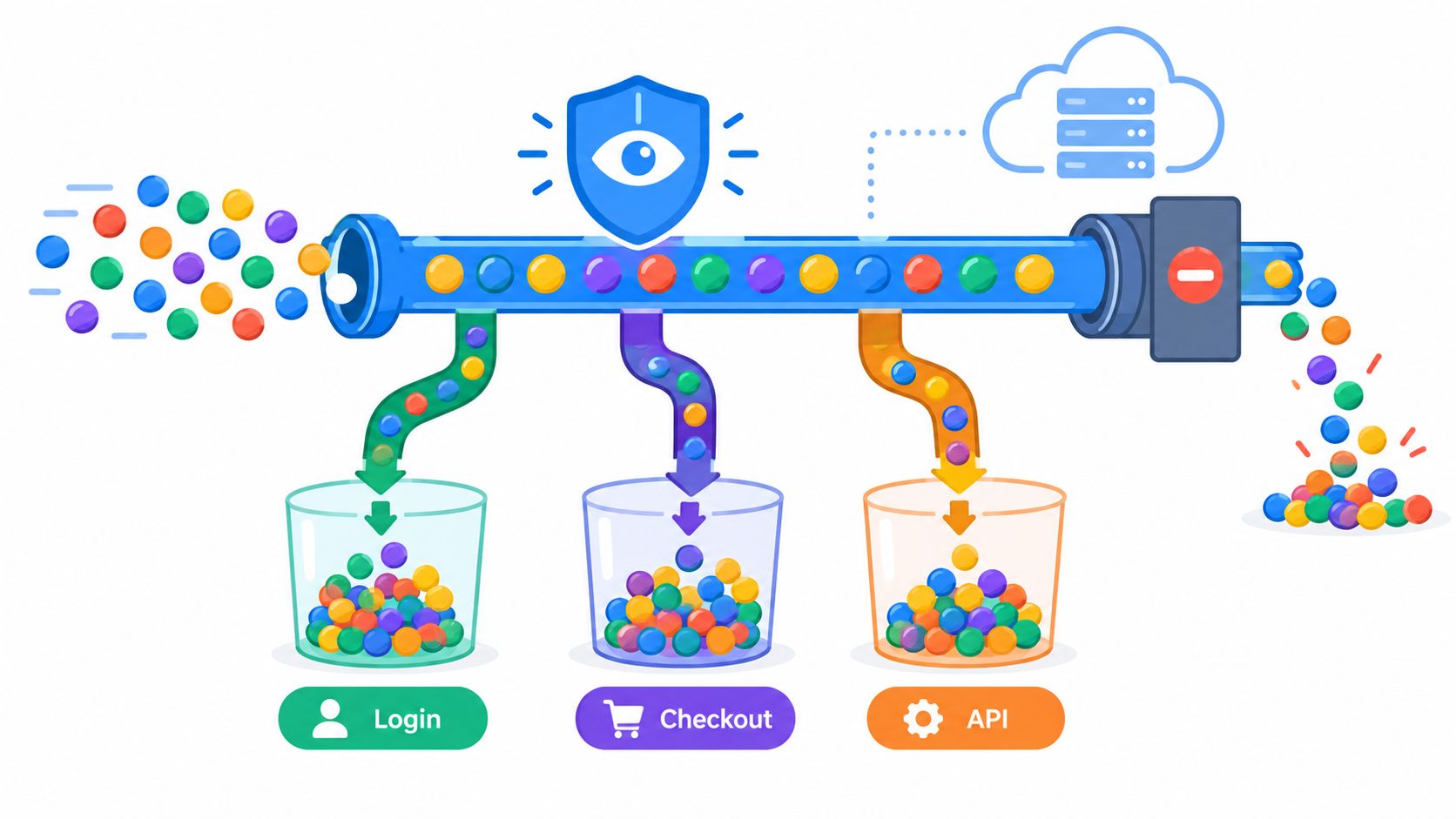
You're staring at a login spike, a checkout queue, or a signup form that's being hammered by automation, and the uncomfortable question is whether your current rate limiter is actually protecting the business or just making graphs look neat. Counting requests per IP can stop the noisiest traffic, but it won't stop distributed abuse aimed at one account, one credential, or one expensive workflow.
A useful limiter has to understand intent, identity, and cost. That means the same action shouldn't be treated the same way just because it arrives from a different address, and a password reset shouldn't spend the same budget as a cacheable read. For high-value web actions, rate limiting is a control surface for revenue, fraud, and reliability, not just a traffic throttle.
Table of Contents
- Why Simple Request Counting Fails
- Choosing the Right Algorithmic Model
- Designing Multi-Dimensional Quotas
- Distributed Enforcement and State Tradeoffs
- Augmenting Limits with Invisible Browser Proof
- Practical Integration Patterns for Web Applications
- Observability and Tuning for Business Outcomes
Why Simple Request Counting Fails
A per-IP counter looks tidy until you put it in front of real abuse. Credential-stuffing traffic can rotate through many source addresses and still stay under a basic threshold while focusing on one account, one login route, or one checkout flow. The limiter is still working, but it's defending the wrong dimension.
The better question is not “How many requests came from this IP?” It's “What action is this request trying to perform, and who pays the cost if it succeeds?” A login attempt and a product page view don't belong in the same bucket. A password reset, a ticket purchase, and a checkout submission each have different abuse economics and different user tolerance for friction.
Practical rule: tie enforcement to the action, not just the origin. If the endpoint can create account risk, chargebacks, or inventory loss, the quota should reflect that.
Business intent beats raw volume
HTTP rate limiting became a standard part of web design in 2012, when the IETF standardized 429 Too Many Requests in RFC 6585. That matters because the response isn't just a denial, it's a machine-readable signal that the client has to back off. The standard also allows a Retry-After header, which helps legitimate clients recover instead of guessing.
That standard solves communication, not policy. You still have to decide whether a request is expensive, whether it comes from a trusted session, and whether the action should be protected by per-account, per-credential, or per-endpoint rules. RFC 6585 explicitly leaves those quotas and windows to the service owner, which is exactly where the hard work lives.
A cheap read and a high-risk state change should not consume equal budget. If you treat them as equal, you either punish normal users with unnecessary friction or leave the sensitive path too open. The right limiter distinguishes between signal-rich actions and background noise.
What breaks in practice
Simple counting fails in three common ways. First, it ignores distribution, so a botnet can spread requests across IPs and avoid any single counter from tripping. Second, it ignores business value, so your limits are either too loose for sensitive routes or too strict for normal browsing. Third, it ignores recovery, so legitimate clients keep retrying at the worst possible time.
That last problem matters because blunt blocking can push the outage into retry traffic. RFC 6585's Retry-After exists for a reason, and client backoff only works when the limiter gives a clear recovery path. A limiter that only says “no” is incomplete.
Choosing the Right Algorithmic Model
The main rate-limiting families are token bucket, leaky bucket, fixed window, and sliding window. Each one answers a different operational question, so the choice should follow the endpoint's behavior, not preference or habit. For a checkout flow, burst tolerance is useful. For a payment queue, smoothing may matter more.
The token bucket is the most forgiving model when you need controlled bursts. It refills at a steady rate up to a capacity, so a user can move quickly through a form or retry a small action without getting punished for a short burst. The leaky bucket does the opposite, it shapes traffic into a steadier output and drops or delays when the queue is full.
| Algorithm | Burst Handling | Memory Footprint | Ideal Use Case |
|---|---|---|---|
| Token bucket | Allows short bursts while enforcing long-run rate | Low | Login, signup, checkout, general APIs |
| Leaky bucket | Very strict, smooths output | Low | Payment pipelines, downstream protection |
| Fixed window | Weak near boundaries, can over-allow at reset | Low | Simple internal controls |
| Sliding window | More precise near boundaries | Moderate | Security-sensitive enforcement |
Where fixed windows go wrong
Fixed windows count requests in discrete blocks of time. That simplicity is tempting, but it creates a boundary burst problem. If a client uses its full allowance right before a window reset, then repeats immediately after, the service can see nearly double the intended rate in a short span.
That's why fixed windows are usually a poor fit for public login or checkout endpoints. They're fine when simplicity matters more than precision, but they're brittle when abuse is adaptive. For sensitive routes, the limit should survive timing tricks.
Why token buckets are the common default
Token buckets are often the practical default because they match human behavior better. A user can click fast, refresh a page, or repeat a failed submission without hitting an artificial wall, while sustained abuse still burns through the bucket. The model is forgiving without being soft.
For teams that want the implementation details, this internal write-up on token bucket algorithm design is a useful companion, and it lines up well with policy-as-code patterns for teams when enforcement needs to stay auditable. Both help when rate limits are managed as configuration, not scattered conditionals.
A limiter should absorb legitimate bursts and still make abuse expensive. If the model can't do both, it's the wrong model for a sensitive path.
Picking by endpoint behavior
The algorithm should follow the route. Public APIs often fit token bucket logic because they need controlled burst tolerance. A leaky bucket can be better when a downstream system must see a predictable flow no matter how erratic the clients are.
For endpoints with tight abuse pressure, sliding-window logic usually gives better boundary accuracy than fixed windows. That doesn't make it perfect, but it does reduce the obvious timing games. If the route is tied to money, identity, or inventory, precision is usually worth the extra state.
Designing Multi-Dimensional Quotas
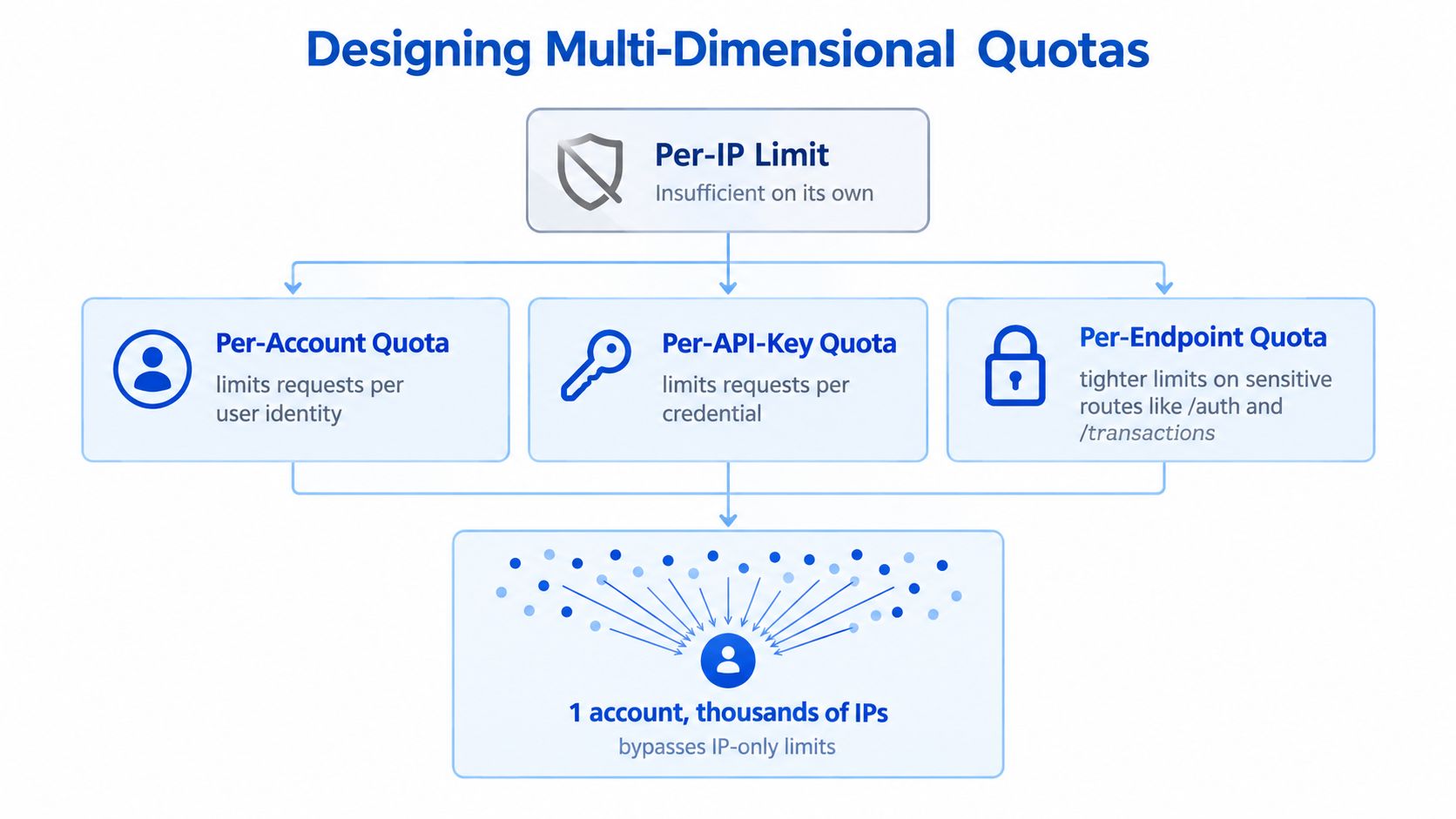
A multi-dimensional quota looks at more than one identity axis before it decides. That might mean IP address, authenticated user, session, API key, or endpoint. The point is to stop an attacker from slipping through one narrow rule by changing only one variable.
Why per-IP alone is too weak
OWASP recommends two independent controls before accepting a login request, a per-username bucket and a per-IP or per-IP-plus-ASN bucket, because one control alone can be bypassed by distributed credential-stuffing traffic. That's the right instinct. If the account is the target, the account has to be part of the policy.
The same logic applies to signup, checkout, password reset, and ticket purchase. Those actions don't have the same abuse profile, so they shouldn't share a single blunt threshold. A login limiter can be strict about guesses while still allowing normal traffic patterns, and a checkout limiter can be tuned more carefully around business volume.
How to build the policy
Start by defining the identity dimensions that matter most for the route. For authentication, that usually means account and source network. For transactional flows, it often includes session, credential, device evidence, and endpoint. For internal workflows, it may be caller identity and procedure.
Then set separate rules per action. Don't reuse the same quota for every route because the damage from abuse is not equal across the system. A request to sign in, create an account, or submit payment information should not consume the same allowance as a harmless read.
MANDATE fits into this kind of design as a way to protect important website actions from automated abuse without CAPTCHAs. Its browser-proof signal can sit alongside the quotas as another dimension rather than a replacement for them, which is useful when the goal is to lower friction without giving up control.
A simple enforcement pattern
Use the limiter to ask two questions in the same decision path. Is this source within policy, and does this action have the expected identity signal? If both are true, the request can move forward. If one fails, you can reduce burst tolerance, step up friction, or block.
The practical rule is simple: treat per-account and per-source limits as complementary, not interchangeable. One protects the target, the other protects the edge. Together they make distributed abuse much harder to hide.
Distributed Enforcement and State Tradeoffs
Once the policy is right, the next problem is where the state lives. Centralized counters are easier to reason about, but they create latency and can turn into a bottleneck. Local enforcement is faster, but it can temporarily disagree across regions or nodes.
A distributed deployment usually starts with a shared in-memory store, and Redis documents the standard pattern of a single shared store queried by services with an allow-or-deny decision designed to complete in sub-millisecond time for very large workloads. But that local or benchmarked speed is not the full story. The path includes network round trips, serialization, contention, and whatever atomicity mechanism updates the counter or token.
Atomicity matters more than cleverness
If the token or counter update is not atomic, concurrent requests can overspend the same bucket. That's not a theoretical bug, it's the kind of race condition that only shows up under pressure. The limiter has to read, decide, and mutate state as one operation.
Redis recommends using a shared in-memory store with atomic updates, bounded expiration for inactive identities, and careful key design to avoid attacker-driven cardinality growth. Those details matter because a limiter can be abused itself if every unique key creates unbounded state. Sensitive identifiers should also be hashed or pseudonymized where possible.
Fail open or fail closed
This decision has to be explicit. Fail-open keeps the service available when the limiter store is down, but it exposes high-value actions to temporary abuse. Fail-closed blocks traffic when the limiter can't evaluate state, which protects the action but can create a self-inflicted outage.
For important website actions, the trade-off should be documented before deployment. A login system might choose fail-open with local fallback. A payment path might justify stricter behavior. The wrong answer is pretending the choice doesn't exist.
Operational advice: choose the failure mode per route, not globally. Login, signup, and checkout don't deserve identical blast-radius decisions.
Centralized, local, or hybrid
A recent comparative study on distributed rate limiting highlights the key trade-off, centralized counters are accurate but can become bottlenecks or single points of failure, while local enforcement with asynchronous global reconciliation improves speed and scalability but allows temporary overages and inconsistent decisions. That's the shape of the problem in practice.
The best architecture depends on what you're protecting. Strict centralized limits fit irreversible financial operations. Bounded local budgets make more sense for latency-sensitive reads. Shadow enforcement is useful when you want to observe policy impact before putting it on the critical path.
Augmenting Limits with Invisible Browser Proof
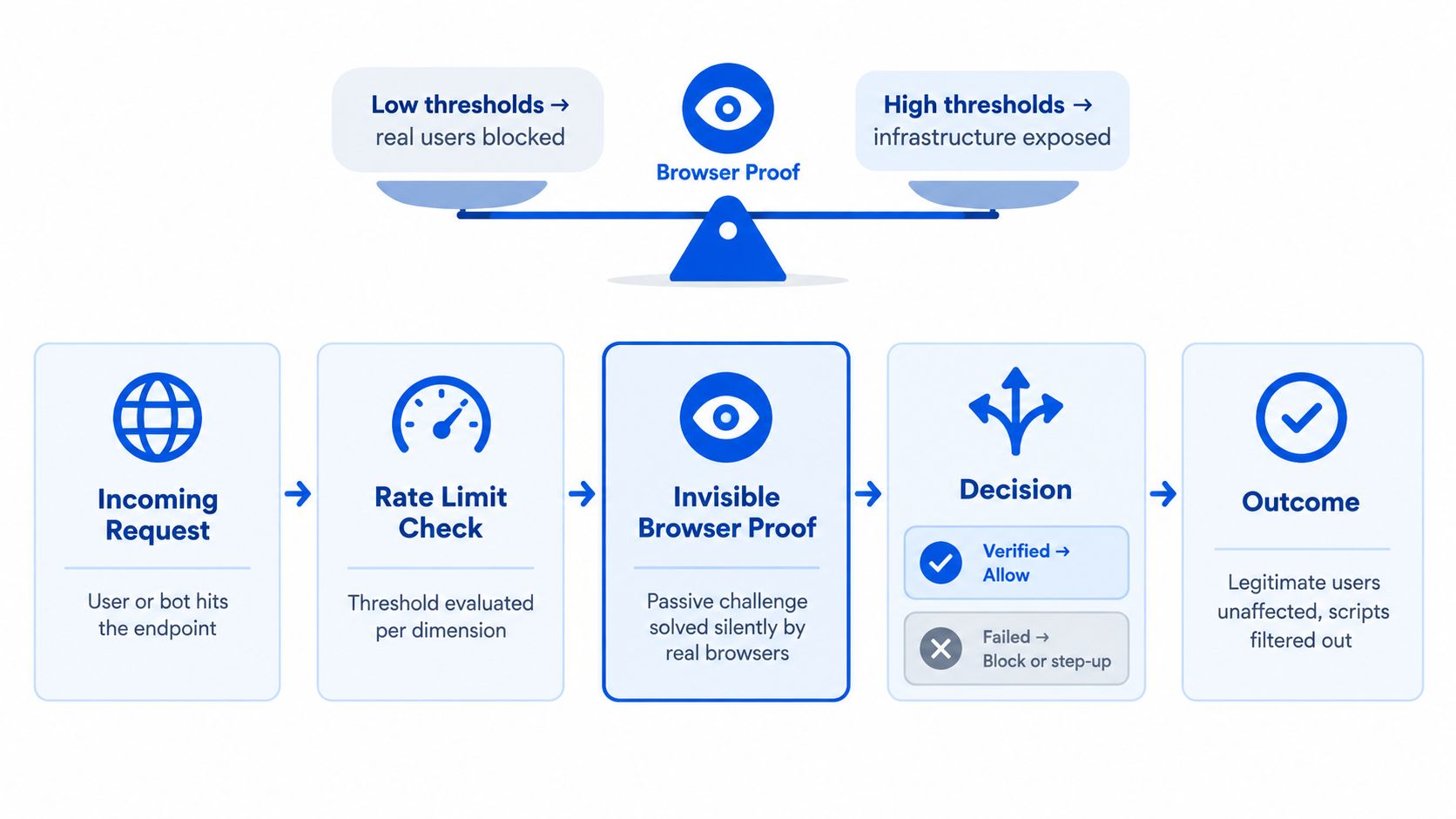
Rate limits alone force a bad compromise. Set them low and real users get blocked during a burst. Set them high and scripted abuse gets more room to move. Browser proof gives the limiter another signal, one that can separate legitimate browsers from replayed or automated requests without adding user-facing friction.
What the proof changes
When browser proof is collected on the client and validated on the server, the limiter can treat a verified browser differently from a script that only has a replayed request. That doesn't make abuse impossible, but it gives the policy a stronger signal than raw volume alone. A valid proof can justify a higher burst budget or a softer path through enforcement.
This is especially useful for signups, logins, and checkout flows where legitimate users often move quickly. The limiter can reserve strict treatment for traffic that lacks proof, looks replayed, or shows other suspicious patterns. That reduces false positives without lowering the floor for abusive automation.
Why server verification matters
Proof only helps if the server checks it. Client-side signals are too easy to fake or replay on their own, which is why the verification step has to happen before the action is accepted. MANDATE's public material describes browser proof collection, server-side validation, and enforcement decisions that can allow, flag, or block traffic based on the result.
That server-side control is also what lets teams use the proof as an input to rate limiting instead of a separate product silo. The limiter can grant more headroom to verified browsers, and reduce it for traffic that can't present fresh evidence. The policy becomes intent-aware, not just volume-aware.
What works in practice
Use proof as a multiplier, not a replacement. The quota still matters, because no proof system should be trusted blindly as the only barrier. But once proof exists, the service can spend less friction on obviously legitimate sessions and more attention on automation that can't keep up.
The link between proof and state is important here. Why browser proof needs server state is a good reference for the architecture behind that decision. It shows why proof that's checked on the server is much more useful than a client-only signal.
Practical Integration Patterns for Web Applications
The cleanest implementation is one decision path, not a pile of disconnected checks. The request arrives, the limiter evaluates the quota, the browser proof is verified if present, and the result is decided before the core handler spends business logic on it. That keeps failure modes visible and makes abuse handling consistent.
For Next.js middleware or edge-adjacent enforcement, intercept early. For backend APIs, apply the check before expensive database or payment calls. In both cases, return a standardized 429 Too Many Requests when the client has exceeded the limit, and include an explicit Retry-After value when the limiter knows when the client should try again.
What the response should tell clients
A good 429 response is not just a refusal, it's guidance. RFC 6585 allows Retry-After, and MDN's reference for HTTP 429 notes that limits can apply to a server, resource, client IP, authenticated user, or authorized application depending on the implementation. That flexibility is useful, but only if the client gets a clear recovery signal.
Client retry behavior also needs care. Immediate retries can create a thundering herd, which is why backoff should be paired with jitter when clients are allowed to try again. The goal is to avoid sending all of the retries back at once when the limit resets.
A simple decision flow
- Check identity and route. Decide whether the request is tied to an account, credential, session, or device context.
- Evaluate the quota atomically. Don't split read and write into separate steps.
- Verify browser proof when available. Treat valid proof as a signal, not a guarantee.
- Return a machine-readable outcome. Use 429 with recovery guidance when the client should back off.
- Choose fail-open or fail-closed per route. Login and checkout shouldn't share the same safety stance by default.
ThreatExploit AI's guide to securing API estates is a useful companion if your team is wiring this into a broader API security program. It pairs well with rate limits because enforcement only works when the edges, middleware, and backend policy all agree.
Observability and Tuning for Business Outcomes
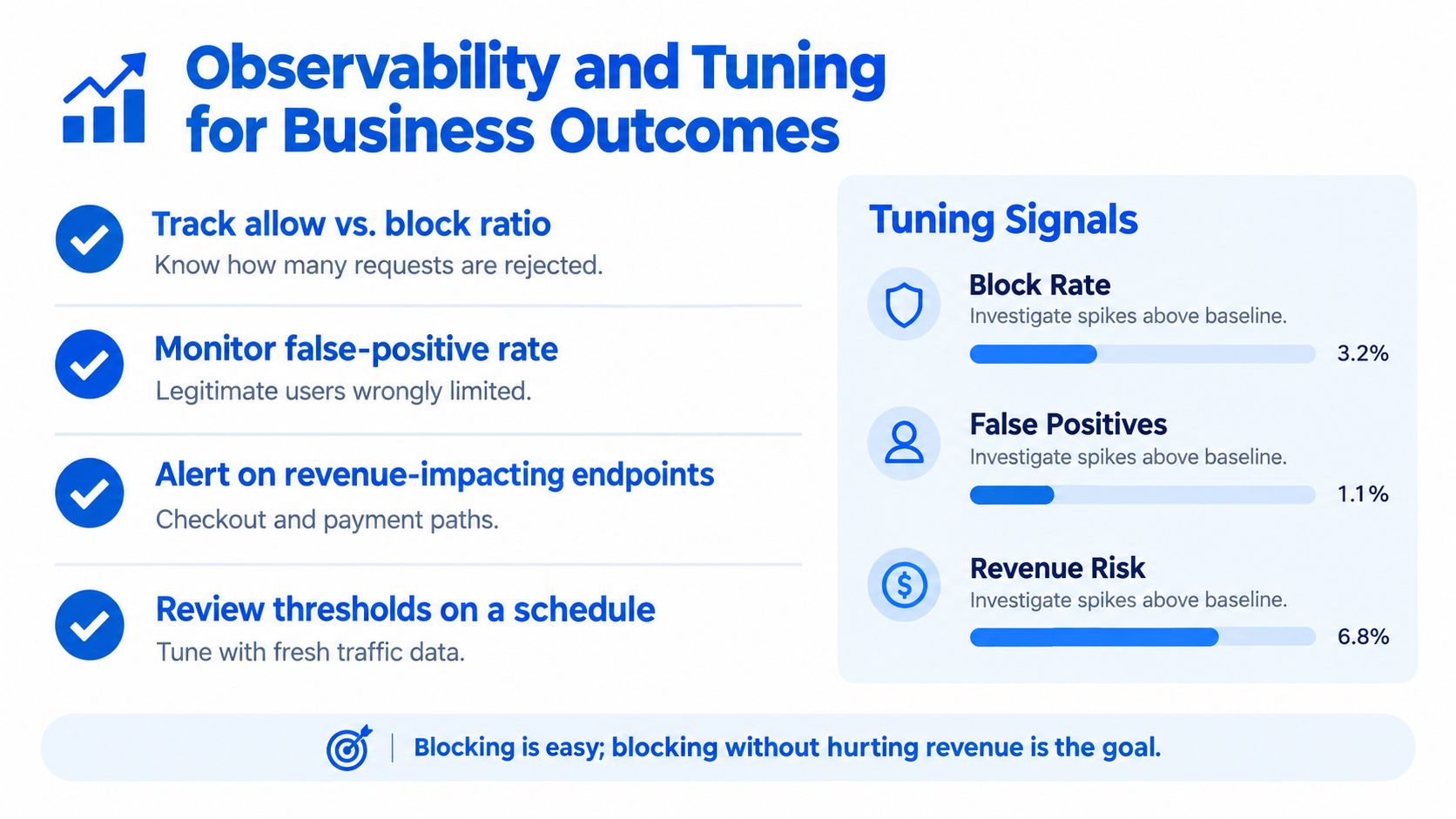
A limiter that's hard to tune becomes a liability. Blocking requests is easy. Blocking the wrong requests is expensive. The metrics that matter most are the ones tied to user completion, not just the raw volume of rejections.
Start with the basics, allow versus block ratio, false positives, and recovery success after a 429. Then add business-specific measures for checkout, payment, login completion, and other sensitive paths. If a policy increases blocks but also hurts completions, the team needs to know quickly.
Shadow decisions before enforcement
Observe mode is the safest way to test a new policy. The limiter records what it would have blocked without stopping the request, so the team can inspect the impact before putting it on the critical path. That's the right way to tune limits for a checkout or login system where mistakes cost real users.
The practical value is simple. You can see whether a new policy catches obvious abuse, whether it creates false positives, and whether the retry traffic gets worse after enforcement begins. Those are the signals that matter when business outcomes are on the line.
What to watch in production
Track whether the limiter is protecting the right route. A spike in blocked requests is not automatically good if it comes with a drop in successful sign-ins or completed orders. Look for retry amplification, because repeated retries can turn a small denial into a larger load problem.
MANDATE's observe-before-enforce workflow aligns with that operating model. It gives teams a way to review decisions first, then turn on enforcement once the behavior looks right.
Tune for cost and intent
Not every request should spend the same budget. A password reset, a ticket purchase, and a search request have different costs and different abuse value. If you tune all of them as if they were equal, you'll overprotect cheap paths and underprotect expensive ones.
That's the tuning discipline. Start with the route's business cost, validate with observe mode, and adjust using the signals that show whether users are still completing the actions that matter.
If you're designing rate limiting for signups, logins, checkouts, or ticketing flows, MANDATE can add invisible browser verification to the same enforcement path so you can reduce friction without losing control. Visit MANDATE to review how browser proof, server-side validation, and observe mode can fit alongside your limiter and help you tune protection before you turn it on.