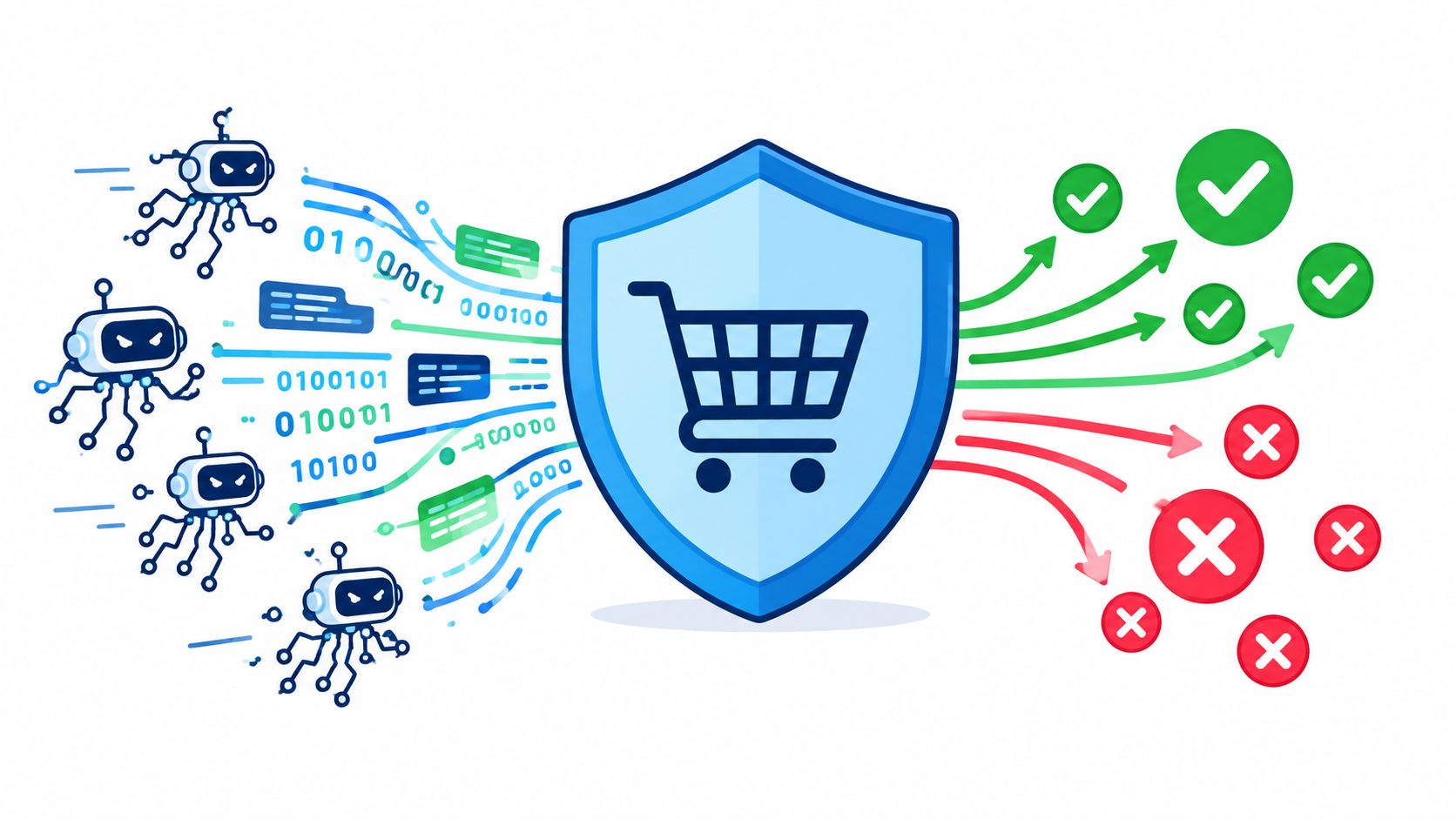
The loudest advice about scalper bots is usually wrong. Teams get told to block faster, tune more signatures, or chase every new automation trick, but the underlying problem is simpler and harder at the same time: you have to protect scarce inventory without breaking legitimate buyers who arrive through shared networks, mobile carriers, accessibility tools, and high-intent retry behavior. That means scalper bot defense is mainly a measurement and operations problem, not a detection contest.
The right question is not, “How many bot requests did we block?” It's, “How many completed orders, signups, or logins did we prevent from being abused, and what did that decision cost real users?” A false-positive budget is the practical limit you set on how much legitimate traffic you can afford to inconvenience before the defense becomes worse than the abuse. If you don't define that budget, blocked-request counts will make bad controls look successful while your real users disappear.
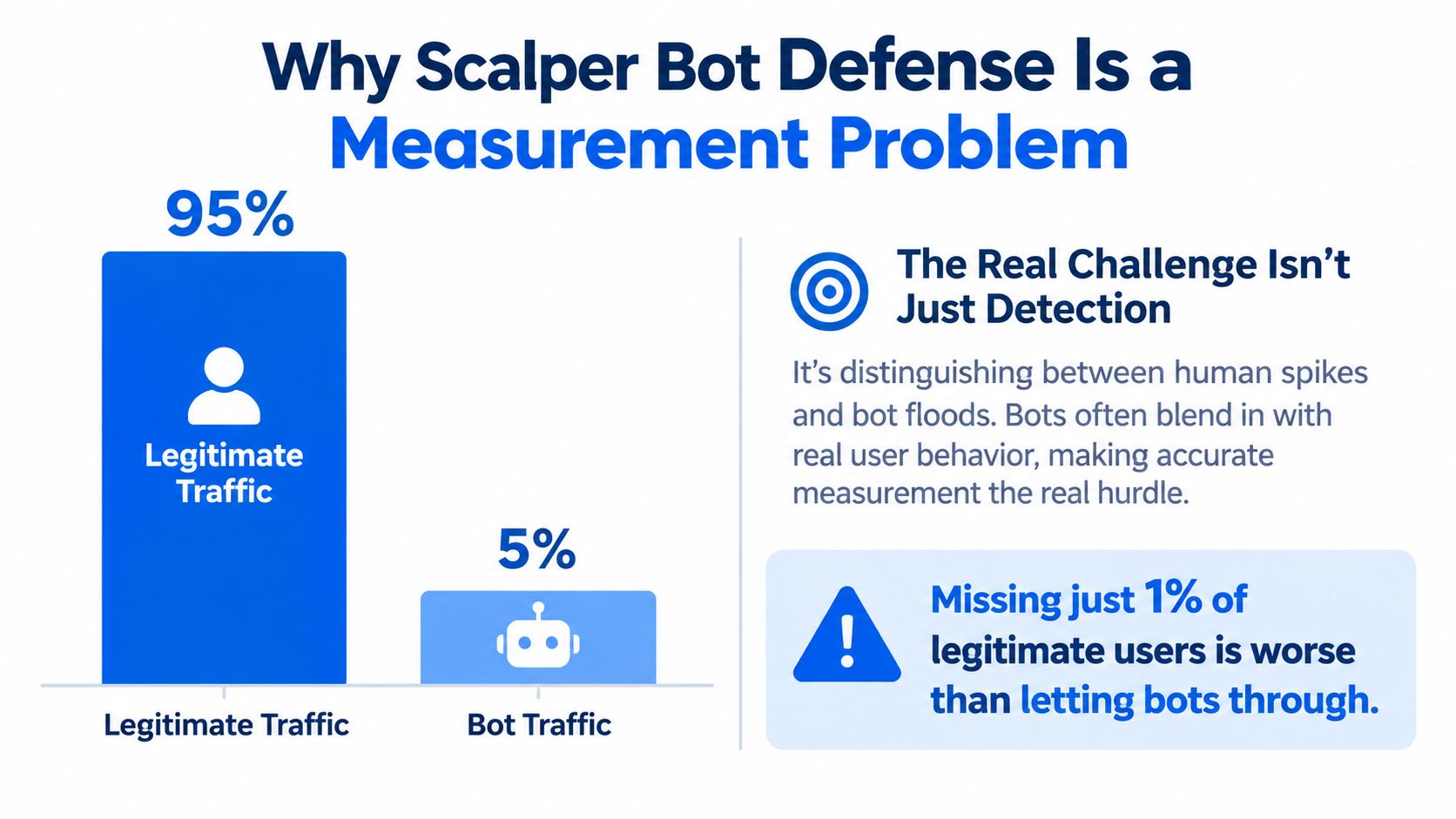
The operational mindset is straightforward. Start by separating observable cohorts, human traffic, verified-browser traffic, suspicious sessions, and failed purchase flows. Then measure decisions at each business boundary, queue entry, reservation, checkout, and payment authorization, instead of treating all blocked requests as one pile. That's the lens that makes staged enforcement workable and keeps teams from overreacting to noise.
Table of Contents
- Why Scalper Bot Defense Is a Measurement Problem
- What Scalper Bots Actually Do on a High-Demand Sale
- Detecting Scalper Bots with a Five-Stage Workflow
- Building Scalper Bot Defenses with Browser Proof and Server Validation
- Choosing the Right Control Combination for Your Stack
- Rolling Out Defenses Safely with Observe Mode and Staged Enforcement
- Monitoring, Incident Response, and Audit-Ready Evidence
Why Scalper Bot Defense Is a Measurement Problem
Most bot defenses fail because teams optimize for the wrong outcome. A system can block a lot of traffic and still let scalpers capture the inventory that matters, or it can stop abuse and inadvertently punish legitimate buyers on the same shared network. The hard part isn't spotting automation, it's telling automation apart from real customers in a way that survives scarce inventory pressure.
The New York Attorney General's report showed why scale matters, three ticket brokers used ticket-buying software to acquire more than 140,000 tickets for New York events between 2012 and 2014, and the report said the average resale markup was 49% overall, with broker averages ranging from 15% to 118%. It also described bots as software that automates ticket purchases on platforms like Ticketmaster, and Ticketmaster's estimate that bots bought 60% of the most desirable tickets for some shows shows why request volume alone isn't the whole story. The same report makes the market point clearly, automation can turn primary-market access into a resale advantage fast. New York Attorney General ticket sales report
What you should measure instead of raw block counts
The useful KPI is prevented completed orders, not blocked requests. A bot that gets rate-limited at the front door but still reaches reservation and payment has already succeeded in the only way that matters economically. A human user who gets blocked before checkout has become your incident.
Practical rule: if you can't show how a decision affected checkout, reservation, or account creation, you're measuring noise.
For engineering teams, that means instrumenting traffic in cohorts. Compare verified-browser sessions against unverified sessions, and compare proposed rejections against business outcomes like successful reservations or completed purchases. Track decisions by route and method, not just by IP or ASN, because a shared mobile carrier or office NAT can look noisy even when the users are legitimate. That framing also makes it easier to set a real false-positive budget, then enforce only when the business impact stays inside it.
The rest of the stack follows from that premise. Collect browser proof, validate it server-side, and roll out enforcement in stages so you can prove the defense improves allocation instead of just inflating your blocked-request dashboard.
What Scalper Bots Actually Do on a High-Demand Sale
A real scalper run usually starts long before checkout. The bot watches inventory, tests access paths, and floods the queue or product page the moment demand spikes. In ticketing, that can mean grabbing presale or onsale links, racing through the queue, and then moving as quickly as possible into seat selection, reservation, payment, and resale handoff. The same pattern shows up in sneaker drops, limited hardware releases, and high-demand booking flows.
The mechanics are visible in the wild. The BOTS Act reporting referenced one operation that bought 1,012 tickets to a U2 concert in New York in less than a minute, another that bought 520 tickets for a Beyoncé concert within three minutes, and a separate scalper who bought 30,000 tickets to Hamilton over roughly 20 months. Those numbers matter because they show where automation creates value, not just where it creates traffic. BOTS Act enforcement and background
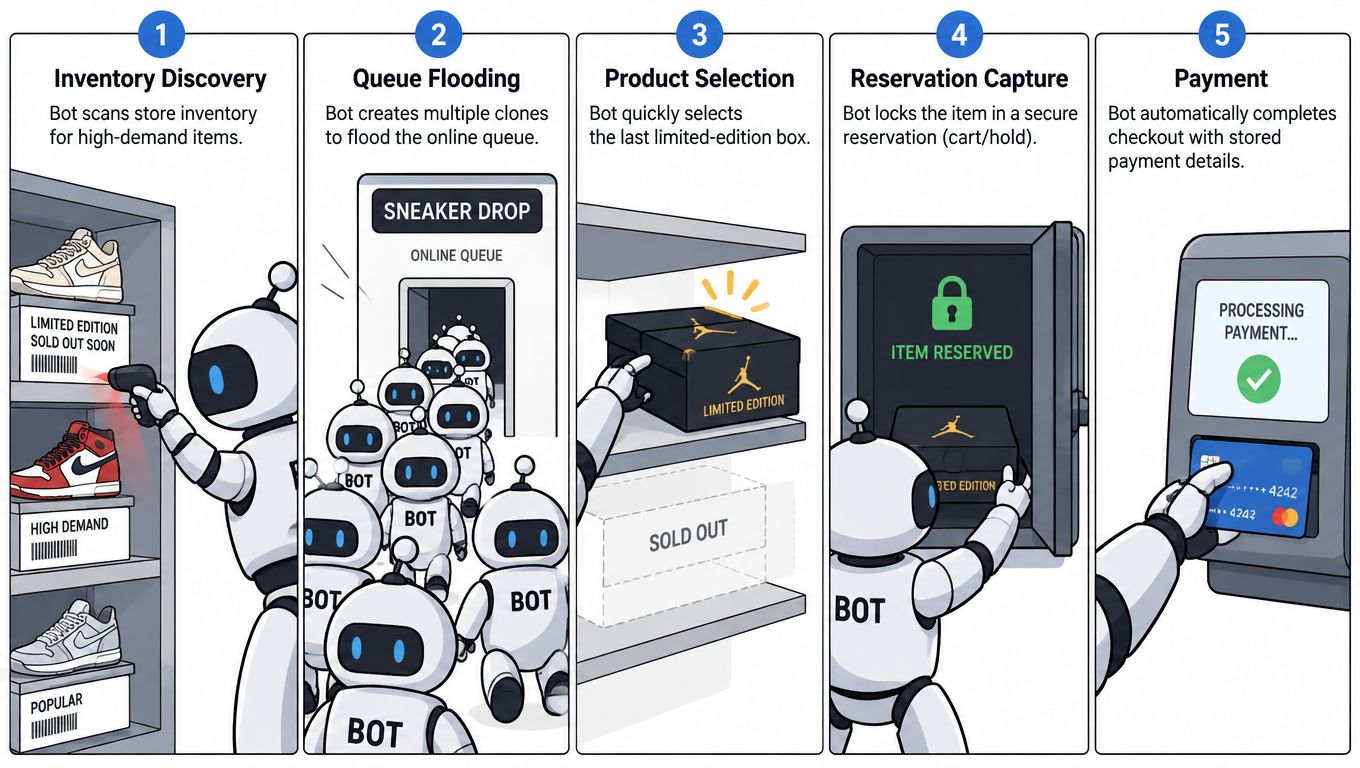
The value is created at the reservation boundary
Request volume is easy to confuse with success. A flood of requests can overload queue systems, but not every request turns into a completed order. One practical reason to study the full path is that scalpers often win by getting a small number of high-value reservations through, not by every single request succeeding.
A good reference point for the human side of ticketing flow is the online ticket booking guide from Paul Robins Promotions, which is useful because it shows what a normal buyer expects from the process before you start hardening it. Once you know that baseline, the defender's job becomes clearer: protect the moments where automation gains economic advantage, especially queue entry, reservation, and checkout.
If you protect only the front door, scalpers keep walking through the side entrance. That's why teams working on ticketing defenses should care about browser proof and server checks at the action boundary, not just the page a user sees first.
Detecting Scalper Bots with a Five-Stage Workflow
The most reliable detection work starts like an investigation, not a rules engine. First define normal human ordering behavior from representative sessions. Then profile timing, transaction duration, account activity, and connection rates. After that, classify sessions, correlate recurring IP, account, and transaction patterns, and preserve evidence so the decision can be reviewed later.
That sequence matters because scalper operators rotate addresses, accounts, and payment methods. A defense that relies on one signal, especially IP address alone, will miss distributed abuse and punish shared networks. The same NTU workflow also warns against a universal timing threshold. Human transaction times differ by sale type, device, and queue pressure, so a single cutoff usually creates false positives instead of useful signal. Five-stage scalper bot forensic workflow
Signals by layer
| Layer | Signals | Limitation if Used Alone |
|---|---|---|
| Queue entry | Request timing, session continuity, browser evidence | Bots can pass the first gate and automate later |
| Reservation | Attempts per second, seat or product selection, reservation success | Shared networks can look abnormal during high demand |
| Checkout | Payment timing, transaction completion, retry patterns | Not every fast session is malicious |
| Account behavior | Account activity, creation patterns, reuse across events | One identity can be split across many accounts |
| Network correlation | Recurring IP, connection rates, request bursts | IP rotation and NAT can hide coordinated abuse |
A useful way to think about the workflow is to score attempts per identity, browser, network, and event, not just raw request count. That's especially important because legitimate buyers do retry when inventory is scarce. The point isn't to block all velocity, it's to separate human urgency from automated coordination.
A bot that looks fast isn't automatically a successful bot. Success has to be measured at the reservation and order layers, not at the request layer.
For teams that already run fraud or abuse tooling, the backlink-worthy takeaway is simple. If your fraud stack is tuned only for login abuse, borrow the same layered thinking for ticketing and checkout abuse, because the path to abuse is the same even when the business object changes. The Million Dollar Sellers guide to fraud prevention is a useful reminder that layered signals beat single-signal confidence when accounts, devices, and transactions all matter.
Building Scalper Bot Defenses with Browser Proof and Server Validation
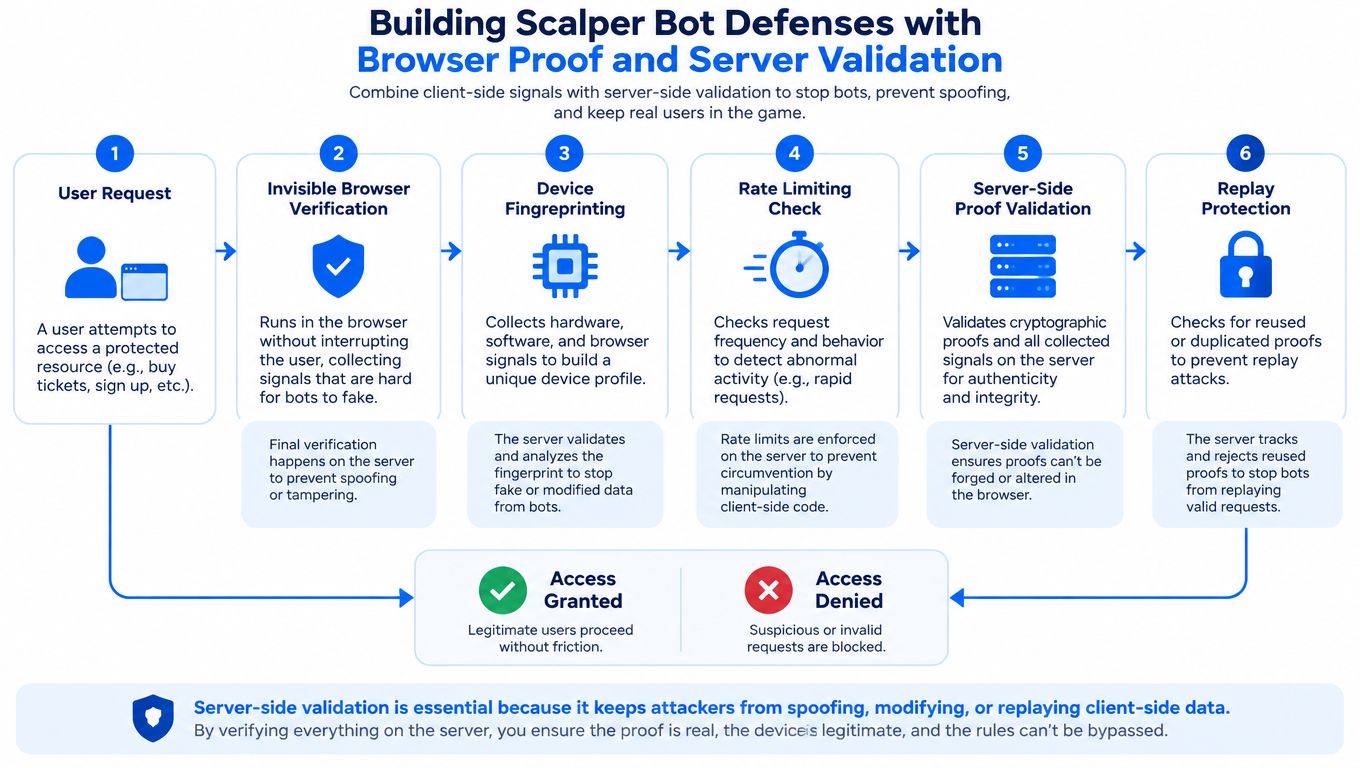
The strongest pattern is browser proof collected invisibly, then verified on the server. The browser can supply evidence that the request came from a real browser environment rather than a replayed or scripted client, but the server has to own the decision. If proof is only trusted client-side, the attacker gets too much room to fake the result.
Tie the proof to session continuity, freshness, and replay resistance, then check those signals against the request that matters. MANDATE's model, invisible browser verification with server-side proof checking, follows that pattern and protects high-value actions without CAPTCHAs. That keeps friction at the edge of risk, not in the middle of every legitimate purchase.
Where each control belongs
Edge integrations work well when early filtering has to happen at a CDN or serverless boundary. Middleware fits better when the request needs route context, account state, or purchase rules. SDK integration helps when the application must collect proof close to the user interaction itself. Client or server verification decisions become easier once the browser is treated as an evidence source and the server as the enforcement point.
What each layer actually stops
- Invisible browser verification helps separate browser-origin traffic from scripted clients before the sale path opens.
- Fingerprinting can group repeat actors, but it brings privacy and stability trade-offs, especially when browsers or devices change often.
- Rate limiting caps raw volume, but by itself it misses distributed attacks and can hurt shared networks.
- Server-side proof validation ties the decision to state the attacker cannot rewrite in the browser.
- Replay protection blocks intercepted or reused proofs from being accepted twice.
Practical rule: if the attacker can alter the proof without talking to your server again, the control is too trusting.
MANDATE's Observe mode also matters, because you can review decisions before enforcement and lower rollout risk. That is worth more than a flashy challenge page. The best defense is the one legitimate buyers never notice, and the one your team can audit later without guessing why a request was allowed or denied.
Choosing the Right Control Combination for Your Stack
No single control covers the full abuse path. Rate limiting is good at volume control, invisible verification is good at separating browser and non-browser traffic, fingerprinting helps cluster repeat behavior, server-side proof validation raises the cost of forgery, and replay protection closes off reused evidence. The trick is choosing which layer protects which action.
For high-volume sales, put lightweight browser proof and conservative rate checks before queue entry. For secure transactions, move stronger server-side validation and replay checks to reservation and checkout. For shared-network environments, be careful with blunt rate limits, because they can punish offices, universities, and mobile carriers that naturally concentrate traffic. The right mix is usually boring, which is a good sign. Boring means the controls line up with the business risk instead of with a vendor demo.
Control trade-offs in plain terms
| Control | Good for | Where it fails |
|---|---|---|
| Rate limiting | Volume spikes and basic automation | Distributed bots, shared networks, retry-heavy users |
| Invisible browser verification | Early distinction between browsers and scripts | Needs server-side enforcement to matter |
| Fingerprinting | Correlating repeated actors | Stability and privacy trade-offs |
| Server-side proof validation | Trustworthy decisioning | Adds implementation effort and sometimes latency |
| Replay protection | Preventing reused request artifacts | Doesn't stop fresh automation by itself |
The BOTS Act reporting and FTC cases make one thing clear, attackers don't need a single perfect bypass path. They mix accounts, conceal infrastructure, and spread behavior across steps. That's why queue protection, reservation checks, and checkout controls need different thresholds. The same policy shouldn't govern every route.
A staged sequence usually works best. First gate the queue with browser proof and mild throttling. Then require server validation before reservation. Finally, apply stronger replay and account-linking checks at checkout where the economic value is highest. That sequencing preserves accessibility better than trying to solve every problem at the front door.
Rolling Out Defenses Safely with Observe Mode and Staged Enforcement
Deployment is where bot defenses usually go wrong. Teams discover a suspicious pattern, turn on enforcement, and then spend the next on-sale dealing with support tickets from real buyers. A safer pattern is to start in Observe mode, record the decisions you would have made, and compare them to control traffic before any block is applied.
MANDATE's Observe before enforce approach fits this rollout style. You review proposed actions, then move from flag-only to soft block, and only later to hard block on the routes that matter most. That lets you define a real false-positive budget by route, method, and business action.
A practical rollout shape
- Observe only on queue entry and reservation.
- Flag only for suspicious browser proof mismatches.
- Soft block at reservation for repeated high-risk sessions.
- Hard block only at checkout or purchase completion when confidence is high.
- Rollback by route, not globally, if a legitimate cohort starts to fail.
The key metrics are not just block rates. Track abandonment, latency, false positives, and completed high-value actions for verified-browser cohorts and control traffic. If a rule looks great in aggregate but hurts mobile buyers or accessibility tooling, it's not ready for production. The point of staged enforcement is to prove the rule works where it counts.
A ticket onsale makes this concrete. You can observe queue entry for one event, flag suspicious reservation behavior during the sale, and only hard block the actors that repeat across sessions, accounts, or payment attempts. If the sale becomes noisier than expected, you can roll back the reservation rule without turning off every other protection.
Monitoring, Incident Response, and Audit-Ready Evidence
Once the controls are live, logging becomes part of the defense. You need to separate proposed rejections, verification errors, applied interventions, and failed business operations. If you collapse them into one blocked count, you lose both security signal and customer impact. That makes tuning harder, and it makes audit questions harder too.
The evidence trail should preserve account networks, bypassed controls, transaction timing, and resale relationships where they exist. The FTC's BOTS Act materials and enforcement posture make that especially important, because the issue is not just whether a request looked automated, but whether someone bypassed posted limits or used coordinated identities to do it. FTC BOTS Act refresher
Incident response during a bot surge
- Detect quickly: watch for queue anomalies, reservation spikes, and odd completion patterns.
- Triage by action: separate login, signup, queue, reservation, and checkout failures.
- Preserve evidence: keep the request path, browser proof status, account links, and timing data.
- Communicate plainly: tell support and operations what route is failing and who is impacted.
- Tune after the event: adjust thresholds only after reviewing the legitimate-user cohort.
A good ops team treats the first surge as a learning event, not a chance to flip every switch to maximum aggression. That's why the incident response basics for operations teams are relevant here, even though the business problem is abuse rather than outage. The discipline is the same, preserve evidence, isolate scope, and avoid decisions you can't explain later.
The quarter-ready checklist is simple. Log decision context, keep browser proof and server outcomes together, review by route, and document why a rule is proportional to the risk. That gives engineering, security, and legal teams one record they can actually use.
If you're protecting signups, logins, ticketing, or checkout flows, MANDATE gives you invisible browser verification with server-side proof checking and Observe mode so you can measure impact before you enforce. If you want a defense that's built around real operations, not just a bot score, visit MANDATE and see how it fits your stack.