
Your growth campaign works. Signups arrive, activation looks healthy, and the team moves on to the next launch. A few weeks later, chargebacks rise, promotional credits disappear, and investigators find accounts that never behaved like genuine customers. The signup form accepted valid-looking data, but it never established that a legitimate browser and user completed the action.
That distinction is the practical center of new account fraud defense. You're not only checking whether identity fields look plausible. You're deciding whether to create an account, issue credit, authorize a login, process a checkout, or fund a wallet based on fresh evidence from the request itself.
Table of Contents
- What New Account Fraud Actually Is and Why It Matters
- The Four Attack Mechanisms Behind New Account Fraud
- Detection Signals That Catch Automated Abuse
- A Layered Mitigation Strategy That Stacks at the Right Places
- Verification Trade-Offs Between Friction, Coverage, and Conversion
- A Rollout Playbook From Observe Mode to Enforcement
- Testing, Monitoring, and the KPIs That Prove It Works
- Treating Verification as a Product Decision, Not Just a Security One
What New Account Fraud Actually Is and Why It Matters
New account fraud is the deliberate creation of an account or service relationship for abuse. Criminals may use stolen personal information, fabricated details, synthetic identities, automated signups, or compromised credentials. The account can support credit abuse, promotional fraud, money movement, resale, phishing, or later account takeover.
The high-value action isn't always signup. It might be a login, checkout, password reset, seller registration, account funding request, or loan application. Each action changes the attacker's potential payoff, so each needs a policy appropriate to its risk.
Why account opening attracts attackers
Account creation gives criminals a clean starting point. There's no established customer history to compare against, no normal device pattern, and often no previous transaction behavior. A basic email confirmation may prove access to an inbox, but it doesn't prove that the person behind the browser is trustworthy or that the request came from a legitimate session.
That's why post-registration monitoring often arrives too late. By the time a fraud rule sees unusual withdrawals or chargebacks, the business may have already issued credit, delivered goods, granted trial access, or paid acquisition costs.
The exposure extends beyond banks. Fintech companies, retailers, marketplaces, telecommunications providers, SaaS platforms, ticketing services, gaming businesses, and social platforms all create value at account opening.
Practical rule: Treat account creation as a protected business action, not as a harmless form submission.
The scale is material. New-account fraud created an estimated $7 billion in losses in 2025, a 13% year-over-year increase, with roughly 5.4 million U.S. victims at an average loss near $1,296 per victim, according to recent identity theft statistics citing Javelin Strategy & Research.
A workable defense combines edge controls, browser evidence, server-side freshness checks, device and behavior analysis, identity review, and measured enforcement. The important design choice is to bind acceptance to evidence that is fresh, verified, and tied to the current request, rather than trusting static fields or copied client claims.
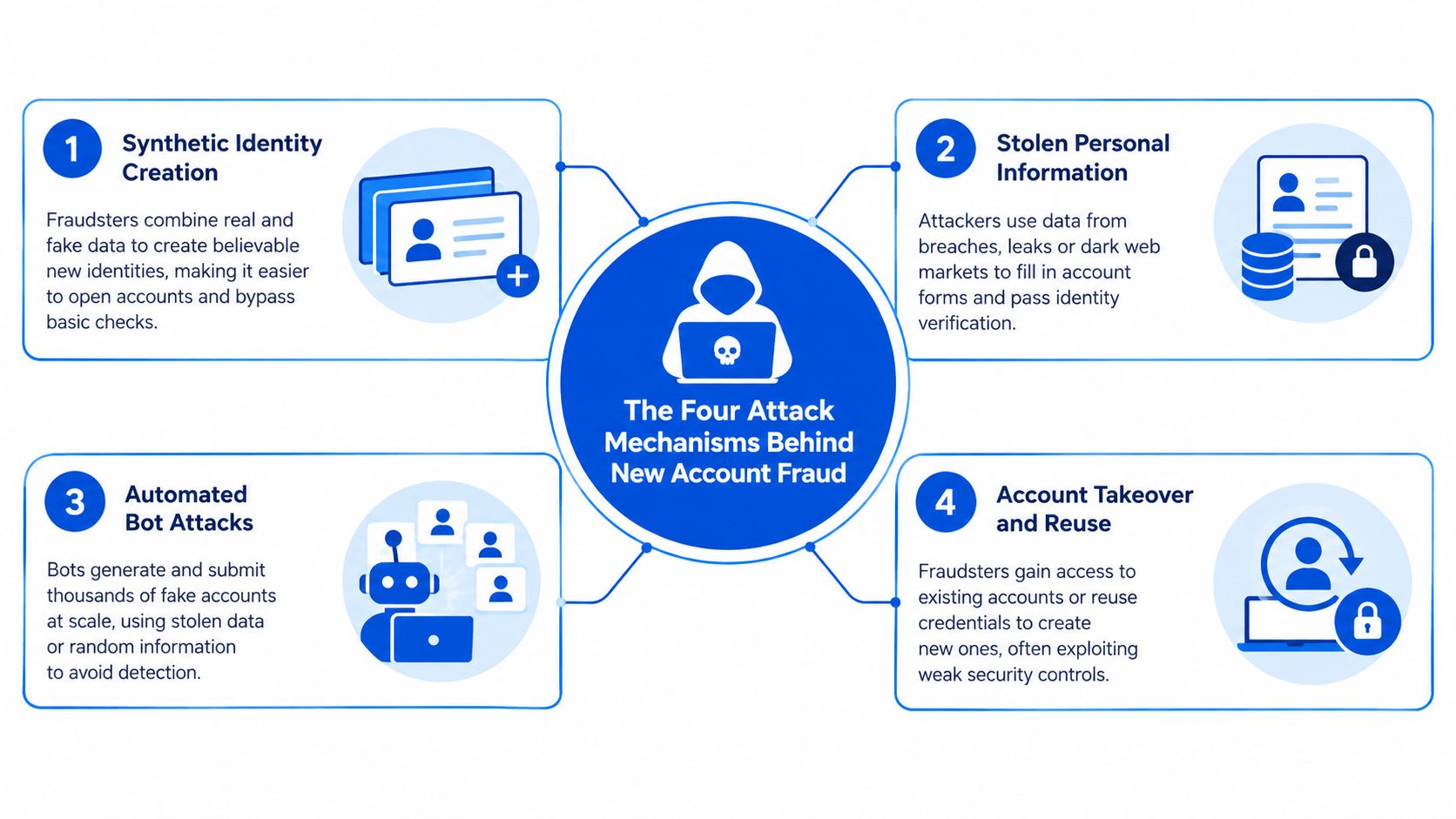
The Four Attack Mechanisms Behind New Account Fraud
Attackers don't need one universal technique. They select the cheapest mechanism that fits the target's controls, then adapt when a control starts blocking them.
1. Automated signups
A script or headless browser submits the registration form repeatedly. Requests may reuse the same automation framework while rotating email addresses, network routes, or input values. The business effect is usually bulk account creation, promotion abuse, inventory manipulation, or a large investigation queue.
A simple IP threshold can reduce obvious bursts, but it won't catch distributed automation that spreads requests across many networks. Browser and session evidence helps determine whether the client can perform expected browser-side behavior.
2. Synthetic identities
A synthetic identity combines genuine and invented information, such as a real Social Security Number paired with a fabricated name, address, and email. The fields can pass basic consistency checks while no single real person recognizes the resulting profile.
The downstream loss can appear later as unpaid credit, a bust-out, or a fraudulent account that ages before abuse. A Federal Reserve-sponsored 2020 white paper estimated that synthetic identity fraud cost U.S. lenders roughly $6 billion and represented about 20% of credit losses in 2016, with some institutions reporting approved synthetic accounts reaching 2.7% of new accounts, as summarized in the Federal Reserve-sponsored synthetic identity fraud white paper.
3. Credential abuse at the signup edge
An attacker can test a breached username and password during registration or an account-claim flow. The request may look valid because the credentials are valid. The key question is whether the request comes from an authorized user or an automated campaign trying to claim an existing identity.
This mechanism needs authentication controls, breach-password checks, rate limits, and browser or device signals. Identity fields alone won't distinguish a real customer from an operator using stolen credentials.
4. Token and session replay
An attacker captures a previously accepted payload, token, or session artifact and submits it again. The replayed request may contain every expected field, but it lacks fresh evidence from the originating browser session.
Replay defense therefore needs server-side freshness, session binding, expiry, and one-time acceptance where appropriate. A copied payload must not become a reusable authorization object. For additional context on scripted signup behavior, see this practical guide to bot attacks.
Detection Signals That Catch Automated Abuse
A signup request can pass identity checks and still be automated. The useful question is whether the server has fresh, verified evidence from the browser, plus enough context to decide before provisioning account value. Evaluate signup signals before account creation, login signals before authentication completes, and checkout signals before payment or fulfillment.
TransUnion reported a 6.9% suspected digital-fraud rate for account creation globally in 2024, above its 5.4% overall digital-fraud rate. In the United States, synthetic identities represented 0.32% of attempted account openings, with roughly $3.3 billion in resulting exposure, according to TransUnion's 2025 State of Omnichannel Fraud report. Even a small attack rate can produce material losses when approved accounts receive valuable access.
Four signal families
Browser proof tests whether a real browser generated the request and whether its evidence is fresh. It can catch basic scripts, unsuitable headless environments, and clients that fail expected browser-side behavior. It does not establish that the person operating the session is trustworthy.
Device and network signals include IP reputation, autonomous system risk, geolocation consistency, device continuity, and network changes. They expose infrastructure reuse and suspicious distribution patterns. Privacy tools, shared networks, travel, and mobile connectivity can produce similar indicators, so these signals need context rather than automatic rejection.
Behavioral signals cover navigation sequence, form timing, keystroke dynamics, and interaction patterns. They can separate scripted workflows from ordinary sessions, although advanced automation can imitate human pacing. Treat behavior as supporting evidence, not proof of identity.
Identity and request signals include velocity, phone and email reputation, breach-password checks, and consistency across submitted data. They catch reusable identities and abnormal request patterns, while legitimate users may share contact details, devices, or networks.
Fraud operations also need shared definitions for decisions, queues, evidence, and escalation. BUNCH's glossary of terms for fraud detection operations provides a reference for that vocabulary.
| Signal Family | What It Catches | Limitation |
|---|---|---|
| Browser proof | Scripted or unsuitable clients and reused browser evidence | Does not prove the person is trustworthy |
| Device and network | Infrastructure reuse, risky networks, and inconsistent locations | Shared and privacy-focused environments create false positives |
| Behavior | Automated navigation and form submission patterns | Advanced operators can imitate human timing |
| Identity and request | Velocity, breached credentials, disposable contact patterns, and data mismatches | Valid identity data can still support fraud |
A sound policy stacks these families so no single signal carries the decision. Validate browser proof on the server, bind it to the current session and action, and measure false positives during observe-only operation before enforcement.
A Layered Mitigation Strategy That Stacks at the Right Places
A deployable design places cheap controls early and expensive decisions later. The edge should absorb obvious volume, the application should verify request integrity, and account-level review should handle ambiguity.
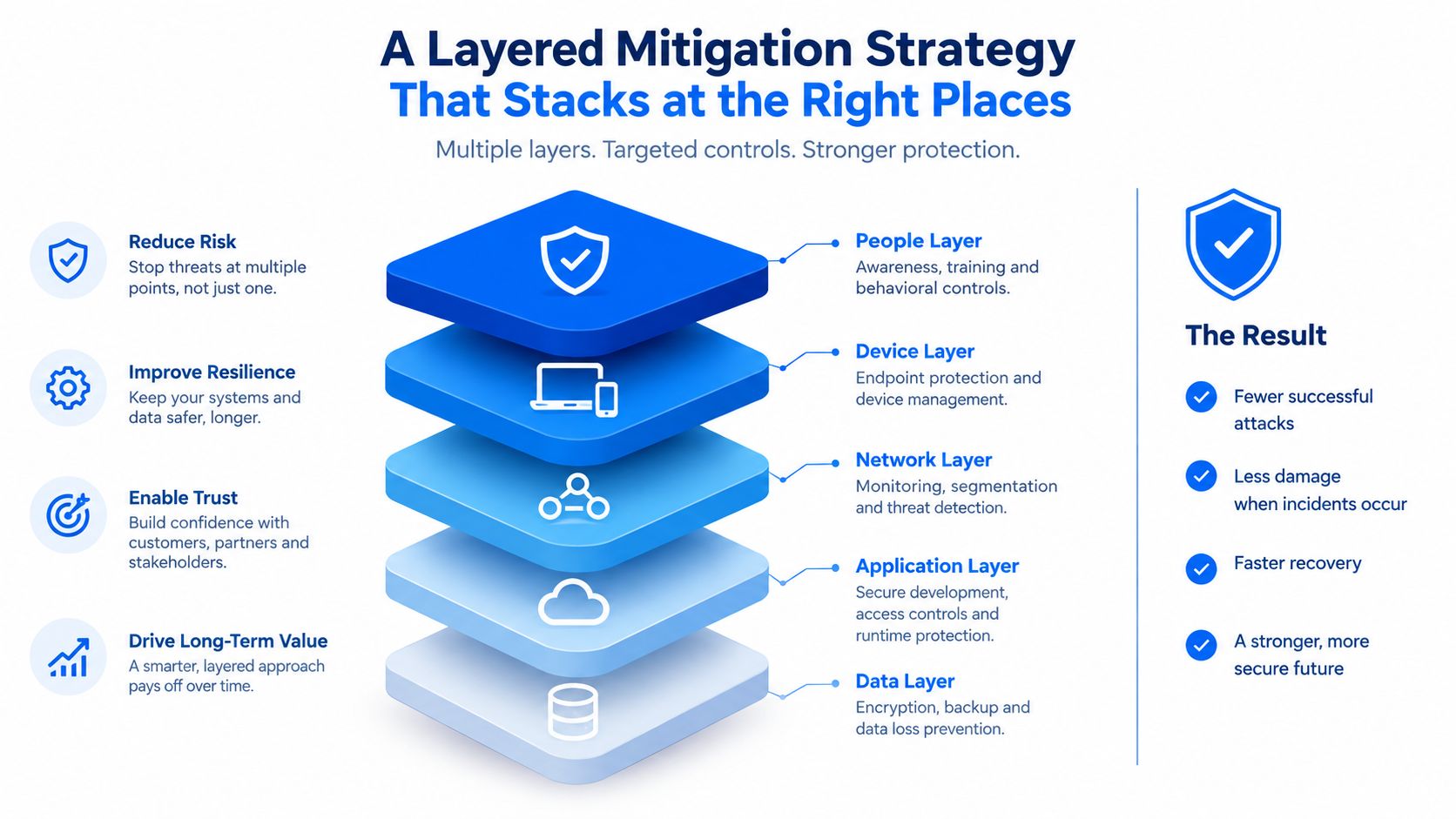
Five layers with separate jobs
Layer one, edge throttling. Apply rate limits by IP, identity, endpoint, and relevant business key. This cuts obvious bulk traffic before it consumes application resources. It shouldn't be the only control because attackers can distribute requests.
Layer two, invisible browser verification. Collect browser proof on protected requests without putting a CAPTCHA on the normal path. This adds evidence about the client environment while preserving a low-friction experience for ordinary users.
Layer three, server-side validation. Verify the proof on the server, check freshness, bind it to the current session and action, and reject reused or mismatched payloads. Client-side claims are not trustworthy authorization decisions.
Layer four, risk scoring. Combine device continuity, velocity, browser evidence, navigation behavior, and identity signals. The score should map to an explicit policy, such as allow, flag, step up, or block.
Layer five, account-level review. Borderline cases should enter a queue rather than being approved or rejected without review. Reviewers need the evidence that produced the decision, not just a final risk label.
This architecture also helps teams understand how attackers operate when they attempt running social accounts at scale. The relevant defensive question is not whether one request looks plausible. It's whether repeated requests share enough session, device, behavior, or identity characteristics to reveal coordinated activity.
OWASP recommends combining controls for credential stuffing rather than relying on one IP threshold. Its guidance includes multi-factor authentication, progressive delays on failed attempts, alerting on suspected stuffing, and rotating high-entropy server-side session identifiers after successful login, as described in OWASP's authentication failure guidance.
Verification Trade-Offs Between Friction, Coverage, and Conversion
Every verification method catches some abuse and creates some cost. The mistake is treating visible friction as proof of stronger security.
Email confirmation is inexpensive and familiar. It confirms mailbox access, but disposable inboxes and compromised mailboxes weaken its value. It should support a decision, not finish one.
SMS one-time passcodes add possession evidence, but delivery failures, phone changes, accessibility needs, and abuse of phone-number infrastructure can interrupt legitimate onboarding. Document verification provides stronger identity evidence for selected financial or regulated flows, but it adds collection, review, privacy, and operational costs. It also doesn't address every automated request before the document step.
Knowledge-based authentication can help in narrow contexts, yet answers may be exposed or unavailable for thin-file users. Browser verification operates earlier and can identify unsuitable or scripted clients without making every user solve a puzzle.
A 2025 U.S. survey found that 59% of consumers reported frustration opening financial accounts online, while 69% expected signup to take less than 10 minutes. At the same time, 75% said they wouldn't abandon an application because of stricter identity verification, according to Alloy's 2025 scams report. That combination points to proportional friction, not friction-free approval or maximum challenge by default.
Match the control to the action
- Low-value registration: Use browser, network, velocity, and contact signals. Flag suspicious users instead of demanding documents from everyone.
- Account funding or credit access: Add stronger identity, payment, or step-up checks when the potential loss justifies them.
- High-risk recovery: Require fresh authentication and server-managed session controls because password reset can bypass the original signup decision.
Shared networks, privacy tools, unusual devices, travel, and thin credit histories can all create legitimate anomalies. A policy that blocks those users without cohort analysis will reduce conversion while producing a misleading block count. Invisible browser verification has a useful role because it adds request integrity evidence without making the normal path interactive. A practical overview of this approach is available in anti-bot verification without visible challenges.
A Rollout Playbook From Observe Mode to Enforcement
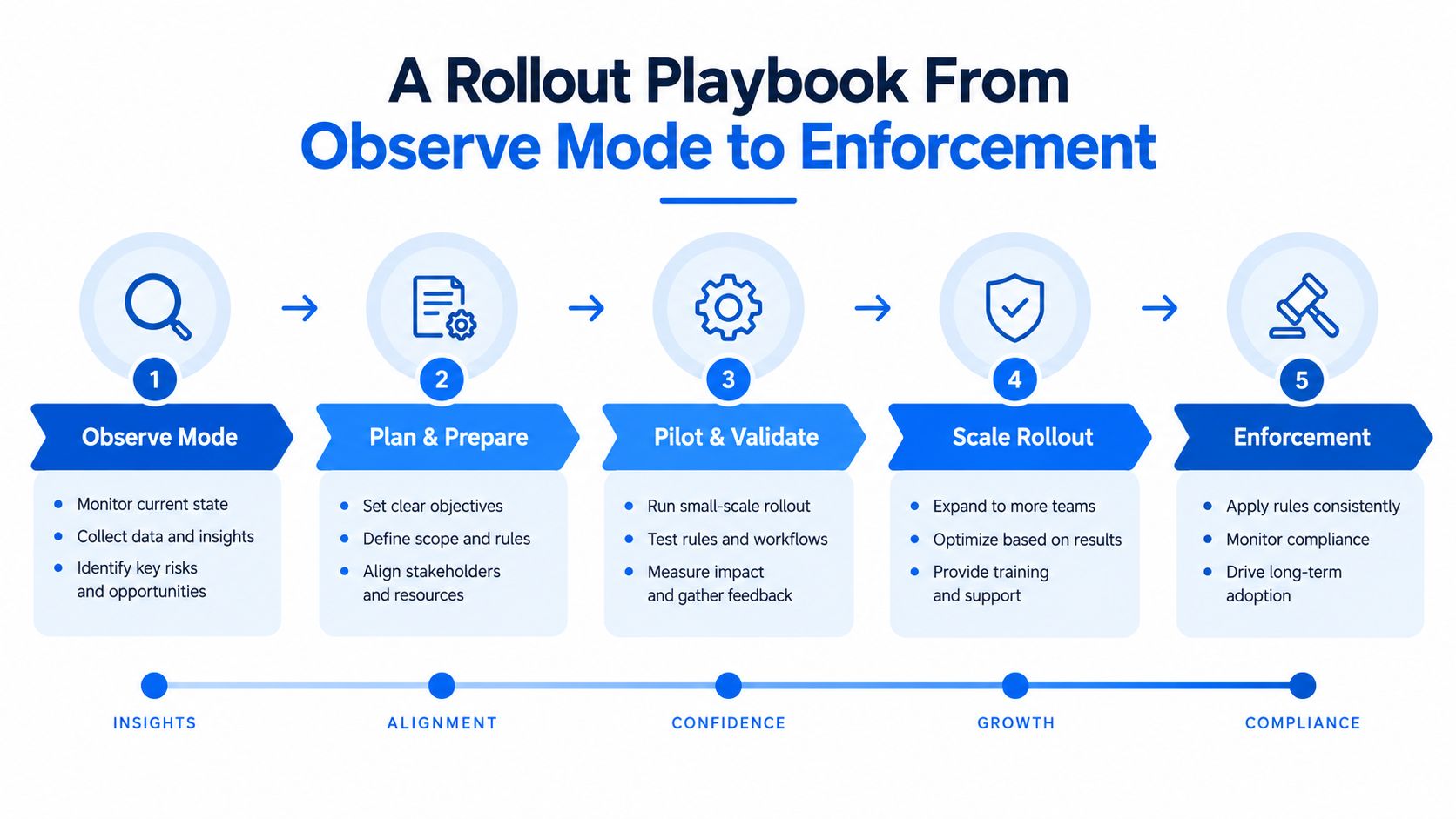
A fraud control isn't production-ready because its detector looks convincing in a test environment. You need to observe real traffic, understand who gets flagged, and connect decisions to outcomes.
Start with visibility
Run the detector in Observe mode first. Score requests and expose decisions in a dashboard, but don't block users. Segment results by route, geography, device type, account cohort, acquisition source, and customer outcome.
A Federal Reserve industry perspective emphasizes staged observation because aggressive controls can suppress legitimate users, particularly on shared networks and privacy-focused or unusual devices, as discussed in its industry perspective on new-account fraud.
Define policy before switching enforcement on
Protect the highest-value routes first. Define what each risk band means:
- Allow: The request has acceptable evidence and no material anomaly.
- Flag: Continue the flow, but create an investigation record.
- Block: Reject the request when evidence is invalid, stale, replayed, or strongly associated with abuse.
Log the decision inputs, verification result, session identifier, route, timestamp, and downstream outcome. Avoid storing unnecessary sensitive data. Investigators need reproducible evidence, not an uncontrolled copy of every submitted field.
Move gradually
Use a canary route or limited traffic cohort before broad enforcement. Compare completion, support contacts, confirmed fraud, and false positives against the observed baseline. Tune thresholds before expanding coverage.
For implementation teams, Observe before enforce captures the operational principle: measurement should precede blocking.
For the first 30 days, review whether:
- The protected routes produce complete decision logs.
- Suspicious cohorts have observable downstream outcomes.
- False positives are separated by device, network, and user segment.
- Replay and stale-proof events are distinguishable from ordinary failures.
- Policy changes can be made without emergency application releases.
The difference between a useful defense and a noisy one is usually operational discipline.
Testing, Monitoring, and the KPIs That Prove It Works
Raw block volume is a weak success metric. A system can block many requests and still miss the attacks that create the largest losses, or it can block legitimate customers and damage conversion.
Track the true positive rate for blocked requests that later show evidence of abuse, and the false positive rate for legitimate users blocked or challenged. Add challenge rate, account creation completion, decision latency, and time to investigation. Keep the denominator and labeling method consistent so the metrics remain comparable.
An older FTC survey covering the 12 months before 2003 found that new-account identity theft averaged $10,200 in loss to businesses and financial institutions per victim, as reported in the FTC identity theft survey announcement. The historical figure reinforces a current operating principle: measure the cost of missed fraud, not only the number of blocked requests.
Build a tuning loop
Back-test policy variants against historical fraud labels where those labels are reliable. Run controlled traffic comparisons when changing a threshold, signal weight, or response. Watch for anomalies in route volume, device concentration, contact reuse, and decision distributions.
When false positives rise, first inspect cohort-specific signals. Shared networks, privacy tools, mobile changes, and unusual but valid browsers may need separate policy treatment. Don't immediately weaken every threshold.
When false negatives rise, examine which signal family the attackers are bypassing. Add independent evidence, tighten freshness and session binding, or move verification closer to the protected action. A new detector should produce an explainable decision and a measurable downstream outcome.
Create alerts for sudden shifts in completion, block, flag, and investigation rates. Fraud teams need enough context to tell a new campaign from a broken integration.
Treating Verification as a Product Decision, Not Just a Security One
Verification changes the customer journey, even when users never see a challenge. A failed browser check can stop signup, delay checkout, or send a legitimate account into review. Security teams therefore need to own the user impact with product and engineering, not hand over a binary block rule and hope for the best.
The practical target is invisible for legitimate users, measurable in production, and tunable without emergency code changes. That requires an event model, a policy layer, clear decision evidence, and a rollback path. It also requires accepting that attacker behavior will change after enforcement.

Keep browser verification in its proper role
Browser proof is valuable evidence about the request environment. It isn't proof that a user is honest, and it isn't a replacement for authentication, authorization, transaction controls, identity checks, or monitoring.
A sound implementation validates browser proof on the server, checks freshness, binds it to the relevant session and action, and records the result. It then combines that result with rate limits, device and network context, identity signals, and account-level outcomes.
The program should mature in stages:
- Observe: Measure decisions and false positives by cohort.
- Tune: Adjust policy against real traffic and confirmed outcomes.
- Canary: Enforce on a controlled route or segment.
- Expand: Protect related actions while monitoring conversion and loss.
- Review: Reassess signals whenever attacker behavior or product flows change.
Start with Observe mode on your signup and highest-value action. Measure false positives by cohort, confirm that the server can validate fresh evidence, and enable enforcement only after the observed outcomes justify it.
MANDATE provides invisible browser verification for important website actions, collecting browser proof in the client and validating it on the server without CAPTCHAs. To evaluate it alongside your existing rate limits, identity checks, and monitoring, visit MANDATE and start with an observe-first deployment.