
A signup flow can look healthy in your dashboard while bots create thousands of disposable accounts. A login endpoint may return normal response times while scripted requests test stolen credentials. A checkout can remain available to real customers while automation reserves inventory, replays payment requests, or submits orders faster than your fraud team can review them.
That's the practical meaning of bot attacks today. They aren't limited to noisy denial-of-service floods. They include automated behavior that scrapes data, inflates demand, creates accounts, takes over users, replays requests, or abuses legitimate business workflows. The right question isn't only, “Is this a bot?” It's, “Is this request legitimate for the action it's attempting?”
Table of Contents
- What Are Bot Attacks and Why They Matter Now
- The Main Types of Bot Attacks Explained
- How Bot Traffic Has Changed in Recent Years
- Comparing Bot Mitigation Strategies
- Where to Deploy Bot Protection
- How to Implement and Tune Verification Safely
- Next Steps for Engineering and Security Teams
What Are Bot Attacks and Why They Matter Now
The incident often starts with an alert that doesn't look like a security incident. Marketing reports an unusual rise in signups. Support sees password-reset emails that users didn't request. The payments team notices repeated checkout failures from accounts created minutes earlier. Meanwhile, infrastructure monitoring shows no obvious traffic flood.
An engineer traces the activity and finds ordinary browser requests. The requests use valid HTTP methods, follow expected URLs, and may even carry realistic headers. The difference is intent and scale. An automated client is moving through the application to create value for the attacker, not to complete a genuine customer journey.
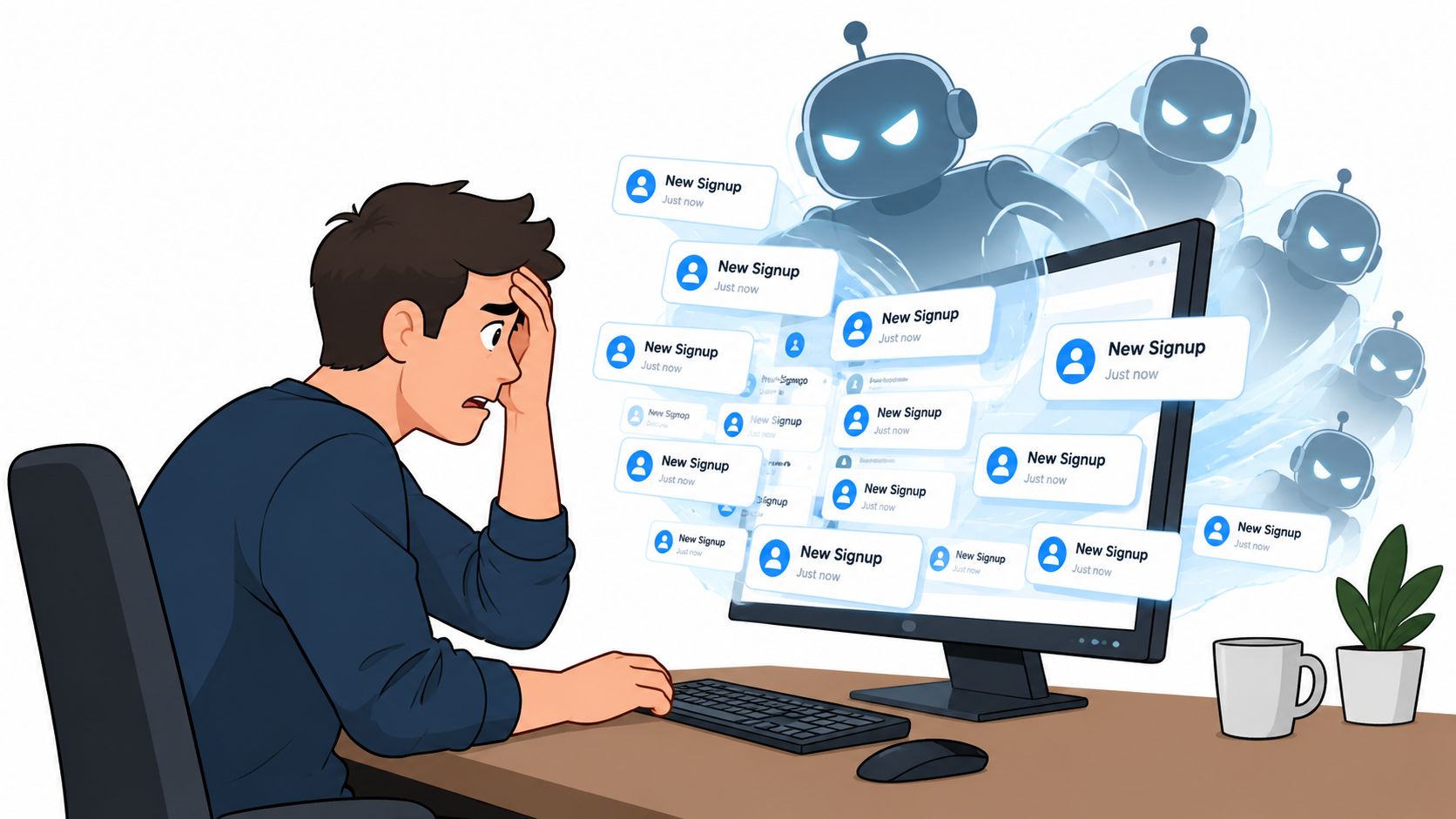
Bot abuse is an application problem
A bot attack is any automated activity designed to misuse a website or its connected services. The objective might be:
- Data extraction: A scraper collects product descriptions, pricing, inventory, articles, or customer-facing content.
- Account abuse: An attacker tests stolen credentials, creates fraudulent accounts, or triggers password resets.
- Demand manipulation: Automation reserves tickets, purchases scarce goods, or prevents genuine users from completing orders.
- Operational disruption: Repeated requests consume application, database, messaging, or fraud-review capacity.
These behaviors can occur through a browser, a mobile application, a direct API client, or a script that imitates a browser. Legitimate automation exists too, including search crawlers, monitoring systems, and partner integrations. Blocking every automated request would break useful services and potentially exclude real customers using accessibility tools, privacy software, or unusual networks.
Practical rule: Treat bot detection as a decision about request legitimacy and business context, not as a permanent label attached to an IP address.
That distinction matters because attackers increasingly operate inside normal traffic patterns. An edge firewall can absorb a volumetric flood, yet it can't decide whether an authenticated session is abusing a password-reset workflow or whether a checkout request belongs to a genuine buyer. Teams that need stronger signup controls may also pair browser verification with an email security verification platform, especially when disposable or unverified addresses are part of the abuse pattern.
The Main Types of Bot Attacks Explained
Different bot attacks target different controls. A login defense won't solve inventory scraping, and a checkout queue won't stop credential testing. Start by naming the behavior you're seeing.
Credential stuffing and account takeover
Credential stuffing is the automated reuse of usernames and passwords exposed in unrelated breaches. Attackers distribute attempts across proxies, devices, and time windows, so a single IP-based threshold may never trigger. The most valuable targets are login endpoints, password-reset flows, session creation, and APIs that exchange credentials for access tokens.
A 2025 cross-industry report recorded attempted malicious login activity at an average of 10.6% of web traffic and 5.2% of mobile API transactions, even where bot mitigation was already deployed. F5's Advanced Persistent Bots Report also describes credential stuffing as cyclical. Activity can surge, fall sharply, and later return at new daily highs as attackers rebuild infrastructure.
Signup abuse and form spam
Signup automation creates fake users, referral fraud, trial consumption, moderation workload, and notification costs. The visible symptom may be a sudden increase in registrations, but the more useful signal is the relationship between signup, email verification, login, and subsequent activity.
Simple forms are frequent targets because they're easy to automate. Teams maintaining public forms can review implementation patterns for HTML form spam protection, but form filtering alone won't protect a complete account lifecycle.
Scraping and scalping
Web scraping systematically copies data through ordinary requests. It can target product pages, prices, availability, search results, content, or authenticated data. Scalping applies automation to high-demand purchases, often combining inventory polling with rapid checkout attempts.
In a 2026 analysis of more than 75,000 customer sites, scraping represented 70.9% of bad bot traffic, while scalping activity increased 290.7%. Help Net Security's coverage of the DataDome dataset explains why network-level volume isn't enough. These attacks often run at application speed and use ordinary HTTP flows.
Replay and request manipulation
A replay attack reuses a captured token, payload, or authentication artifact. For example, an attacker might repeat a previously accepted purchase request or reuse a session artifact from another environment. A request can be syntactically valid and still be unsafe because it lacks fresh proof that it came from the expected browser and session context.
Start with the business action, then identify which evidence must be fresh, server-validated, and bound to that action. A generic blocklist can't make that judgment.
For a related explanation of repeated automated authentication attempts, see this guide to a brute-force attack.
How Bot Traffic Has Changed in Recent Years
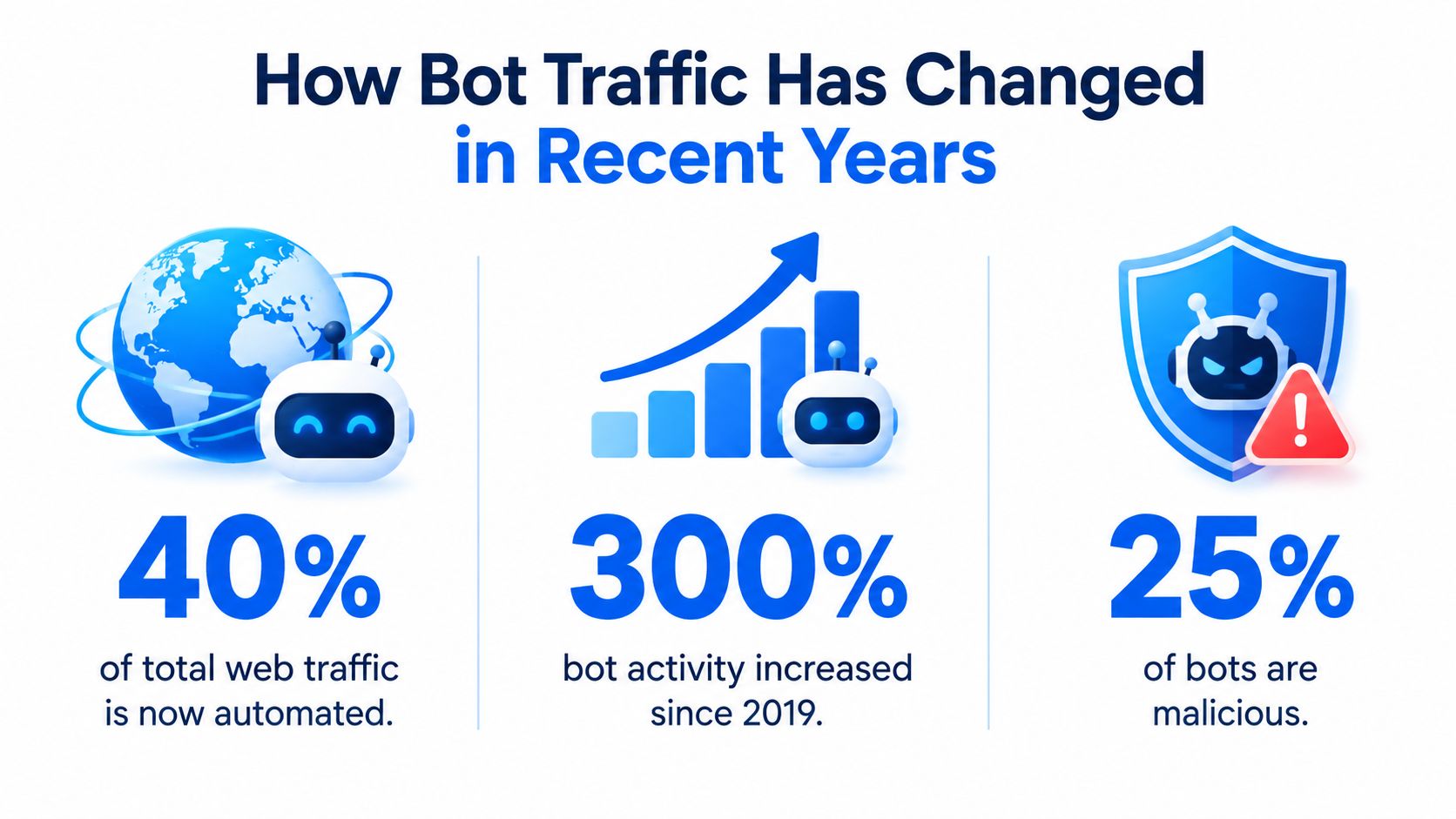
The useful shift in thinking is from traffic volume to traffic purpose. Automated systems now account for a substantial share of activity across the web, and attackers increasingly combine scripts, headless browsers, AI-assisted navigation, and rotating infrastructure to make requests resemble ordinary use.
The 2026 Imperva and Thales Bad Bot Report found that automated traffic reached 53% of all web traffic in 2025, exceeding human traffic for the first time in the report's 12-year history. It attributed 40% to bad bots and 13% to benign automation, while AI-driven bot attacks increased 12.5 times year over year. The Imperva and Thales Bad Bot Report places the trend in operational terms, organizations were blocking an average of 25 million AI-driven bot attacks per day.
Volume rules miss workflow abuse
A separate 2026 analysis of more than 75,000 customer sites and 21,491 popular websites found bad bot traffic grew 124% between July 2025 and June 2026. Human traffic grew 13.2%, AI traffic grew 82.3%, and bots and AI agents generated about 26.5% of all traffic. The same analysis reported that 65.3% of tested popular websites failed to stop any of 10 simulated bots. DataDome's Bot and Agent Security Report shows why a rule that merely asks whether traffic is “high volume” is incomplete.
Scraping accounted for 70.9% of bad bot traffic in that dataset, and scraping grew 185.2% year over year. The important engineering consequence is that an attacker can harvest product or account data through normal-looking requests without creating the kind of network spike that activates DDoS controls.
API and business-logic targeting reinforce the same point. In 2025 reporting summarized by DataDome's state of bot and agent security analysis, advanced attacks represented 44% of bot attacks, moderate attacks represented 14%, 27% targeted API endpoints, and 21% targeted business logic. Separate reporting found 44% of advanced bot traffic targeted APIs.
A request can be low volume, correctly formatted, and still be malicious if it performs an abusive business action.
IP blocks and velocity rules remain useful filters. They're cheap, easy to deploy, and effective against some obvious automation. They shouldn't be the final decision for login, signup, checkout, password reset, or other workflows where the server needs context about the browser, session, token, and action.
Comparing Bot Mitigation Strategies
No single control covers every bot attack. Rate limits constrain speed. Fingerprinting can identify repeated environments. CAPTCHAs add a challenge. Server-side validation checks whether the request carries the evidence your application requires.
Match the control to the action
Traditional rate limiting is a good first guardrail for public endpoints and expensive operations. It limits requests by a selected key, such as an account, session, device signal, or network source. It struggles when attackers distribute attempts across many identities or keep each identity below the threshold.
Behavioral analysis and fingerprinting look for patterns across navigation, timing, browser attributes, session history, and request sequences. They can identify automation that avoids simple velocity rules, but they need careful tuning. A shared corporate network, mobile carrier, privacy browser, or accessibility tool can resemble suspicious traffic.
CAPTCHAs create visible friction and can stop basic scripts. They aren't a complete answer because attackers can use image recognition, OCR, AI-based solvers, or human solvers to bypass them. Radware's guidance on CAPTCHA alternatives also describes non-invasive browser challenges and behind-the-scenes checks that avoid putting a puzzle in front of every legitimate user.
Invisible browser verification collects browser proof and validates it on the server. It fits high-value actions where you need evidence that the request came through a legitimate browser context without adding a visible challenge. It still needs integration, monitoring, and a fallback plan. No browser signal is a magic shield against every automated client.
Server-side payload and token validation checks freshness, binding, origin, session state, and whether a request can validly perform the operation. This is essential for payments, account changes, and token-bearing APIs because client-side checks can be removed or rewritten by an attacker.
| Approach | What It Detects | User Friction | Bypass Risk | Best For |
|---|---|---|---|---|
| Rate limiting | Excessive activity from a selected key | Low | High when attackers distribute requests | Public APIs, login guardrails, expensive endpoints |
| Behavioral analysis and fingerprinting | Suspicious patterns across sessions and clients | Usually low | Moderate, especially with adaptive browsers | Signups, logins, scraping investigation |
| CAPTCHA challenges | Basic scripted interaction | High for challenged users | Moderate to high | Selective step-up checks |
| Invisible browser verification | Missing or invalid browser proof | Low | Lower when proof is freshly server-validated, but not zero | Signups, logins, checkouts |
| Server-side payload and token validation | Replay, invalid context, stale or malformed requests | Low | Lower for workflow-specific abuse when implemented correctly | Payments, account changes, transactional APIs |
OWASP's Bot Management and Anti-Automation Cheat Sheet maps controls to actions rather than recommending one universal filter. Login defenses can combine rate limiting, breached-password checks, and MFA. Signup defenses can use email or phone verification with velocity limits. Checkout defenses can use queues, purchase limits, and 3D Secure.
Where to Deploy Bot Protection
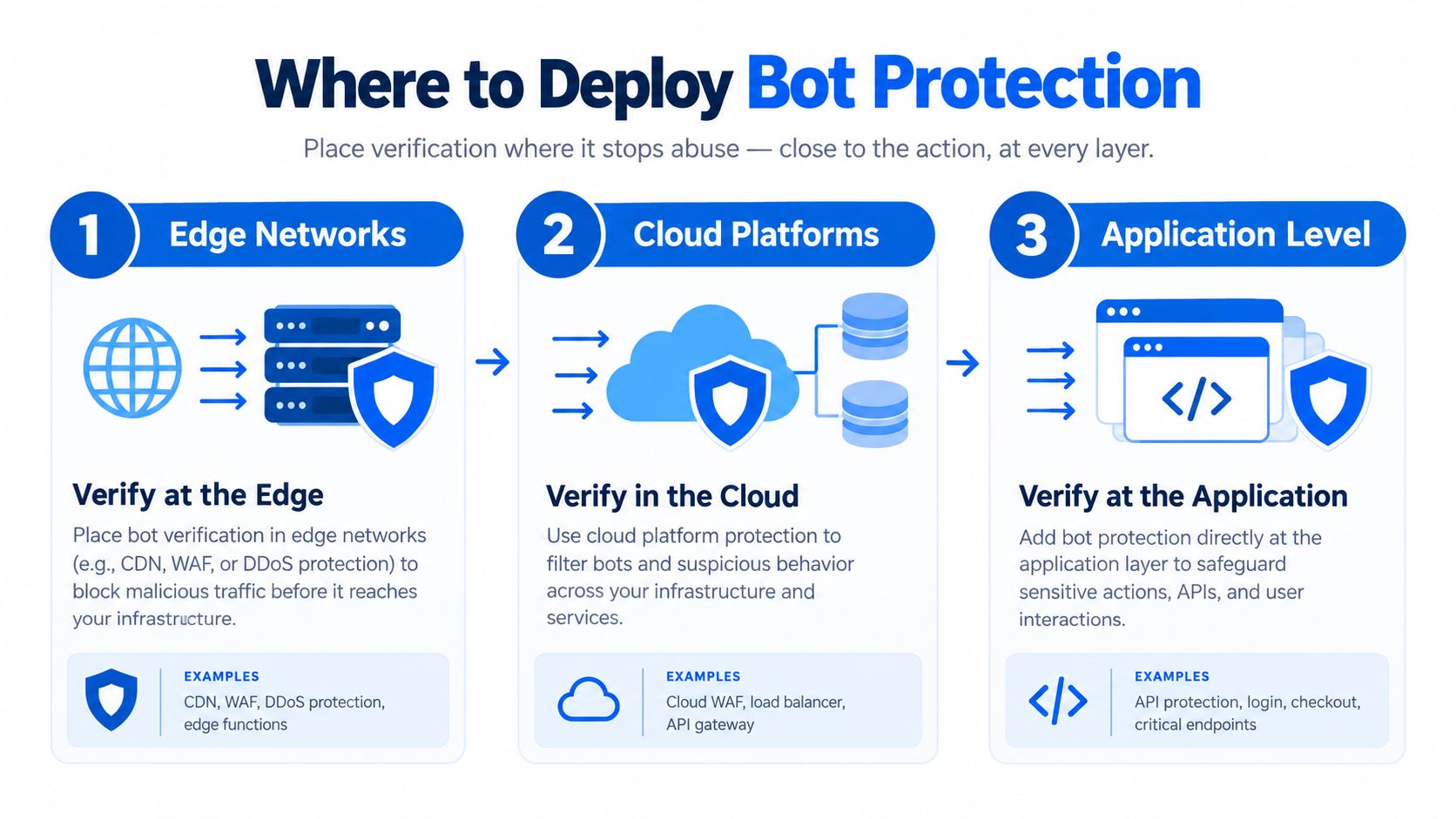
Deploy protection close to the action, not only at the outer edge. Edge inspection can reject obvious abuse before it reaches your infrastructure, but the application is where the server knows whether a session may reset a password, create an account, or submit an order.
Use the edge for early filtering
At the edge, a CDN, serverless function, or gateway can inspect requests before they consume application resources. This layer suits broad policy enforcement, known bad patterns, coarse rate limits, and browser verification that should apply consistently across multiple services.
Edge controls have limits. They may not know the authenticated user, account history, cart state, inventory rules, or whether a token was already used. Don't expect a CDN rule to understand the full meaning of a checkout request.
Use the application for decisions with context
Application middleware can sit around the endpoints that create business value:
- Signup: Verify browser context before creating the account, sending an invitation, or consuming a trial.
- Login: Verify the request before authentication work, then combine the result with password, MFA, account, and device signals.
- Password reset: Protect both the request for the reset message and the endpoint that changes the credential.
- Checkout: Verify before reserving inventory, authorizing payment, or submitting the final order.
- Account changes: Apply the same reasoning to email changes, API-key creation, payout details, and permission updates.
Automated abuse concentrates on these high-value actions because a scripted workflow can test them repeatedly with limited effort. Arcjet's explanation of API abuse makes the practical implication clear, protect the action where fraud or account takeover occurs, not only the network path around it.
A layered deployment doesn't require every request to receive the same treatment. Public content may need only caching and basic limits. Authentication and checkout deserve stronger proof, server-side validation, and carefully selected step-up controls. Teams evaluating traffic direction and placement can also use this explanation of ingress and egress traffic to keep network terminology from obscuring the actual enforcement point.
How to Implement and Tune Verification Safely
Enforcement should be the last step, not the first. A protection rule that blocks a large share of legitimate customers is an availability incident, even if the rule catches real bots.
Start with observation
Choose one workflow with a clear abuse signal, such as signup or login. Run verification in Observe mode so the system records browser proof, decisions, verification errors, flagged requests, and proposed blocks without immediately denying users.
Review the results against application telemetry. Compare flagged requests with successful account creation, payment outcomes, support reports, and known internal automation. Look for false positives from mobile networks, corporate proxies, privacy tools, test environments, and legitimate integrations.
Roll out by action and risk
Avoid enabling a single global policy across every route. A safer sequence is:
- Select the endpoint: Start with the action creating the clearest cost or risk.
- Record decisions: Separate valid proof, missing proof, verification failure, flag, and block.
- Test real journeys: Exercise new browsers, returning sessions, slow connections, mobile devices, and accessibility paths.
- Enforce narrowly: Block only the most confident failures first, while flagging ambiguous traffic.
- Review continuously: Watch conversion, support contacts, error rates, queue depth, and fraud outcomes.
A dashboard is useful only if it helps engineers connect a decision to a request and an outcome. Keep the raw evidence available for incident review, but don't retain more browser or account data than your security and privacy requirements justify.
For implementation patterns around staged controls and server-verified browser evidence, see the anti-bot verification guide. The same operational principle applies regardless of vendor: tune against real traffic, make rollback easy, and treat policy changes as production changes.
Next Steps for Engineering and Security Teams
A team usually doesn't need a large rewrite to improve its bot defenses. It needs an accurate inventory of actions, a decision about acceptable friction, and a deployment plan that starts with visibility.
Begin with the customer journeys that can create or transfer value. List signup, login, password reset, checkout, inventory reservation, coupon redemption, account recovery, and API-key creation. For each action, record the cost of abuse, the signals already available, the downstream systems touched, and what a legitimate request must prove.
Build a workable operating loop
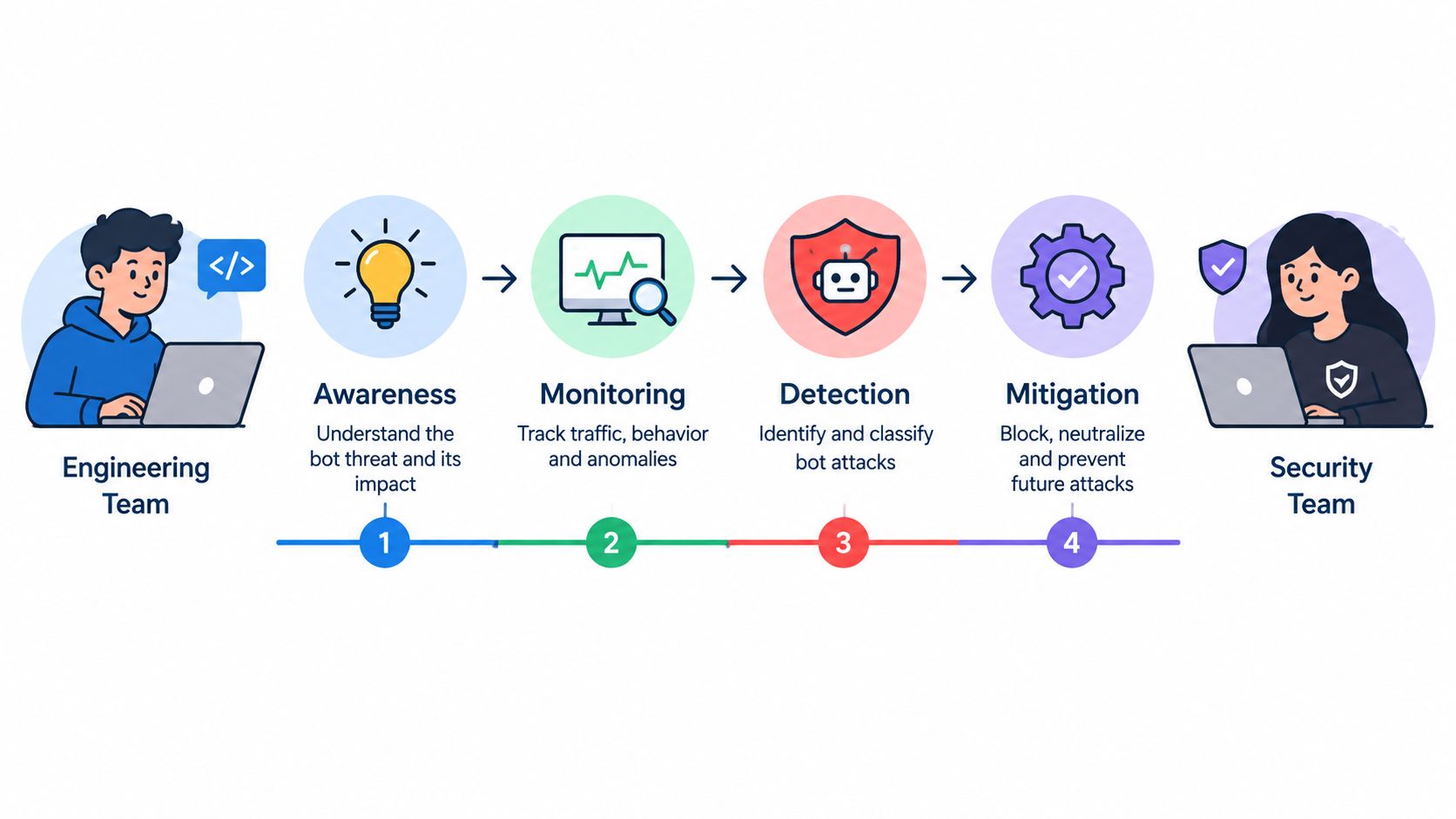
Use the inventory to create a short cycle:
- Observe: Collect browser, session, account, and request signals without disrupting customers.
- Investigate: Compare flagged behavior with authentication, payment, fulfillment, and support data.
- Verify: Require fresh, server-validated evidence at the highest-risk actions.
- Enforce and tune: Allow, flag, or block based on confidence, then review outcomes regularly.
Keep rate limits and account controls in place. Browser verification doesn't replace breached-password checks, MFA, payment controls, authorization, secure session handling, or abuse monitoring. It adds evidence at a point where the application can make a better decision.
The strongest architecture is usually selective. Let low-risk content remain fast and accessible. Apply more scrutiny to actions that create accounts, authenticate users, move money, consume scarce inventory, or change security settings. When attackers change proxies or automate a more human-like journey, your controls should still evaluate the request's context rather than depend on one static fingerprint.
Bot attacks are an operational discipline, not a one-time configuration. Start with the action that matters most, deploy in observation mode, validate decisions against real customer outcomes, and expand only when the team understands the trade-off.
MANDATE provides invisible browser verification for signup, login, checkout, and other high-value web actions, with browser proof collected client-side and validated on the server without CAPTCHAs. Visit MANDATE to review its Observe mode, enforcement options, and integration paths for testing protection before you block real traffic.