You can feel the pattern before the event even starts. The queue opens, the first good seats disappear, the checkout page lags, and your support inbox fills with angry buyers who swear they were ready on time. In that moment, ticket buying bots stop being an abstract abuse problem and turn into a direct test of your site's fairness, your infrastructure, and your ability to protect high-value actions without punishing real customers.
Table of Contents
- The Ticket Buying Bot Problem
- Understanding Bot Architecture and Tactics
- Detection Signals and Technical Heuristics
- Implementing Invisible Browser Verification
- Integration Patterns for Different Architectures
- Beyond Detection, Measuring Impact and Fairness
- Legal Compliance and Operational Best Practices
The Ticket Buying Bot Problem
The hard part isn't that bots are fast. It's that they turn a normal onsale into an experience where legitimate buyers lose confidence in the platform itself. Once people believe the sale is rigged, every technical glitch looks suspicious, every sold-out notice feels premature, and every resale listing becomes part of the story.
For engineering teams, the core issue is that inventory protection and customer trust are tied together. The FTC describes the prohibited conduct under the BOTS Act as automated software, fake identities, and technological methods used to evade issuer controls, and that framing matters because it shows the abuse pattern clearly, software defeats limits, gets scarce inventory ahead of ordinary buyers, then pushes those tickets into resale markets. The law marked a shift from scattered state rules to federal enforcement, which tells you how seriously this problem sits in the consumer-protection stack. FTC refresher on the BOTS Act
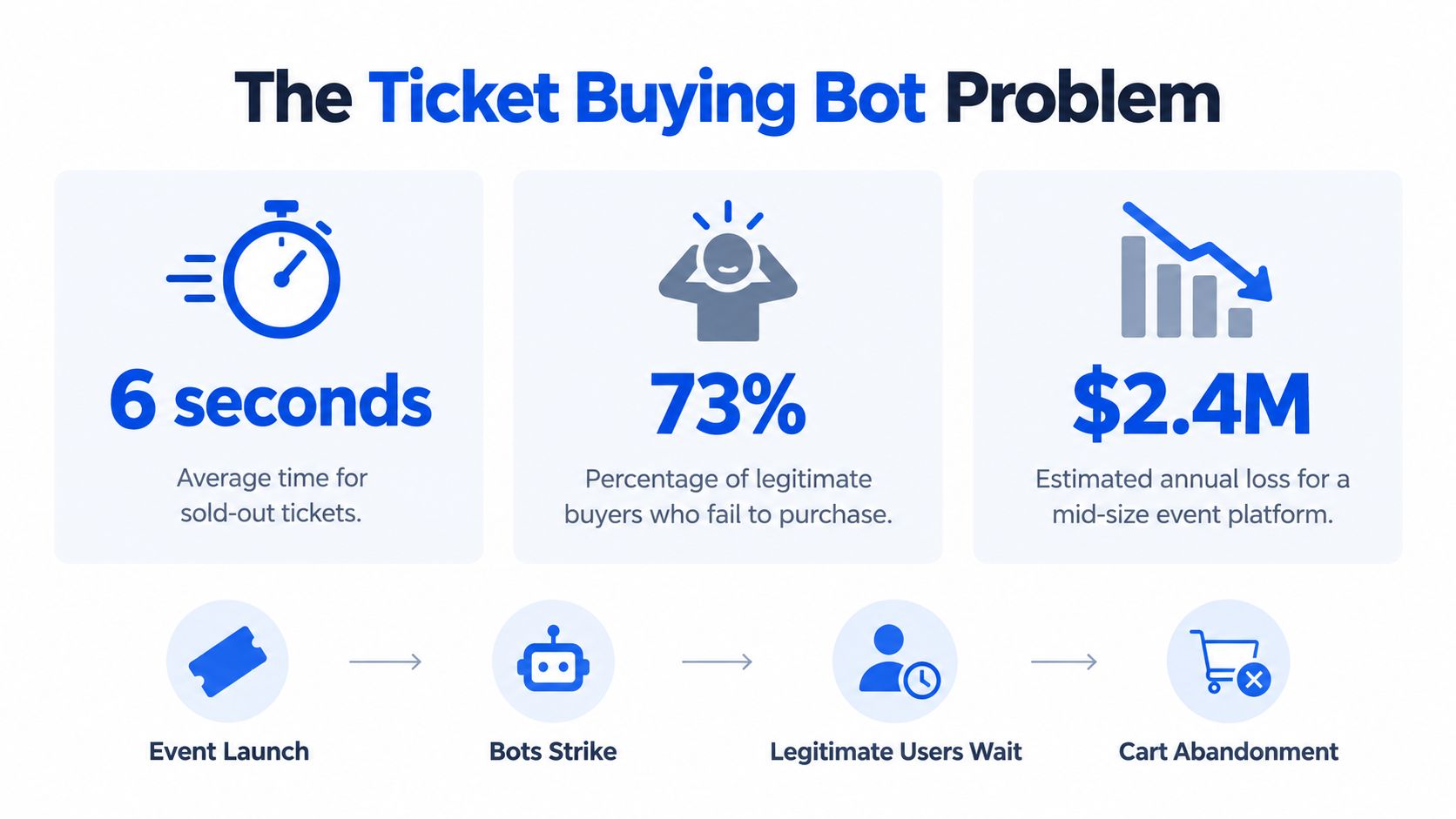
The failure mode is familiar if you've protected signups or checkouts before. A small number of automated clients doesn't just take seats, it changes the whole request pattern around the sale, which makes the site feel unstable even when the underlying release is healthy.
Practical rule: if your protection only reacts after a cart is created, you're already late.
For ticketing teams, that means the actual target is not just checkout abuse. It's the full path from discovery to hold to payment, because that's where bots can turn public inventory into private scarcity.
Explore how MANDATE fits ticketing protection
Understanding Bot Architecture and Tactics
Ticket buying bots are better understood as a pipeline than as a script. One component watches for inventory, another rushes the seat map, and another handles the purchase flow with rotating identities and payment details. That division of labor is what makes them resilient, because a failure in one stage doesn't stop the rest of the operation.
How the pipeline works
The release-monitoring bot, often called a spinner, polls for new inventory and alerts the rest of the system the moment stock appears. Search bots then move quickly enough to place items on hold before ordinary users finish the first search round. Purchasing bots finish the job by submitting batches of identities and payment instruments, sometimes alongside CAPTCHA bypass techniques or IP masking.
A 2018 analysis of 26.3 billion requests across 180 ticketing domains found that bad bots generated nearly 40% of ticketing traffic, with 42% bot traffic on primary markets, 24% on secondary platforms, and 27% at venues, while 78% of ticket bots were classified as advanced or moderately advanced (conference paper). That matters because it explains why simple request-count thresholds don't hold up. Advanced operators don't behave like noisy attackers, they behave like distributed customers.
Why the inventory layer is the real target
The key advantage appears before checkout. Tickets can be placed on hold before ordinary users even finish searching, which creates the appearance of scarcity while inventory is still being manipulated. Once that happens, the platform has already lost the fair race for access, even if the payment step later blocks some of the fraud.
Bot operators don't need to win every step. They only need to win the step where inventory becomes scarce.
The engineering takeaway is simple. If you correlate only one signal, you'll miss the handoff between the components. Correlate session timing, hold behavior, identity reuse, payment relationships, and browser integrity together, or you'll keep seeing fragments of the attack instead of the whole system. Learn more about bot detection patterns
Detection Signals and Technical Heuristics
Good detection doesn't start with volume. It starts with inconsistency. Real buyers may be excited, impatient, or distracted, but they still leave a trail that's hard to fake across a full checkout path, especially when you compare browser behavior with server-observed evidence.
Signals worth correlating
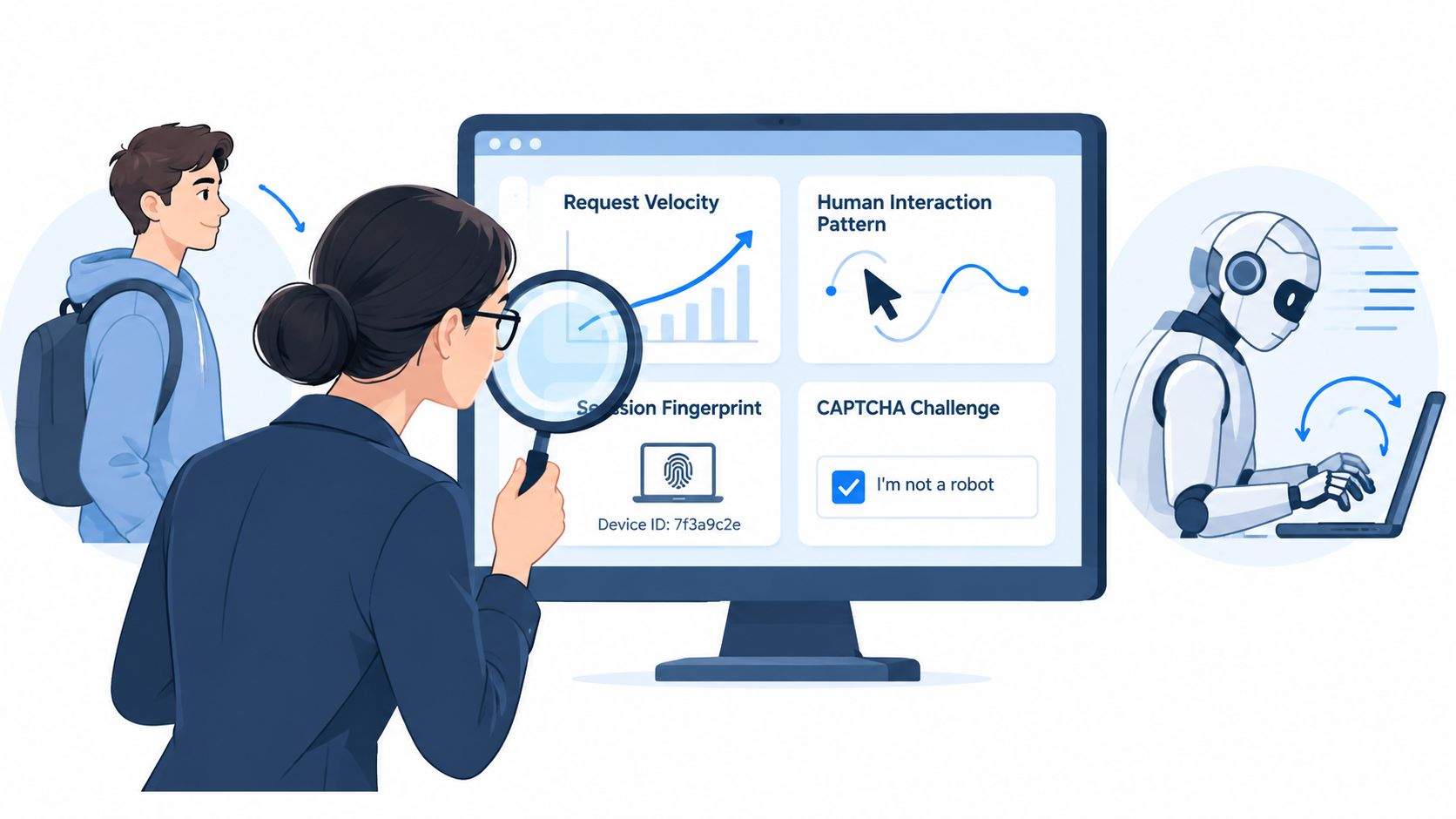
The useful signals are the ones that line up across the transaction lifecycle. Look at session continuity, the timing between inventory search and hold creation, checkout velocity, identity reuse, and how payment instruments relate to one another. If a browser claims to be normal but the sequence is unusually tight, synchronized across accounts, or repeatedly tied to the same payment patterns, the traffic deserves a closer look.
A legal analysis reported that automated software attempted to purchase five billion tickets on Ticketmaster during 2016 at a rate of 10,000 tickets per minute (UC eScholarship analysis). That number shows why rate limits alone fail when attackers spread activity across many sessions and identities. A single user-shaped request stream is easy to throttle. A coordinated system with distributed timing is not.
What tends to work in practice
Use browser integrity checks, device fingerprinting, and server-side validation together. Then combine those with behavioral scoring so a single suspicious event doesn't trigger a hard block by itself. I've seen too many teams rely on one signal, then spend weeks untangling the false positives after an onsale.
If you want a broader fraud lens, the guide to fraud prevention systems from Wonderment Apps is a useful companion piece because it frames abuse as a cross-channel risk, not just a bot problem.
Engineering rule: treat detection as a scoring system, not a binary gate.
The goal is to catch coordinated automation while leaving ordinary buyers alone. That means validating the browser on the server, not trusting whatever the client says, and reviewing suspicious flows by step instead of assuming one metric tells the whole story. See anti-bot verification patterns
Implementing Invisible Browser Verification
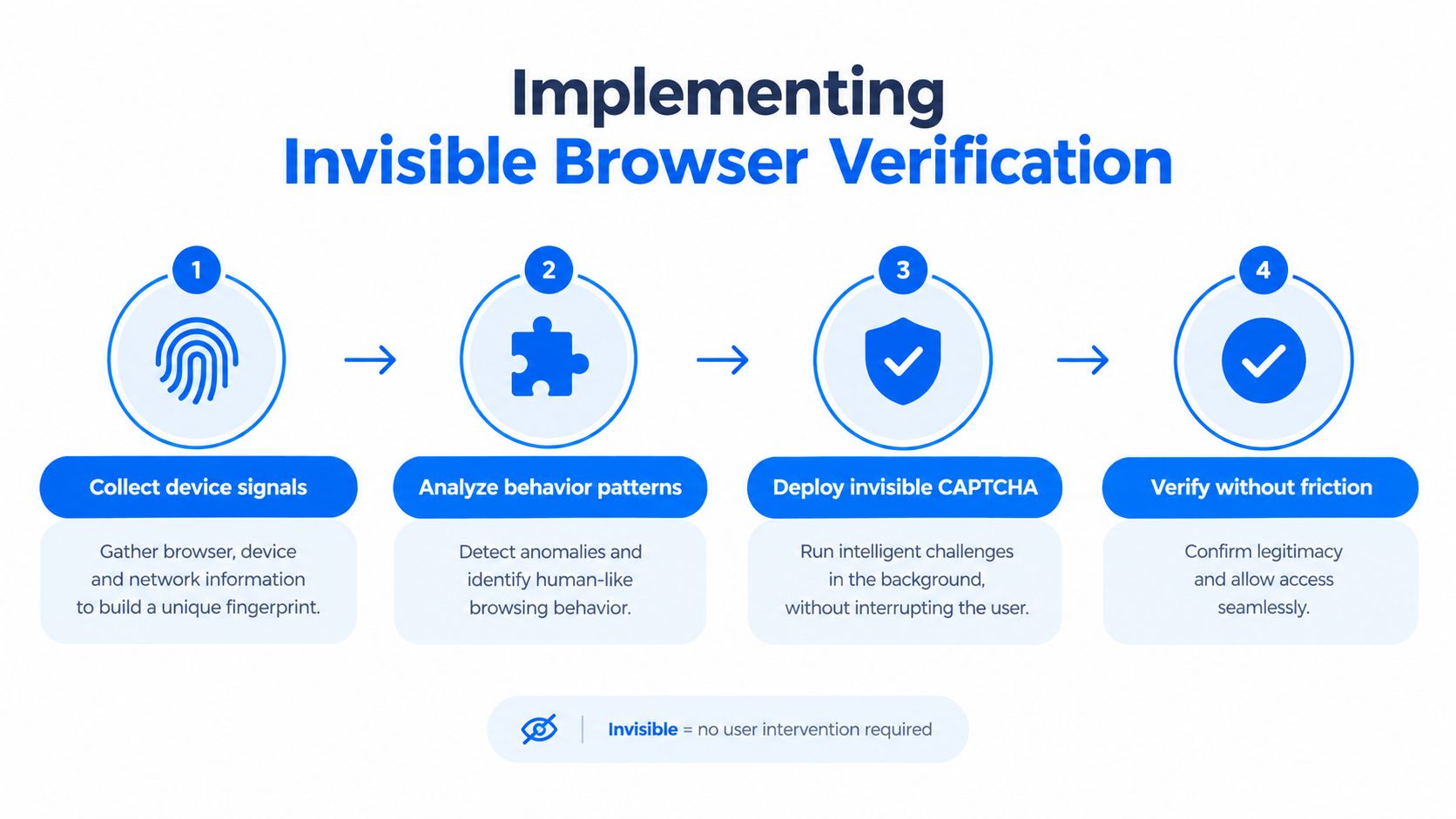
Invisible verification works best when the browser contributes proof and the server decides what to do with it. That sounds obvious, but many teams still treat bot defense like a front-end challenge problem. The better pattern is to collect browser proof without drawing attention, verify it on the server, and then use that decision to allow, flag, or block the request based on risk.
Start with staged rollout
Roll out in Observe mode first. That means you collect browser proof and score requests, but you don't enforce blocks until you understand the false-positive rate and the edge cases. This matters most during live onsales, when a mistaken block can cost you a real buyer and create support load you don't need.
For implementation reference, the AgentStack identity verification docs are a practical example of how teams can structure verification workflows without turning the user journey into a visible challenge. Use that kind of pattern as a model for server-confirmed decisioning, not as a reason to shift trust back to the client.
Verify on the server, not in the browser
Client-side checks are easy to observe and easier to adapt around. Server-side verification is stronger because it lets you compare fresh browser proof with the actual request path, then tie that proof to the session, payload, and checkout step. That's where you catch replay attempts, stolen tokens, and session artifacts that don't match the originating environment.
A clean implementation usually follows four moves.
- Collect device signals. Gather browser proof early, before the request reaches sensitive inventory or payment logic.
- Analyze behavior patterns. Look for timing, sequence, and consistency across requests.
- Make a server decision. Allow, flag, queue, or block based on your policy.
- Review and tune. Keep the first rollout in observation until the false-positive profile is acceptable.
Where to place enforcement
Edge, cloud, and application middleware all work, but they solve different problems. Edge placement reduces latency and catches abuse close to the request origin. Middleware sees richer application context, which is valuable when checkout state matters. Cloud integrations sit between those two and often make rollout easier when you need room to inspect traffic before you enforce.
The most important detail is not where you put the check. It's whether the proof is tied to the request that actually matters. If the browser proof can be replayed or reused without fresh validation, the attacker will find that gap fast.
Integration Patterns for Different Architectures
The right integration pattern depends on where your platform can see context without adding fragility. A CDN can stop a lot of bad traffic early, but it won't know as much about application state. Middleware can see more, but it touches the core request path and needs careful testing. Cloud services sit in the middle, which makes them easier to adopt but sometimes less precise.
Edge, cloud, or middleware
Edge integration is the best fit when latency is your biggest constraint and you need a fast first pass on risky traffic. It's strong for filtering obvious abuse before it touches origin systems, but it can't always see the deeper session context you need for nuanced checkout decisions.
Cloud integration gives you more flexibility and better central policy control. The trade-off is extra network hops and one more layer to maintain, which can matter during high-pressure onsales if you're already close to latency limits.
Application middleware gives you the richest context because it sits near the business logic. It's the right choice when session state, seat holds, and checkout progression all matter, but it asks more from your engineers because it reaches into core code paths.
How to choose
A practical rule is to place the strongest control where the decision is most valuable. Use edge filtering for early abuse suppression, middleware for checkout and payment decisions, and cloud policy layers when you need a central place to manage enforcement logic across services.
A simple decision matrix helps.
| Pattern | Strength | Trade-off |
|---|---|---|
| Edge | Fast, low latency | Less application context |
| Cloud | Flexible, centralized | Extra hop, more moving parts |
| Middleware | Deep context | Higher implementation cost |
That choice also affects replay protection. Edge layers are good at dropping obvious repeats. Middleware is better when you need to bind browser proof to a live session or a specific inventory event. If you're defending ticketing, that distinction matters more than architectural fashion.
Beyond Detection, Measuring Impact and Fairness
Blocking bots is not the same as proving fairness. A lot of ticketing coverage stops at the claim that automation is the reason inventory disappears, but the public evidence often can't separate successful bot purchases from ordinary high-demand buying, presales, authorized resellers, speculative listings, or inventory withheld by the primary seller.
A 2025 submission to the U.S. Federal Trade Commission argued that the 2016 BOTS Act had been enforced only once and that primary ticketing platforms often don't provide the forensic data needed to verify bot claims (submission PDF). That's the uncomfortable part of the conversation. If you can't measure what was bought by prohibited automation, you can't claim that every sold-out event was a bot event.
Measure outcomes, not just attacks
The useful reporting model separates the pieces that usually get blurred together.
- Unique sessions: count distinct buyers, not just raw requests.
- Challenged traffic: track how much traffic triggered bot controls.
- Completed checkouts: measure actual purchases, not just holds.
- Duplicate identities: record account overlap and reuse.
- Recovered inventory: show what became available again after enforcement.
That structure forces teams to answer the right question. Did a defense reduce abuse, or did it only increase friction? Those are different outcomes, and they shouldn't be mixed in the same dashboard.
Fairness needs a broader lens
There's also a risk in over-optimizing for attack volume. Platforms can end up celebrating block counts while buyers still lose out because inventory allocation, resale channels, or access controls remain opaque. That's why the right metric is not how many bots you stopped. It's how much legitimate access improved after you changed the system.
If the ticket still disappears into opaque channels, bot reduction alone won't fix trust.
That doesn't make detection less important. It makes measurement more honest. Teams that separate attack volume from purchase outcomes get a better picture of what's happening on sale day, and they make fewer bad decisions based on headline-friendly numbers.
Legal Compliance and Operational Best Practices
The law matters here because bot defense isn't only an operations problem, it's a compliance issue. The U.S. Better Online Ticket Sales Act of 2016, or BOTS Act, prohibits bypassing a ticket issuer's security measure, access-control system, or other technological control used to enforce posted purchasing limits or preserve the integrity of online ordering rules (Congress text). It also prohibits selling a ticket acquired through that circumvention when the seller participated in, controlled, or knew or should have known about the violation.
The statute also identifies the kinds of controls engineering teams need to take seriously. Per-user quantity limits, transaction-frequency limits, queue rules, and anti-automation checks aren't just product choices, they're part of the control surface that bots may unlawfully bypass. The law specifically addresses software designed primarily to circumvent technological measures that limit purchases in computerized ticketing systems, including software with limited legitimate use outside that purpose (bill text).
What enforcement showed
The first federal enforcement actions arrived in January 2021, when the Department of Justice and the FTC announced settlements involving automated ticket-buying software, CAPTCHA bypass, IP masking, hundreds of fictitious accounts, and hundreds of credit cards. The FTC reported $3.7 million in civil penalties in that sweep, which is the number that matters for collectability, even though a separate description of the same cases referred to $36.1 million in aggregate penalties with much of that suspended because the defendants couldn't pay (DOJ and FTC announcement).
That difference is worth remembering. Headline penalty amounts can look dramatic, but the collectible amount and the operational restrictions are what change behavior. The cases also required compliance reporting and restrictions on future use of bots or any other methods used to defeat access controls.
What teams should do when violations appear
Preserve logs, session data, account history, payment relationships, and queue events as soon as you suspect abuse. Those records matter for internal review and for any coordination with regulators or law enforcement. Don't wait until after the sale to decide what evidence you should have kept.
A practical incident playbook should include:
- Triage quickly: confirm whether the issue is abuse, misconfiguration, or both.
- Preserve evidence: save the request trail before retention windows expire.
- Separate actions: freeze suspicious accounts without blocking the whole sale path.
- Report cleanly: keep compliance, legal, and engineering aligned on what happened.
The best long-term posture is boring in the best way. You make the controls visible to the right people, keep the enforcement logic server-verified, and maintain a rollout path that doesn't wreck the customer experience when demand spikes. That's the kind of protection ticketing teams need, and it's the kind of protection that scales better than CAPTCHAs alone.
If you're protecting ticketing, signups, or checkout flows and you want invisible verification that fits into real production systems, take a look at MANDATE. It's built to collect browser proof, verify it on the server, and let you protect important website actions without forcing legitimate users through challenges.