
The popular advice to “block the bots” starts with the wrong decision. A web application needs to decide whether a particular signup, login, checkout, or redemption should proceed, given the browser evidence and the application's current state. A convincing browser session doesn't make a request authorized, fresh, or safe to repeat.
Bot protection should be action-specific, verified server-side, and rolled out before it's enforced. Engineering teams should combine browser verification with authentication, rate limits, transaction validation, and duplicate-submission controls. The difficult part isn't producing a detection score. It's deciding what that score should change without disrupting legitimate customers.
Why bot protection starts with the action, not the traffic
A login endpoint can be under sustained attack while the rest of a website looks ordinary. Cloudflare reported that during the first week of March 2025, more than 94% of authentication requests worldwide were automated, compared with about 30% of all requests in its observed traffic, according to its analysis of authentication traffic and leaked credentials. A site-wide average would obscure that concentration.
Consider a synthetic credential-stuffing attack. An attacker submits stolen username-and-password pairs through browser-driven requests, searching for accounts where those credentials still work. OWASP distinguishes this from credential cracking, where an attacker tries different passwords against usernames, in its automated-threat ontology.
Define the decision at the endpoint
The relevant question isn't whether the visitor looks automated somewhere on the site. It's whether this login attempt should reach the authentication system, trigger additional controls, or be rejected.
Teams should separate decisions by business action:
Signup: Should the application create an account and grant its initial benefits?
Login and recovery: Should an attempt proceed through identity checks?
Checkout and reservations: Should the application commit inventory or accept an order?
Redemption: Is this account entitled to consume this promotion now?
Each action needs its own evidence, expected callers, and completion definition. An automated test runner, a customer retry, and a stolen-credential attack shouldn't inherit the same policy merely because they share an endpoint.
Connect security decisions to business outcomes
For commerce teams, Quikly's analytics e commerce guide is a relevant companion resource when defining the business measurements around protected actions. Security telemetry should connect to completed checkouts and redemptions, not stop at request counts.
Recommendation: Start with the action that exposes a concrete business risk. A perimeter policy can reduce noise, but it shouldn't decide whether an account, order, or benefit is valid.
What bot protection actually means
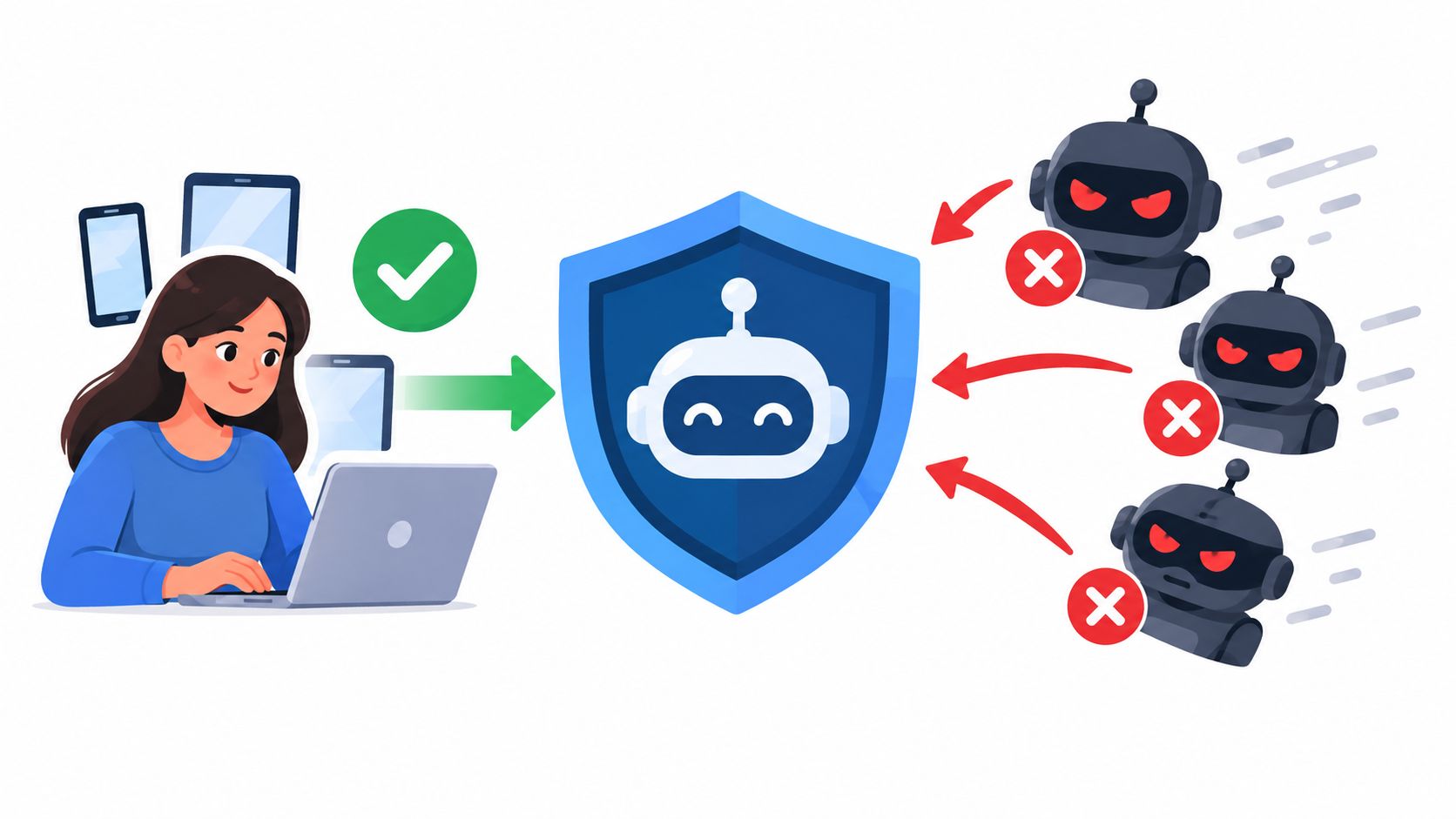
Bot protection is an application-security capability for distinguishing and controlling automation. It isn't proof of human identity, and it isn't authorization to perform a business operation.
The scale of automation explains why that distinction matters. Imperva's global internet-traffic analysis found that bots generated 49.6% of web traffic in 2023, while bad bots accounted for 32%, according to the Thales announcement of Imperva's findings. Those figures describe an observed traffic population, not the probability that any particular customer is malicious.
Separate automation, identity, and permission
Browser verification supplies evidence about a browser-originated request. Authentication establishes an account's identity through credentials and other checks. Authorization determines whether that account may perform the requested operation.
A legitimate customer retrying checkout may need the same order result returned without another charge. An attacker retransmitting a captured checkout request needs rejection. Similar-looking HTTP requests can require different decisions because the server knows different things about their histories.
A password-reset page opened on another device creates a similar trade-off. A device mismatch deserves scrutiny, but a customer may legitimately open an emailed reset link on a phone after requesting it on a laptop. Policy should preserve the recovery flow's identity checks rather than treating device continuity as absolute proof.
Practical rule: A positive browser signal should permit the next check, not erase the checks that follow.
Keep the vocabulary explicit
The main terms describe different jobs:
Client signals: Evidence from the browser environment, such as automation hints. A script reports observations; the server evaluates them.
Server verification: Validation of browser evidence against the current protected action and server context.
Behavioral analysis: Evaluation of interaction patterns, such as repeated recovery attempts across accounts.
CAPTCHA: A visible challenge that asks the visitor to perform an additional task.
Device or token binding: Restrictions connecting a proof to an expected caller or context, rather than accepting it wherever it appears.
False positive: A legitimate attempt classified as suspicious. A false negative is abusive activity that the control misses.
Ownership matters as much as terminology. Rite NRG's case study on enabling secureops at scale provides an adjacent operational resource for teams coordinating security work across an enterprise. For bot protection, developers and security engineers should agree on who owns policy changes, customer-impact review, and incident rollback.
Detection approaches compared by what they actually decide
Detection techniques shouldn't be ranked on a single accuracy leaderboard. Teams need to compare which decision each technique can support, what evidence it lacks, and how it fails.
Client-side evidence can identify suspicious browser characteristics, but the client is outside the application's trust boundary. Server verification can enforce request validity, but it needs an explicit contract with the protected action. Neither alone establishes whether an account is entitled to receive a promotional benefit.
Detection approaches against the questions an action must answer
| Approach | Best at | Limitations | Complements |
|---|---|---|---|
| Client signals | Identifying browser-environment inconsistencies and automation hints | Browser evidence can be manipulated; collection also needs privacy review | Server verification and action-specific policy |
| Server verification | Checking whether submitted evidence is valid for the current action | Needs context, reliable state, and defined failure handling | Application authentication and transaction validation |
| Behavioral analysis | Finding suspicious patterns across attempts or interactions | Unusual legitimate behavior can resemble automation | Endpoint history and completion outcomes |
| CAPTCHA | Introducing an explicit user-visible checkpoint | Adds a task for legitimate visitors; doesn't establish business permission | Recovery paths and server-side checks |
| Device or token binding | Restricting where a captured proof can be accepted | Depends on the binding mechanism and can conflict with legitimate device changes | Freshness validation and account recovery policy |
Client signals are useful early filters. Collectors should gather only evidence needed for the decision, with documented retention and access rules. Calling fingerprinting “privacy-light” without examining the actual fields collected isn't a privacy assessment.
Behavioral analysis is a pattern signal, not a verdict. Repeatedly cycling through account names may justify a stricter login policy. A customer using assistive technology or taking an unusual navigation path shouldn't be blocked solely for departing from an expected interaction pattern.
Match friction and binding to the risk
CAPTCHAs make the checkpoint visible. That can be an acceptable trade-off for some workflows, but the team must account for the added interaction and provide an accessible failure path. An invisible alternative removes that task, not the possibility of misclassification.
Binding deserves equally careful language. Binding a proof to a session or action can restrict reuse outside that context. Stronger caller binding depends on the actual mechanism; placing a device identifier inside a bearer token doesn't automatically prevent another caller from presenting it.
Rate limits remain complementary. OWASP calls rate limiting a foundational anti-automation control and recommends multiple keys, including identity, IP address, and endpoint, in its bot management and anti-automation guidance. Teams selecting algorithms and keys can also consult this practical rate limiter guide.
The recommendation is a layered decision: evaluate browser evidence, validate the current action, constrain request volume, and preserve the application's permission checks.
Replay resistance is a server state problem
A captured credential can remain cryptographically valid after its intended use. That's why checking a signature isn't the same as checking freshness.
NIST defines replay resistance as making it impractical to succeed by recording and retransmitting an earlier authentication message. Its authenticator requirements explain how nonces and challenges distinguish current exchanges from recorded ones, and require relevant authentication secrets to be accepted only once during their validity period. These authentication principles provide a useful foundation for designing protected browser actions, without making browser verification an identity authenticator.
A captured checkout request
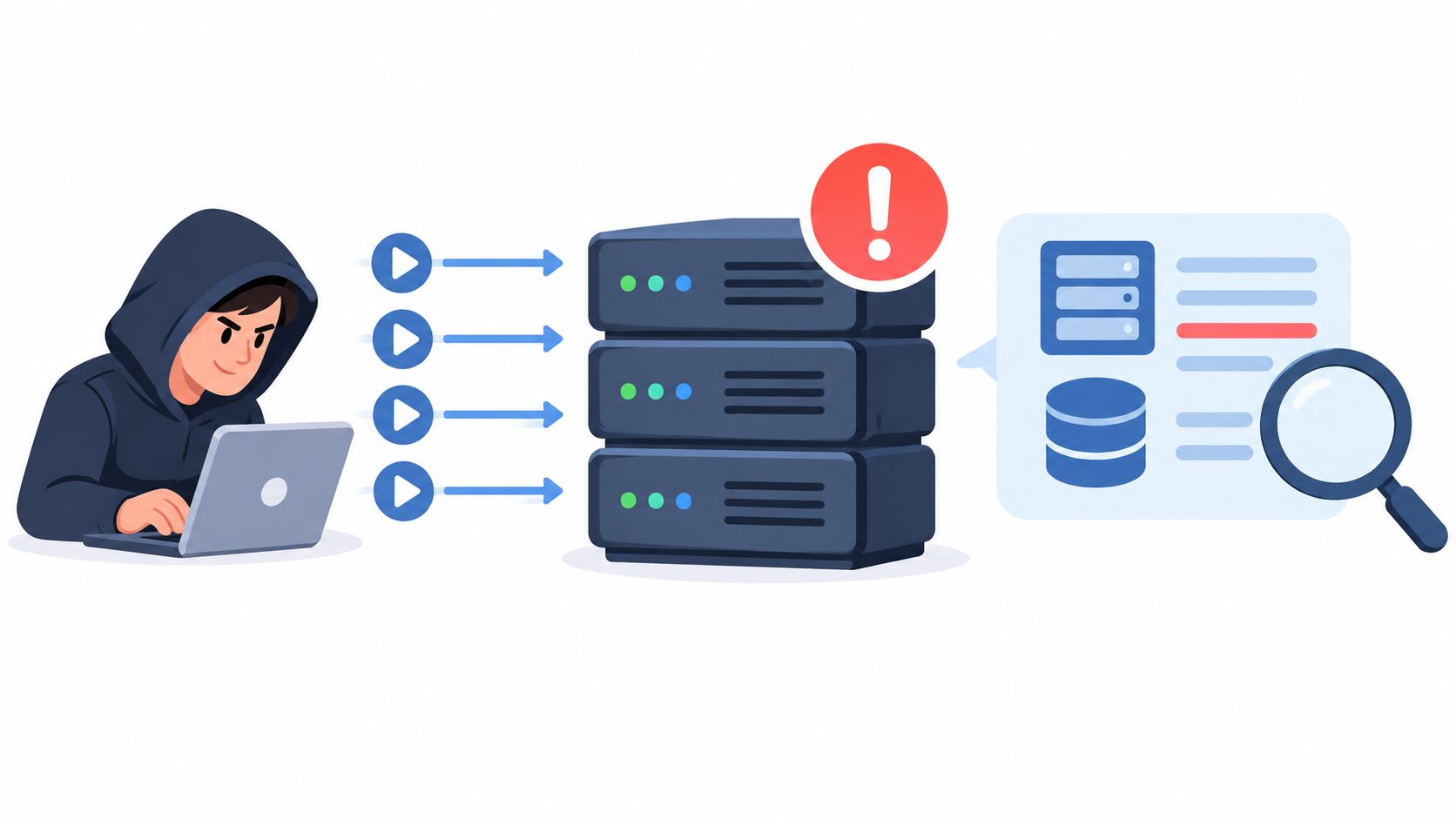
Synthetic example: A customer submits a checkout request with browser proof attached. The server validates the proof, checks its association with the session and checkout action, and consumes it before proceeding with the transaction.
An attacker captures that request and retransmits it from a different network address. The signature may still pass cryptographic validation because the signed content hasn't changed. The verification layer should reject the request because the proof has already been consumed, regardless of the changed address.
A nonce is a random or non-repeating value used to distinguish a current exchange from a recorded one. Combined with expiry and single-use enforcement, it gives the verifier evidence that a request belongs to the current exchange.
The state transition must be atomic, meaning concurrent requests can't both observe an unused proof and both consume it successfully. A separate “check unused” operation followed by “mark used” leaves a race unless the storage operation coordinates them.
A valid signature answers whether the content was signed correctly. Current server state answers whether the application should still accept it.
Keep replay rejection separate from retry handling
Use opaque, short-lived, single-use credentials for the verification layer. Opaque means the application treats the credential as a value to verify, not as readable permission that client code can interpret or extend.
An idempotency key serves a different purpose: it identifies repeat submissions of the same business operation so the application can avoid duplicate acceptance. Checkout still needs a durable order result and payment-provider handling when a customer retries after losing the response.
Credential reset requires its own state transition too. Once a reset operation succeeds, a later submission must not change the password again merely because the earlier browser proof or reset artifact remains readable.
The analysis of why browser proof needs server state is relevant when reviewing this boundary. The design review should cover consumption races, retry behavior, and transaction failures, not just token format.
Architecture and deployment patterns for browser verification
Placement determines which system has enough context to reject a request and which team carries the operational burden. Architecture should follow the protected action's requirements, not a preference for moving every security decision to the edge.
For hosted browser-verification services, remote verification should be treated as a production dependency. Teams need documented timeout behavior, monitoring, and a deliberate degraded-mode policy before enforcement begins.
Choose placement by context and ownership
Edge deployment evaluates requests before they reach application servers. It's useful for rejecting clearly invalid traffic early, but an edge decision may lack authoritative account, inventory, or transaction state. The application must still enforce its business rules.
Cloud verification separates the verification service from the application's hosting environment. This can suit teams with mixed infrastructure, provided backend routes consistently call the verifier and handle its response. The trade-off is dependency management across network and service boundaries.
Middleware offers a different operational boundary. It can centralize checks in front of existing handlers, reducing duplicated integration logic. However, alternative routes, background callers, and legacy endpoints need review so that attackers can't reach the same operation through an unchecked path.
SDKs and browser collectors help connect evidence collection to dynamic applications. Their presence in frontend code isn't enforcement: the backend must reject protected requests that lack acceptable verification. Teams should confirm published support and availability rather than infer them from a sample integration.
Define the degraded-mode contract
Hosted verification is the normal integration path for the product design discussed here. Local cryptographic verification is limited to an offline emergency tier and legacy compatibility, not an equivalent replacement for current server-state verification.
Deployment review should resolve these questions:
Timeout ownership: Which component stops waiting, and what response reaches the caller?
Dependency failure: Does the named action pause, continue under restricted controls, or use an approved emergency path?
Context transfer: How does the backend identify the action and session without trusting client-supplied claims?
Coverage: Can another route perform the same business operation without verification?
Logging: Can operators distinguish verifier unavailability from a policy rejection?
A read-only page and a promotion redemption shouldn't automatically share failure behavior. Teams should choose a degraded policy based on what the application can safely accept, then test it under dependency failure and recovery.
Observe mode and a safe move to enforcement
The rollout is harder than the detection. A team can demonstrate suspicious traffic quickly; demonstrating that a blocking policy preserves legitimate completion requires better evidence.
Observe mode separates evaluation from enforcement. The system records what a policy would do while the application continues under its existing controls. Operators then compare proposed decisions with actual action outcomes before enabling rejection.
Radware's financial-services bot-protection case study from 2025 reports false positives and false negatives. That's an operational reason to validate classifications rather than assume an invisible control has no legitimate-user cost.
Measure outcomes for the named action
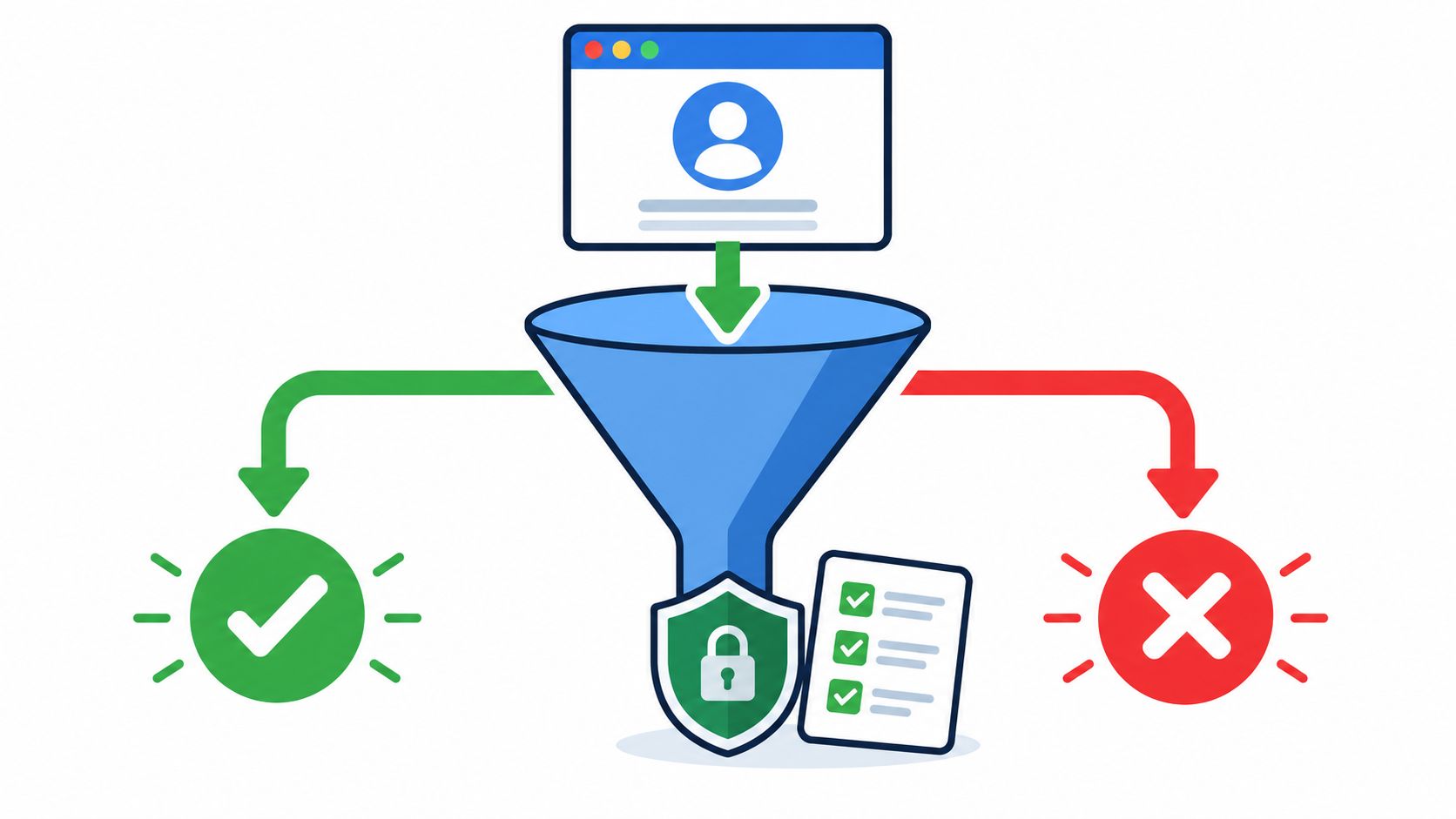
A traffic funnel can illustrate classification, but rollout decisions need a more precise ledger. Proposed blocks and enforced blocks must remain separate, and both must connect to application outcomes.
| Measurement | What operators should investigate |
|---|---|
| Legitimate completion | Whether known-good attempts still finish the protected action |
| Abandonment after verification | Whether visitors leave at the newly introduced checkpoint |
| Support contacts | Reports of signup, recovery, or checkout failures |
| Duplicate submissions | Whether retries produce inconsistent results |
| Replay attempts | Whether reused proofs are rejected as intended |
| Authentication and payment outcomes | Whether downstream systems still complete expected operations |
Successful completion alone doesn't prove an attempt was legitimate. Teams should reconcile verification evidence with application outcomes, abuse reviews, and support findings. Otherwise, an attacker who successfully creates accounts may be counted as a healthy conversion.
Release criterion: Enforcement needs an explicit user-impact threshold and an owner who can reverse the change.
Make the first policy narrow and reversible
The Observe-before-enforce rollout guidance is a useful basis for a reviewable deployment plan. The initial scope should be small enough that operators can explain every relevant failure category.
Select a route: Name the protected action and the backend handler that commits it.
Inventory callers: Identify browser users, testing tools, integrations, and legitimate non-browser access.
Define completion: Specify the application event that represents a finished attempt.
Set thresholds: Establish acceptable user-impact limits and the evidence required to block.
Retain a fallback: Document how legitimate callers recover without creating an unchecked bypass.
Prepare rollback: Record the policy version, owner, and procedure for returning to observation.
Review grouped evidence by action and relevant caller context. Aggregate blocked-request totals can conceal a broken recovery flow or checkout regression; they shouldn't be the release criterion.
A worked example and the implementation checklist
Synthetic example: A SaaS application wants to protect account creation without interrupting every visitor. Its signup handler creates an account and grants introductory access, so automated creation can consume benefits even when no existing account is compromised.
The team starts by defining the protected operation as account creation, not page viewing. Frontend evidence collection begins before submission, while the backend remains responsible for deciding whether the account can be created.
Follow the operation through the backend
The browser submits signup data and its proof. The backend identifies the expected signup action from its own route configuration, then sends the proof for current server-side verification. It doesn't accept a client declaration that the request belongs to a less restrictive action.
After verification, the application checks whether the operation has already completed. A repeated submission with the same business-operation key returns the established result where appropriate, rather than creating another account.
Normal account validation still runs. The backend validates fields, enforces account-creation rules, handles identity verification as required, and applies authorization when granting access. Browser verification neither validates an email address nor establishes entitlement to introductory benefits.
Initially, a proposed rejection is recorded rather than enforced. Operators investigate legitimate signup failures and confirmed abuse before approving a blocking policy for that route.
Preserve the companion controls
The implementation checklist should travel with the backend change:
Rate limits: Apply per-identity and per-endpoint limits, with additional keys suited to the workflow.
Credential security: Keep breached-password checks and appropriate MFA requirements alongside browser evidence. OWASP's credential-stuffing prevention guidance supports a layered approach rather than reliance on IP blocking alone.
Business-operation handling: Preserve idempotency, durable results, and documented retry semantics.
Payment controls: Checkout deployments still need payment-provider fraud checks and transaction validation.
Operational review: Test expired proofs, repeated requests, concurrent submissions, dependency failures, and legitimate alternate-device flows.
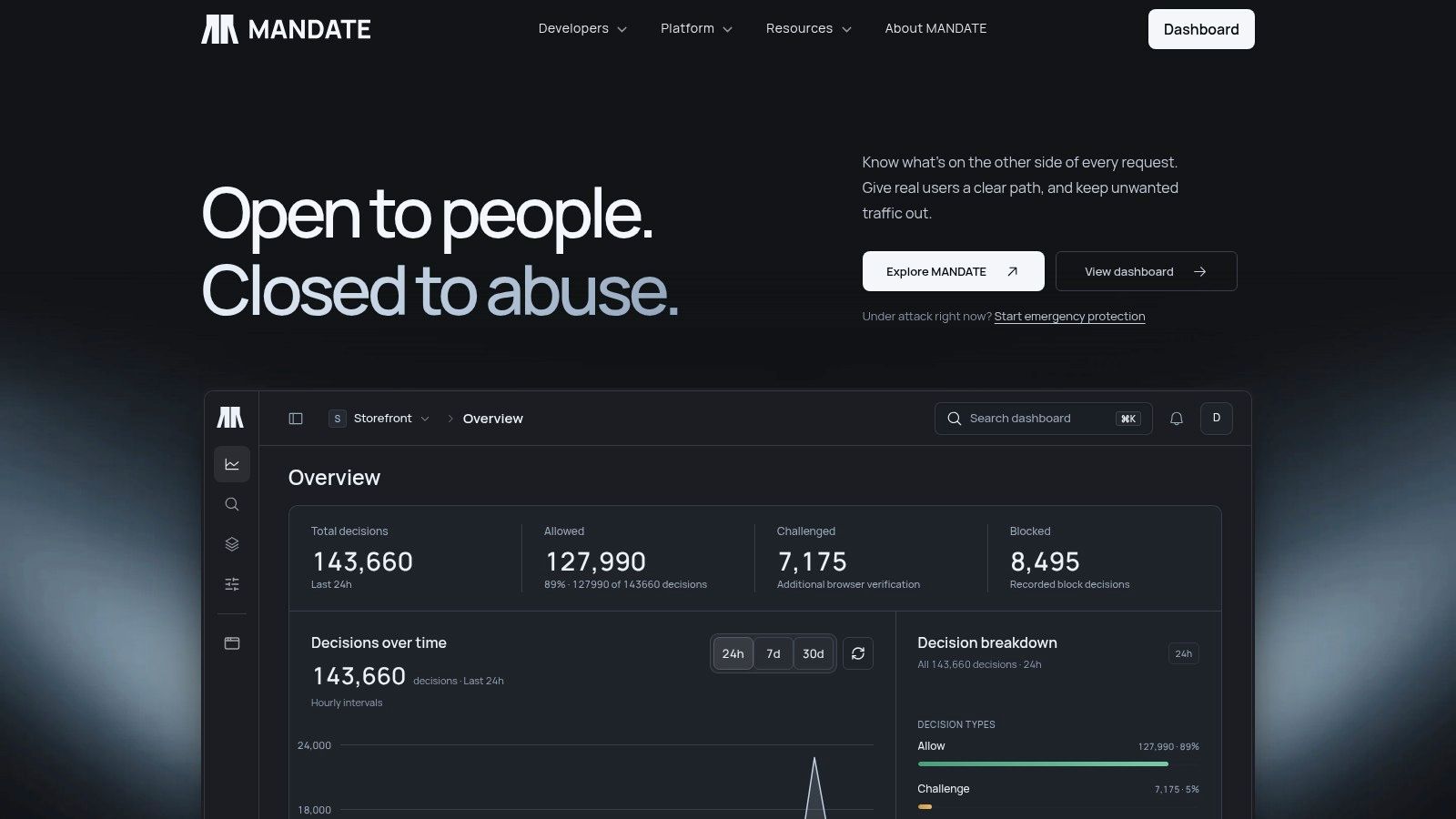
MANDATE is one option for protecting important website actions from automated abuse without CAPTCHAs. Its described integration uses browser evidence, opaque short-lived credentials, hosted server-side verification, and Observe mode. Local cryptographic verification remains limited to an offline emergency tier and legacy compatibility; it shouldn't be presented as the normal deployment path.
Confirm the integration’s current availability and test the actual route contract. Review enforcement independently from documentation.
MANDATE offers CAPTCHA-free browser verification for important actions such as signup, login, and checkout, with an Observe-first path to enforcement. Engineering and security teams can visit MANDATE to evaluate hosted verification against a named endpoint, review legitimate-user impact, and plan a controlled rollout alongside existing application controls.