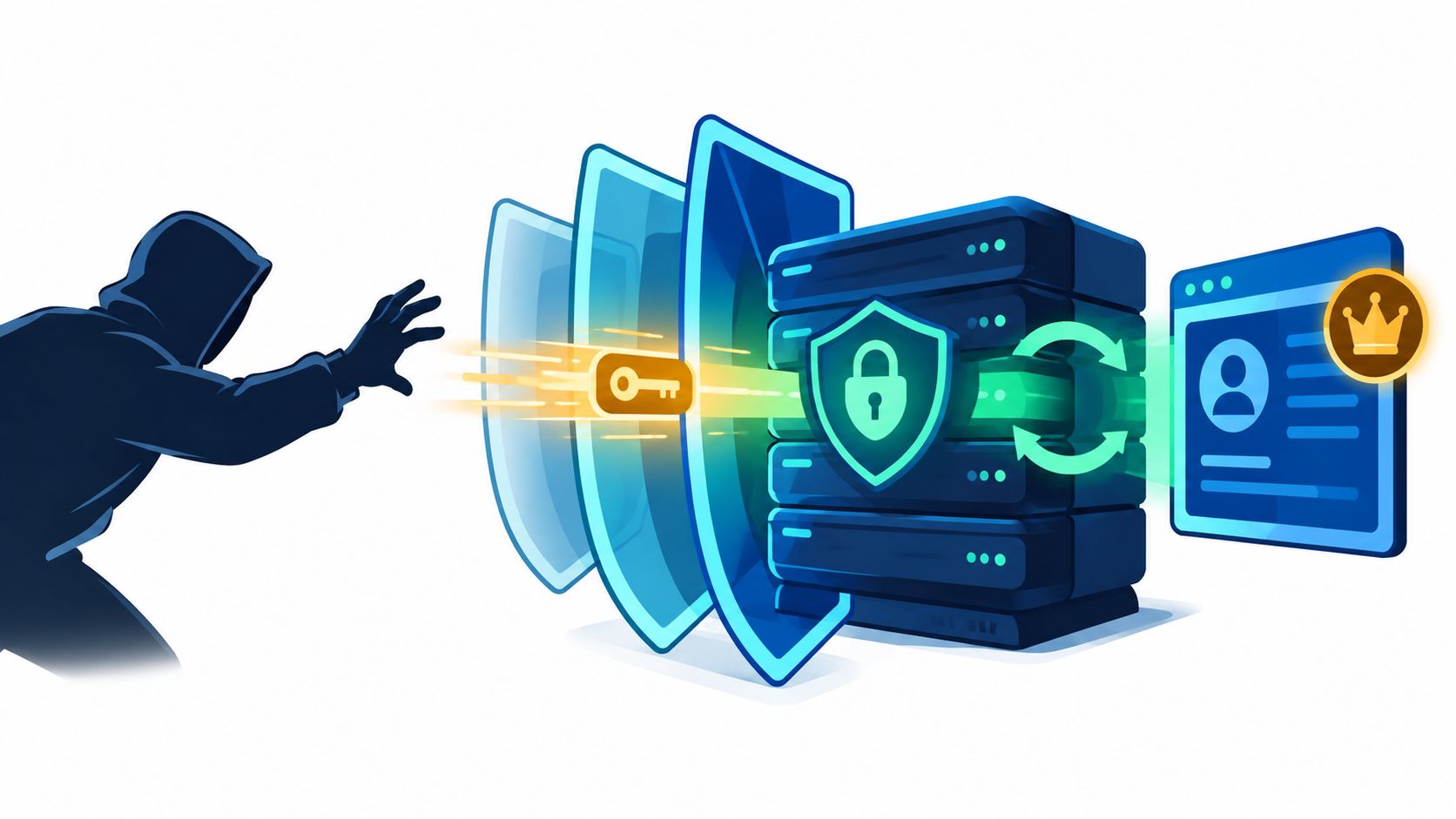
A team has strengthened login, enabled multifactor authentication, and added checks around account recovery. In a synthetic account-recovery scenario, an attacker then submits a stolen session cookie after the legitimate user has finished signing in. The recovery endpoint accepts the cookie and lets the attacker change the account's recovery details.
Session hijacking is the unauthorized use of a valid session identifier, usually a cookie or token, to act as an authenticated user. The attacker may not need the victim's password or another login step, because the application already accepts the session credential as evidence of authentication, as OWASP's session-management guidance explains.
Why Session Hijacking Still Matters
The recovery request looks authenticated. That's precisely the problem: the application must distinguish a valid credential from a legitimate, currently authorized action. A successful login establishes an authenticated session, but it doesn't establish the intent behind every later request.
A bearer credential works like a key. Whoever holds an accepted copy may be able to use it, including someone who never participated in the original login. Strong password authentication remains important, but it doesn't make an already-issued session impossible to steal or misuse.
Protect the action, not just the login
In the synthetic recovery flow, the dangerous design decision is allowing possession of the cookie to settle every subsequent security question. The application still needs to determine whether recovery is permitted, whether additional verification is required, and whether the submitted change matches current account state.
Engineering teams should separate their immediate priorities:
Reduce exposure: Protect authenticated traffic and handle session cookies securely.
Control continuity: Rotate session identifiers at authentication boundaries and invalidate superseded credentials server-side.
Recheck permissions: Authorize sensitive operations against current account and application state.
Bound acceptance: Give recovery, checkout, and similar actions their own freshness and transaction checks.
These responsibilities belong across authentication middleware, application services, and transaction storage. A login team can issue a well-protected cookie while a recovery service still accepts stale authority.
Practical rule: A valid session should begin the decision about a high-value action, not finish it.
The useful security question isn't whether an attacker can sign in. It's whether someone holding copied session material can complete a recovery, spend account credit, claim a reservation, or change security settings. Reviewing those acceptance points makes session hijacking defense concrete and testable.
How Session Hijacking Differs From Related Attacks
After login, the browser sends a session credential with authenticated requests. The server associates that credential with session state and an account. NIST's session-management explanation describes this continuity as a shared secret: obtaining that bearer secret can enable impersonation without repeating the original authentication exchange.
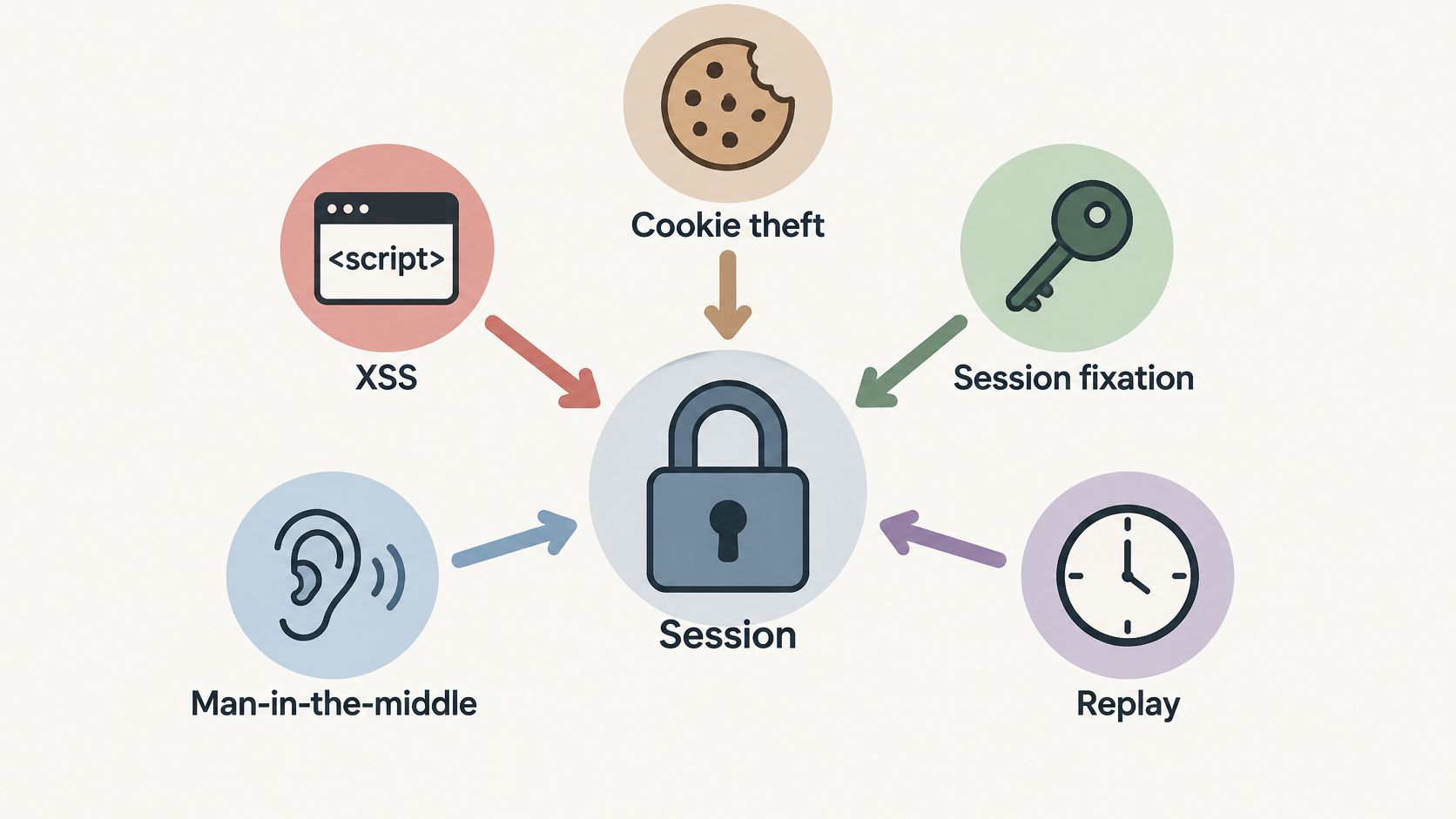
The names of related attacks describe different failures within this lifecycle. They shouldn't become interchangeable labels in an incident report.
Different questions need different controls
| Attack or failure | Security question | Defensive responsibility |
|---|---|---|
| Credential stuffing | Can stolen login credentials establish access? | Authentication controls and login-abuse handling |
| Session hijacking | Can someone misuse an existing authenticated session? | Session protection, invalidation, and sensitive-action checks |
| Session fixation | Does authentication retain an attacker-known identifier? | Session rotation at the authentication boundary |
| Replay | Can previously submitted evidence be accepted again? | Freshness checks and single-use acceptance |
| Broken authorization | Is the authenticated account permitted to perform this operation? | Current server-side permission checks |
Cross-site scripting, or XSS, means attacker-controlled script executes within a trusted website's browser context. It can contribute to session abuse, but script execution and session theft aren't identical events. Man-in-the-middle interception describes an attacker positioned along a communication path; whether it exposes session material depends on the transport and surrounding controls.
These paths can cooperate. An attacker might obtain credentials, establish access, capture session material, and later replay an action request. Incident analysis should preserve that sequence rather than attribute every step to a single mechanism.
Separate access from permission
An authenticated customer attempting to modify another customer's order presents an authorization problem even if no session was stolen. Conversely, a stolen session may carry permissions that legitimately belong to its victim.
This distinction helps teams investigate account takeover fraud and its underlying access paths without treating every unauthorized outcome as a password failure. A valid cookie proves possession, not necessarily current intent, freshness, or continued control of the endpoint.
Examine the Main Session Hijacking Vectors
Consider a synthetic checkout in which a signed-in customer reviews a basket before submitting payment. The review should follow each attack path from its entry condition to the evidence available and the defensive layer responsible.
Trace the entry condition
Cookie theft: Session material escapes through browser compromise, unsafe storage, or logging. The attacker submits it from another client. Teams should inspect credential handling and correlated session activity, while removing raw credentials from diagnostic pipelines.
XSS: Unsafe rendering allows hostile script to execute in the checkout's browser context. Review injection points and unexpected script activity. Secure rendering and Content Security Policy, or CSP, should reduce script-execution paths; cookie protections alone shouldn't be treated as a complete response.
Session fixation: Checkout inherits an identifier known before authentication. Inspect whether the identifier changes at login and whether the old value remains accepted. The primary correction belongs at session establishment, not payment processing.
Transport interception: Authenticated traffic crosses an unprotected connection. Examine transport enforcement throughout the journey, including redirects and secondary routes. Transport Layer Security, or TLS, must protect the authenticated session, not merely the login form.
Replay: Previously captured checkout evidence is submitted again. Review repeated credential use and acceptance records. Action-specific freshness and consumption checks should distinguish a fresh submission from reused proof.
TLS must protect the complete authenticated journey. Encrypting only the login form leaves later traffic exposed if it travels over plaintext HTTP.
Match defenses to the failure
The same review applies to recovery flows, where a successful login can precede a separate, sensitive account change.
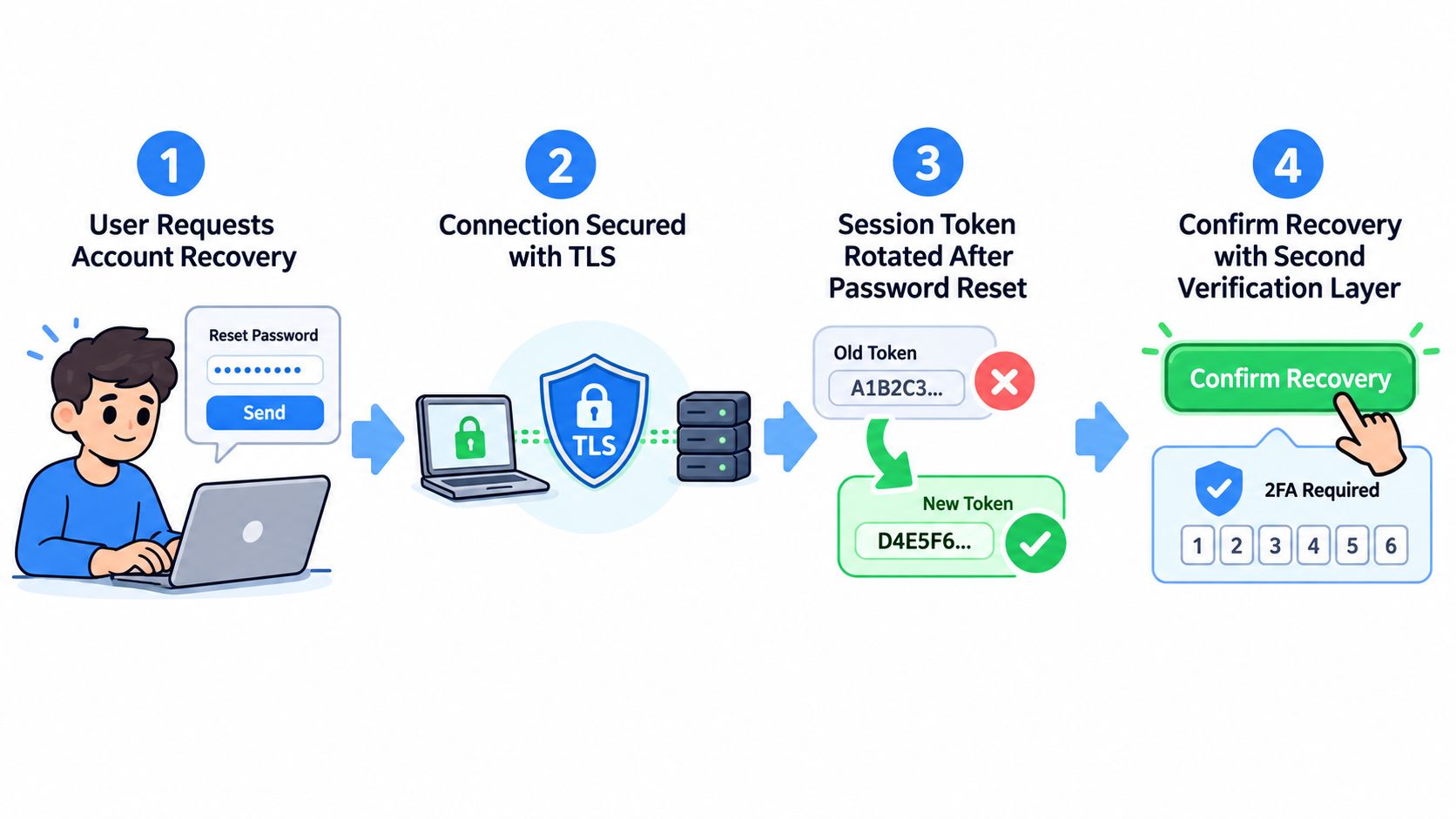
Secure cookies, TLS, rotation, CSP, HTTP Strict Transport Security (HSTS), bounded lifetimes, and action binding address different conditions. Teams should test them as a layered design rather than infer complete protection from any individual setting.
In particular, preventing script from reading a cookie isn't the same as preventing malicious script from making requests inside the browser. A checkout review must cover both exported credentials and hostile execution within the existing authenticated context.
Detect Hijacking and Prioritize Logging
Detection should produce a decision an application can apply. A changed browser characteristic might justify observation; continued use of a revoked identifier demands a different response. Treating both as a generic suspicious-session event makes investigations harder.
OWASP's cookie-theft mitigation guidance recommends reauthentication as the most reliable response to suspected hijacking: invalidate the session temporarily, authenticate again, and issue a new cookie. It also cautions that contextual changes can have legitimate explanations.
Correlate before intervening
Prioritize events that connect suspicious behavior to session lifecycle state:
Rotation mismatch: An old identifier continues appearing after its replacement.
Context divergence: The same session appears in materially different client contexts alongside sensitive-action attempts.
Refresh inconsistency: Requests don't follow the application's expected credential-renewal sequence.
Weak context changes: A user-agent string or network changes without corroborating evidence.
These are review priorities, not universal identity tests. Mobile network transitions, privacy tools, and normal browser behavior can complicate interpretation. Teams should evaluate the combination of signals and the consequence of the attempted action.
Record the acceptance decision
A useful event schema should include:
Request context: Action, route, method, timestamp, and correlation identifier.
Session context: Protected or redacted session reference, credential age, and rotation generation.
Security decisions: Verification outcome, authorization result, and intervention applied.
Business outcome: Idempotency result, transaction status, and legitimate completion event.
Raw cookies and action secrets don't belong in these records. A protected reference should support correlation without becoming another reusable credential.
A blocked request isn't an investigation outcome. The record should show what failed, what intervention occurred, and whether the business action completed.
Response policy should be proportionate. A weak contextual anomaly may remain under observation; stronger evidence may justify holding checkout, requiring reauthentication, or invalidating affected sessions. Investigators should then trace related recovery changes, orders, or reservations rather than stop at the rejection event.
This separation also helps support teams explain interrupted actions without presenting an uncertain detection signal as proof of wrongdoing.
Build Preventive Session Controls Layer by Layer
Use established framework session management. For custom session IDs, OWASP recommends at least 128 bits from a cryptographically secure random generator. Protect authenticated traffic, invalidate sessions server-side at logout, and rotate identifiers at authentication and privilege changes.
Session state should remain under server control. Browser deletion alone shouldn't determine whether a credential remains valid, and logout should reach every service that can accept it.
Session Defense Control Matrix
| Control | Primary Failure Addressed | Useful Evidence | Residual Limitation |
|---|---|---|---|
| Unpredictable identifiers and server-controlled state | Guessing and uncontrolled credential acceptance | Issuance records and session-state lookups | A securely generated credential can still be stolen |
| Secure, HttpOnly, and appropriate SameSite cookies | Unnecessary cookie exposure and cross-site transmission | Cookie configuration and browser tests | Doesn't establish intent or eliminate hostile browser execution |
| TLS and HSTS | Exposure through insecure transport | Transport-policy and redirect tests | Doesn't protect credentials already exposed at an endpoint |
| Rotation, timeouts, and invalidation | Continued acceptance of stale credentials | Rotation generations and revocation events | Requires consistent enforcement across services |
| Secure rendering and CSP | Script-injection execution paths | Rendering tests and policy reports | Doesn't make every script or browser trustworthy |
| Action credentials and authorization checks | Reused proof and invalid sensitive operations | Consumption records and permission decisions | Doesn't replace transaction validation or idempotency |
Review the uncomfortable trade-offs
Cookie policy needs testing against legitimate cross-site journeys. A setting that appears strict in isolation can disrupt sign-in redirects or other intended flows. Exceptions should be explicit and tested, rather than introduced through broad weakening of the policy.
HSTS tells a browser to require secure transport after receiving a valid policy response; it doesn't repair a leaked cookie. CSP should accompany secure rendering, not substitute for fixing an injection vulnerability.
Timeouts also have distinct purposes. An overall timeout bounds session duration, while an inactivity timeout reacts to an absence of activity. Shorter lifetimes can limit exposure but may interrupt legitimate work, especially during checkout or recovery.
Client-context binding deserves similar restraint. An address or device signal can inform a risk decision, but rigid matching can reject legitimate network transitions. These choices fit into broader web application security practices, alongside secure development and operational ownership.
The defensible design assigns a clear responsibility and known limitation to every control. It doesn't assume that enough overlapping settings make session compromise impossible.
Protect a High-Value Action End to End
A synthetic checkout lifecycle demonstrates where session security ends and transaction correctness begins. This is a design example, not production-ready pseudocode or a customer result.
Replay resistance rejects reuse of recorded messages. A proof designed for one-time use needs atomic server-side consumption. Ordinary session cookies remain reusable under their session policy.
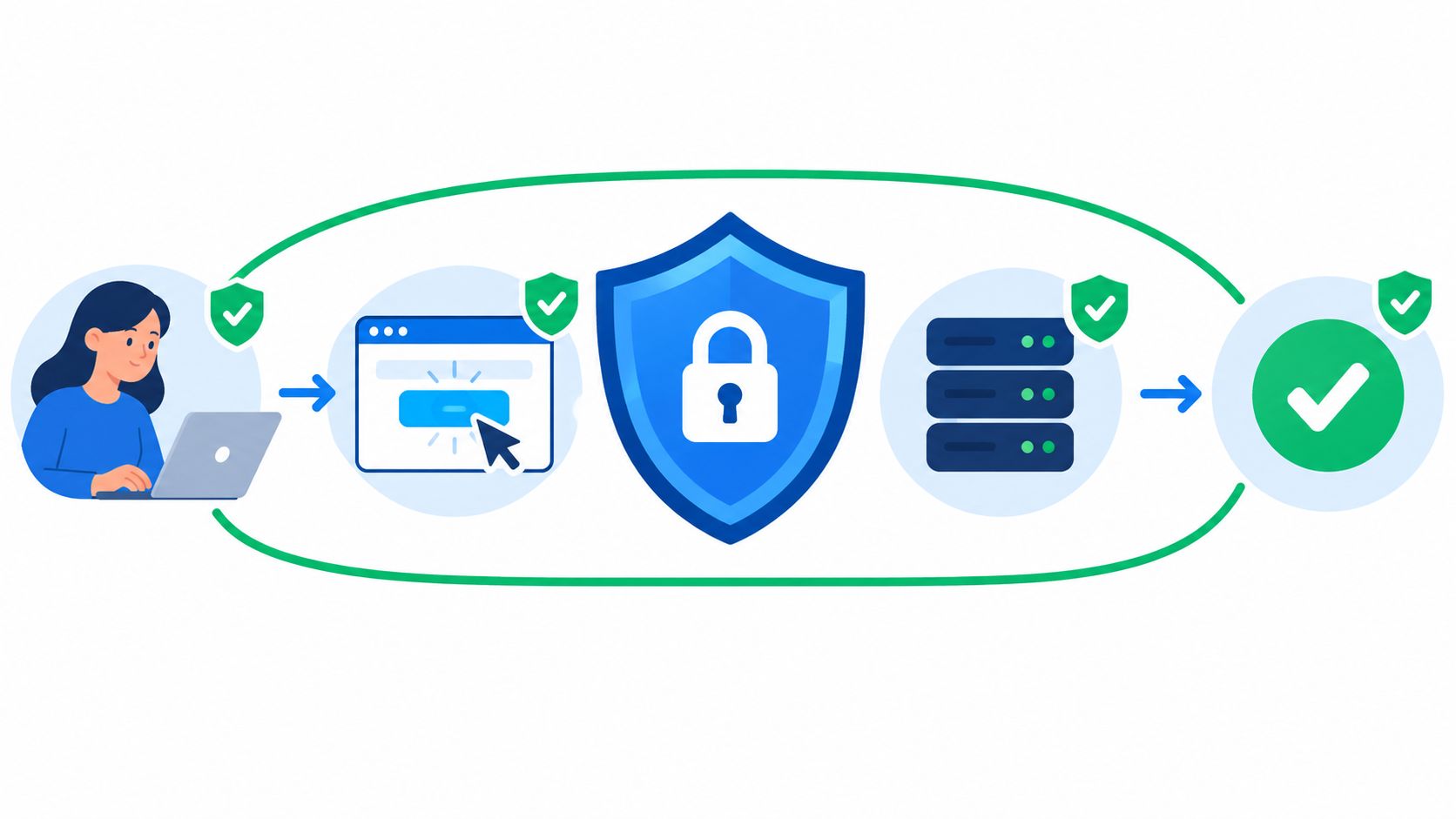
Follow the acceptance path
Establish continuity: Issue the session over TLS and rotate it after authentication or a relevant privilege change.
Prepare the action: Create an opaque, short-lived credential associated with the intended checkout and current server-side session state.
Evaluate the request: Confirm credential validity, expiry, intended action, and session generation before allowing execution.
Authorize the operation: Check that the account can purchase the referenced basket and that the transaction remains valid.
Commit acceptance: Atomically consume accepted proof alongside the relevant transaction transition, or use an equivalent concurrency-safe design.
Record the outcome: Preserve a protected correlation trail connecting verification, authorization, and the business result.
Separate replay from retry
Suppose checkout succeeds, but the response never reaches the customer. The browser retries. Replay protection should prevent reused proof from authorizing another execution; idempotency should let the application recognize an already-accepted operation without creating another order.
An idempotency key therefore needs an explicit scope, ownership check, and association with the submitted operation. Returning an existing result must not bypass authorization or disclose another account's transaction.
Design boundary: Single-use proof governs acceptance. Idempotency governs duplicate business effects.
Checking only the action credential leaves transaction correctness unresolved. Checking only idempotency may prevent duplicate orders while still allowing a stolen session to initiate a different operation.
Middleware can handle credential parsing and session lookup, but the business service must retain authority over permissions, prices, inventory, and commit behavior. Transaction records should connect those decisions so incident queries can distinguish a rejected replay from a legitimate retry.
Add Browser Verification Without Replacing Core Controls
Browser verification adds another acceptance check for actions originating in a website. It should answer a narrower question than authentication: whether the application has acceptable browser evidence for this action under current server-side conditions.
MANDATE is an option for protecting important website actions from automated abuse without CAPTCHAs. Its described integration uses a browser script to collect proof and hosted server-side verification to check current state before acceptance, with opaque, short-lived credentials. The architectural rationale is explained in why browser proof needs server state.
Keep verification in its proper role
For signup, verification can sit beside account-creation limits and application validation. For sign-in, it can complement credential-stuffing defenses without deciding whether the submitted credentials are correct. For recovery, checkout, reservations, and promotion redemption, it belongs before the protected action is accepted.
The described experience is invisible, without checkboxes, puzzles, interstitials, or user-facing challenges. That makes it a CAPTCHA alternative for browser-originated abuse, not proof of human identity.

Verify integration scope before deployment
Normal verification path: Hosted server-side verification checks acceptance against current state.
Limited alternative: Local cryptographic verification is limited to an offline emergency tier and legacy compatibility.
Controlled rollout: Observe mode supports reviewing grouped evidence and legitimate-user impact before applying a policy to a selected action.
Retained responsibilities: Authentication, authorization, rate limits, transaction validation, payment controls, and idempotency remain application concerns.
Browser proof shouldn't become a substitute session cookie with broader implied authority. A positive result should satisfy only its defined verification requirement; the application must still decide whether the operation is permitted and correct.
Integration planning should confirm current availability rather than assume a particular SDK, framework package, or deployment path exists.
Deploy Tune and Respond With Confidence
Start with a selected route and method whose outcome can be measured clearly, such as an account-recovery submission or checkout confirmation. Inventory browser callers, service callers, support workflows, and retry behavior before introducing enforcement. Define legitimate completion separately from a successful verification response.
Observe mode should compare proposed decisions with actual application outcomes. A rejected proof, an authorization failure, and a failed order aren't interchangeable events.
Use explicit promotion criteria
| Operational question | Evidence to review |
|---|---|
| Does the policy affect intended callers? | Caller inventory and route-level events |
| Are legitimate users interrupted? | Completion outcomes and support reports |
| Do failures remain distinguishable? | Verification errors, proposed rejections, and applied interventions |
| Can enforcement be reversed safely? | Tested rollback procedure and named owner |
Thresholds should reflect representative traffic and expected user transitions, not borrowed benchmarks. Teams should establish who can pause enforcement, how interrupted users recover, and which security requirements remain mandatory during rollback.
A verification outage also needs an explicit response. Accepting every request without comment and denying every request without comment are both consequential choices; the application owner should approve the trade-off for the particular action.
Deployment and incident checklist
Browser and transport: Test secure cookie attributes, TLS, CSP, and HSTS throughout the protected journey.
Session lifecycle: Confirm rotation, expiry, logout invalidation, and rejection of superseded credentials.
Action acceptance: Exercise replay checks, current authorization, and transaction validation.
Retry correctness: Test idempotency after lost responses and concurrent submissions.
Investigation readiness: Correlate logs without retaining reusable secrets, and rehearse reauthentication and revocation.
Adversarial coverage: Retest cookie theft, XSS, fixation, replay, expired sessions, and legitimate network changes.
Ongoing review: Recheck sources, integration availability, policy behavior, and customer impact after material changes.
A deployment review should end with evidence that each layer behaves as intended, including its failure path. Session hijacking defense becomes operationally useful when teams can explain not only why a request was rejected, but also whether the protected action succeeded.
For teams protecting browser-originated actions, MANDATE offers verification without CAPTCHAs alongside existing session and application controls. Engineering and security teams can review its integration materials, select a sensitive route, and evaluate Observe-mode evidence before deciding where enforcement belongs.