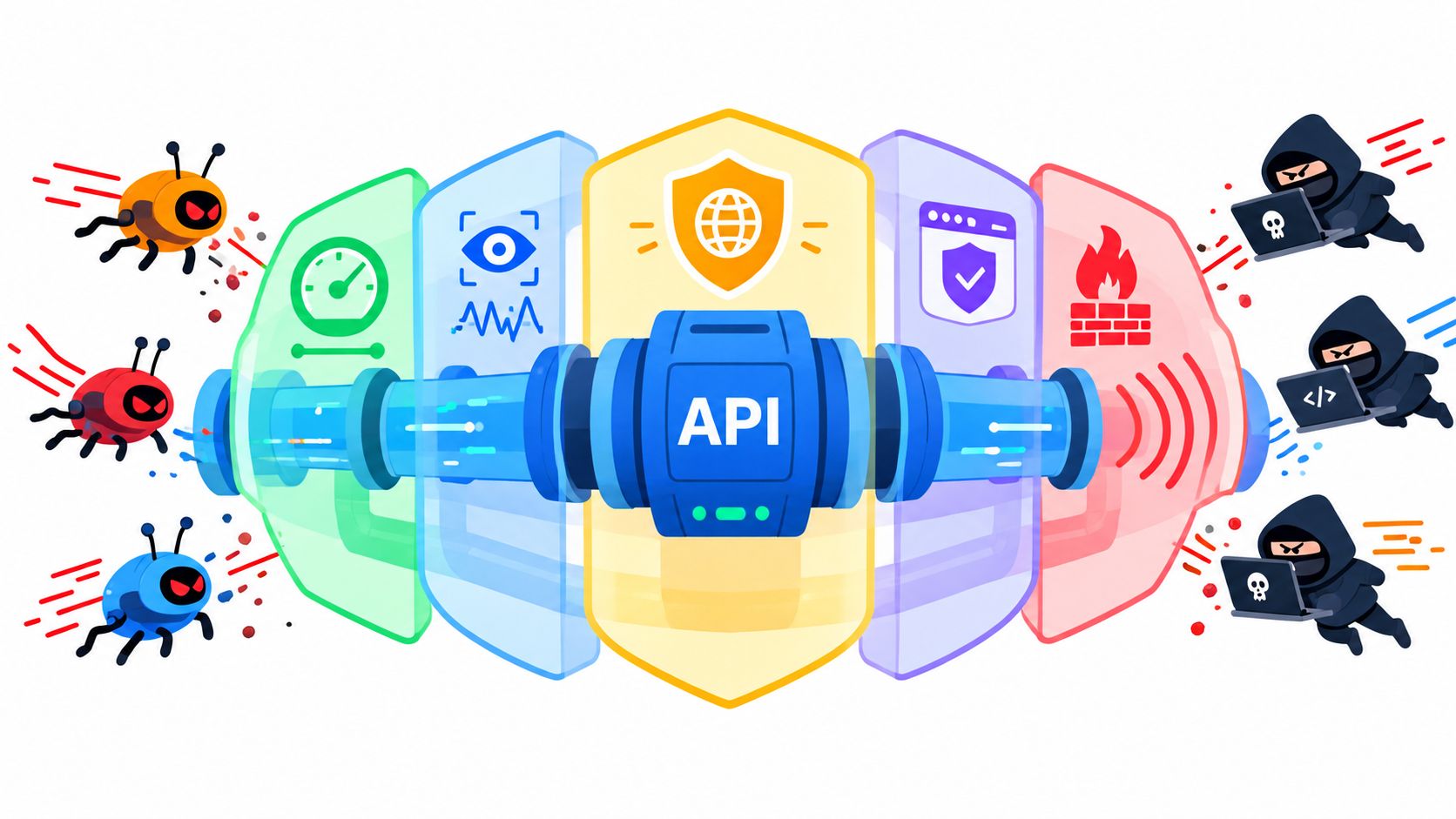
Most advice on api abuse starts in the wrong place. It tells teams to scan for missing authentication, block suspicious IPs, and tighten the perimeter, as if the attacker has to look obviously fake to do damage. In production, the harder problem is more subtle, because an attacker can use valid credentials, pass normal login checks, and still automate harmful actions at scale.
That's why the true unit of defense is not the endpoint, it's the business action. Signups, logins, password recovery, checkouts, refunds, and inventory reservations all have different abuse patterns, different cost profiles, and different blast radii. If you only protect the API surface, you miss the part that matters.
A useful external reference for teams building secure commerce flows is API2Cart's guide on secure eCommerce integrations, because the security model has to match how high-value actions behave in practice. The same principle applies across SaaS, ticketing, and consumer apps. Protect the action, not just the route.
Table of Contents
- Redefining API Abuse Beyond Perimeter Attacks
- Common Attack Patterns Targeting Business Logic
- Instrumenting APIs for Accurate Detection
- Building a Layered Mitigation Strategy
- Deployment Options and Safe Rollouts
- Implementation Checklist and Monitoring KPIs
- Addressing Common Operational Questions
Redefining API Abuse Beyond Perimeter Attacks
Treating api abuse as a perimeter problem misses how real attacks work. The request can be authenticated, the payload can look valid, and the abuse can still be the point. Salt Security's research showed why teams cannot rely on perimeter checks alone, malicious API traffic rose by 681% while total API call volume rose by 321% in the same period, and 95% of surveyed professionals said their organization had experienced an API security incident in the prior 12 months, with 34% reporting no API security strategy at all and only 11% saying they had dedicated API testing and protection Salt Security report.
Valid authentication is not valid intent
That distinction matters most in production logs. A stolen credential, a compromised session, or a legitimate account can still drive abuse across signups, logins, and checkout flows while every request looks clean. Per the same Salt Security report, 94% of observed exploits targeted authenticated APIs, which is why login success and perimeter controls are not enough on their own.
Practical rule: if your defense stops once authentication succeeds, you are still trusting identity instead of behavior.
Business-logic abuse is the core problem. A refund loop, a coupon replay, a password-reset spray, or a checkout sequence that seems normal one step at a time can still be fraudulent as a chain. MANDATE's model, and any similar invisible browser verification approach described in why browser proof needs server state, is useful because it shifts attention toward server-verified evidence around the action instead of forcing users through a challenge on every request.
Protect actions, not just endpoints
The key question is whether the sequence of actions still looks like legitimate human behavior when you inspect it over time. That is why teams need operation-level controls tied to specific workflows, not generic rate limits applied at the edge.
A workflow-first mindset also changes ownership. Security teams cannot do this alone, because fraud teams know abuse patterns, application engineers know state transitions, and backend developers know which actions are expensive or irreversible. The best control plan comes from that shared view, and a practical starting point for commerce teams is secure eCommerce integrations, since high-value actions need protections that match how they behave in production.
Common Attack Patterns Targeting Business Logic
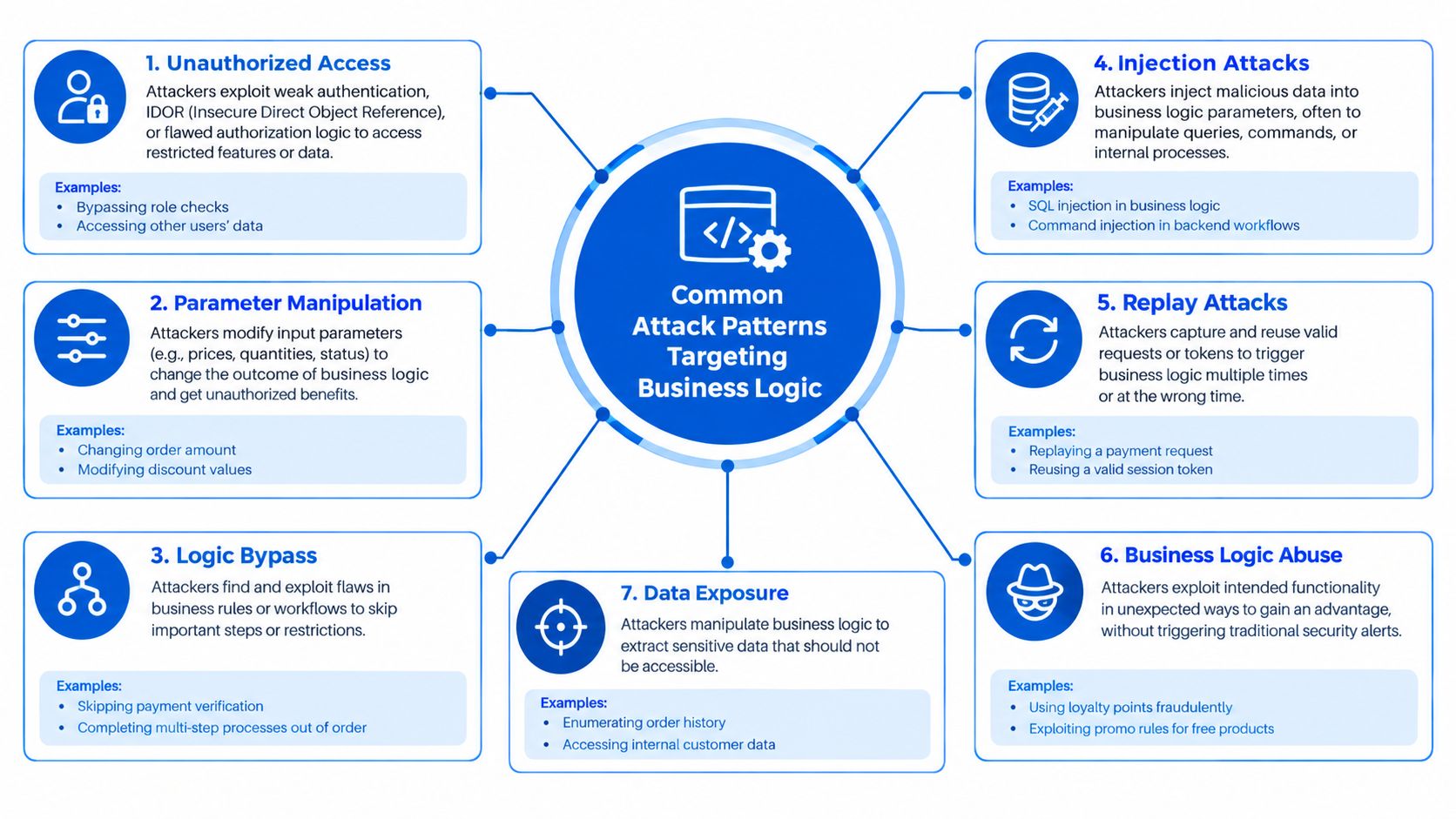
Attackers don't need exotic techniques when the workflow itself is the weakness. They rotate identifiers, reuse valid tokens, spread requests across infrastructure, and make the traffic look ordinary enough to pass basic checks. Datadog's GitHub research shows the pattern clearly, because many requests hit public or authenticated paths cleanly, and the concern is the aggregate behavior, not a single failed request Datadog GitHub API abuse research.
The patterns that slip past simple controls
Credential stuffing is the obvious one, but it's only the start. Once an attacker gets a foothold, they can reuse refresh tokens, replay accepted requests, or automate a sequence of individually valid actions that should never happen at machine speed. The problem isn't a single bad request, it's a request chain that exploits business logic.
The mechanics are usually boring, which is part of why they work. Attackers distribute traffic across cloud hosts, several user agents, multiple API keys, and many sessions so no single source crosses a simple threshold. That's why IP blocking, gateway rules, and “login succeeded” signals are weak as standalone controls.
An internal reference that helps explain the replay side of this problem is what a replay attack is, because replayed material can be just as dangerous as stolen credentials when the server can't tell whether the proof is fresh.
Why legitimate-looking traffic is dangerous
Datadog's findings on GitHub abuse are a good reminder that attacker behavior often blends in at the request layer. Most of the activity targeted public data or authenticated API routes, returned successful responses, and still served reconnaissance or access goals. That pattern maps directly to product APIs, because a checkout API, a voucher API, or a password-recovery API can also be abused while every request looks structurally valid.
A successful response isn't proof of legitimate intent, it's only proof that the server accepted the request.
The practical response is to examine scope, sequence, and rate together. Scope asks whether the actor is touching the right object. Sequence asks whether the order of actions makes sense for a human workflow. Rate asks whether the pace is plausible for that same workflow. If you only look at one of those dimensions, the attacker will usually find the blind spot.
Instrumenting APIs for Accurate Detection
Good detection starts with measurement that reflects business impact, not just traffic volume. Counting raw HTTP requests helps with capacity planning, but it misses the core question: did the request complete a signup, a checkout, or a password reset that changed account state?
Measure outcomes, not just traffic
Give each important operation its own budget and baseline. Authentication, password recovery, inventory reservation, and checkout should not share one generic threshold, because each carries different cost and abuse risk. Expensive requests can still consume CPU, memory, storage, or third-party capacity even when they are technically valid.
Use event data that captures the operation name, actor identity, session, device or browser proof, result, and downstream effect. Store the final business outcome beside the raw request. A flood of password-reset requests matters, but a smaller number of successful resets can be more dangerous.
Idempotency is the pattern many teams miss. If a client retries a request, the server should know whether it is the same intent or a fresh action. The idempotency key approach gives engineering teams a cleaner way to separate retry behavior from abuse.
Build shared ownership into the schema
Security, fraud, and application teams need one schema, not three disconnected logging conventions. If security logs “request blocked” while product logs “order created,” reconciliation becomes manual and slow. Put the business operation, the decision outcome, and the enforcement reason into the same event stream.
A practical event record should answer four questions:
- What operation happened? Name the business action, not just the path.
- Who or what performed it? Capture account, session, device proof, and API key when relevant.
- What changed? Record whether state moved.
- Was the action expected? Compare it to the baseline for that operation.
That structure makes tuning possible. You can see whether legitimate customers are being challenged too often, whether abuse is slipping through, and whether the control is protecting revenue without breaking conversions. Without that visibility, teams either over-block or under-block.
Building a Layered Mitigation Strategy
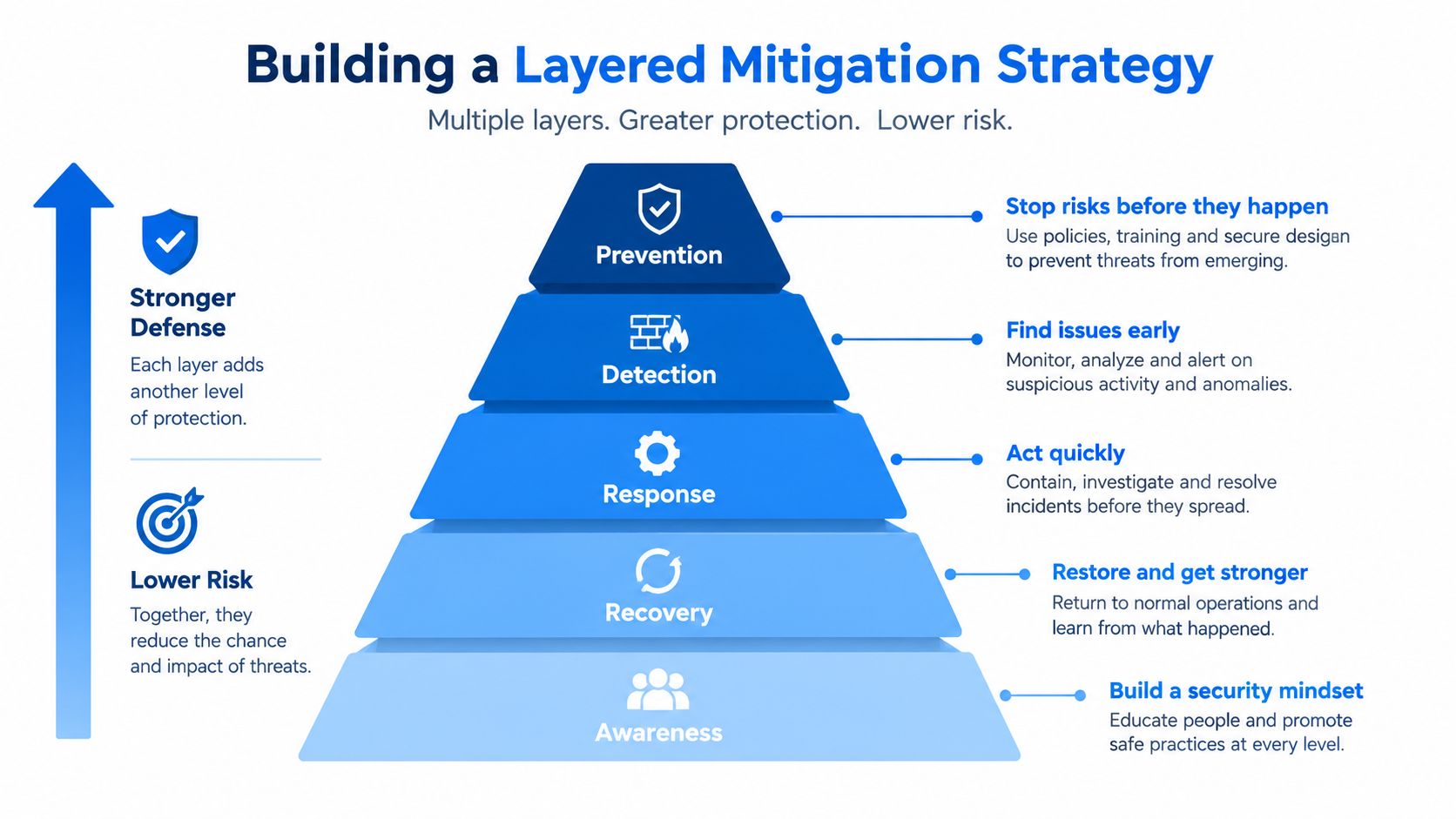
The strongest defense pairs request frequency controls with request cost controls and server-verified proof about the browser or client. A single layer will not hold up for long, because attackers can work around simple IP limits, replay tokens, or spread traffic across enough sessions to stay under a threshold. OWASP's treatment of unrestricted resource consumption is a useful reminder to cap both how often a request can happen and how expensive each request can be.
Constrain cost and frequency together
Start with semantic quotas. A password reset, OTP validation, checkout submission, or inventory reservation should have a tighter budget than a read-only catalog call. Then add payload limits, timeouts, bounded pagination, and caps on multi-operation requests so one request cannot burn through too much compute or downstream capacity.
The trade-off is clear. Coarse limits can break legitimate spikes, while loose limits give abuse room to grow. Short burst ceilings and longer rolling quotas work better, especially when they are set at the operation level. If a person can reasonably complete a flow once or twice, but not fifty times in a minute, the policy should say that plainly.
Add invisible browser proof at the server
Server-verified browser proof shifts the control point. The client collects proof without interrupting the user, and the server checks it before expensive or irreversible actions. That matters because a stolen token should not be enough to push through a high-value transaction if the proof does not match the expected browser context.
For teams that need a practical reference on request authentication, how to authenticate API requests is a useful complement, because proof-based controls still sit beside standard authentication rather than replacing it.
Practical rule: use browser proof to raise confidence before the action, then let application logic decide whether the action is allowed.
The best result is layered friction. Low-risk traffic moves through. Suspicious automation gets challenged or flagged invisibly. High-risk actions get blocked only when the evidence is strong enough. That protects the business without turning every user journey into a CAPTCHA queue.
Deployment Options and Safe Rollouts
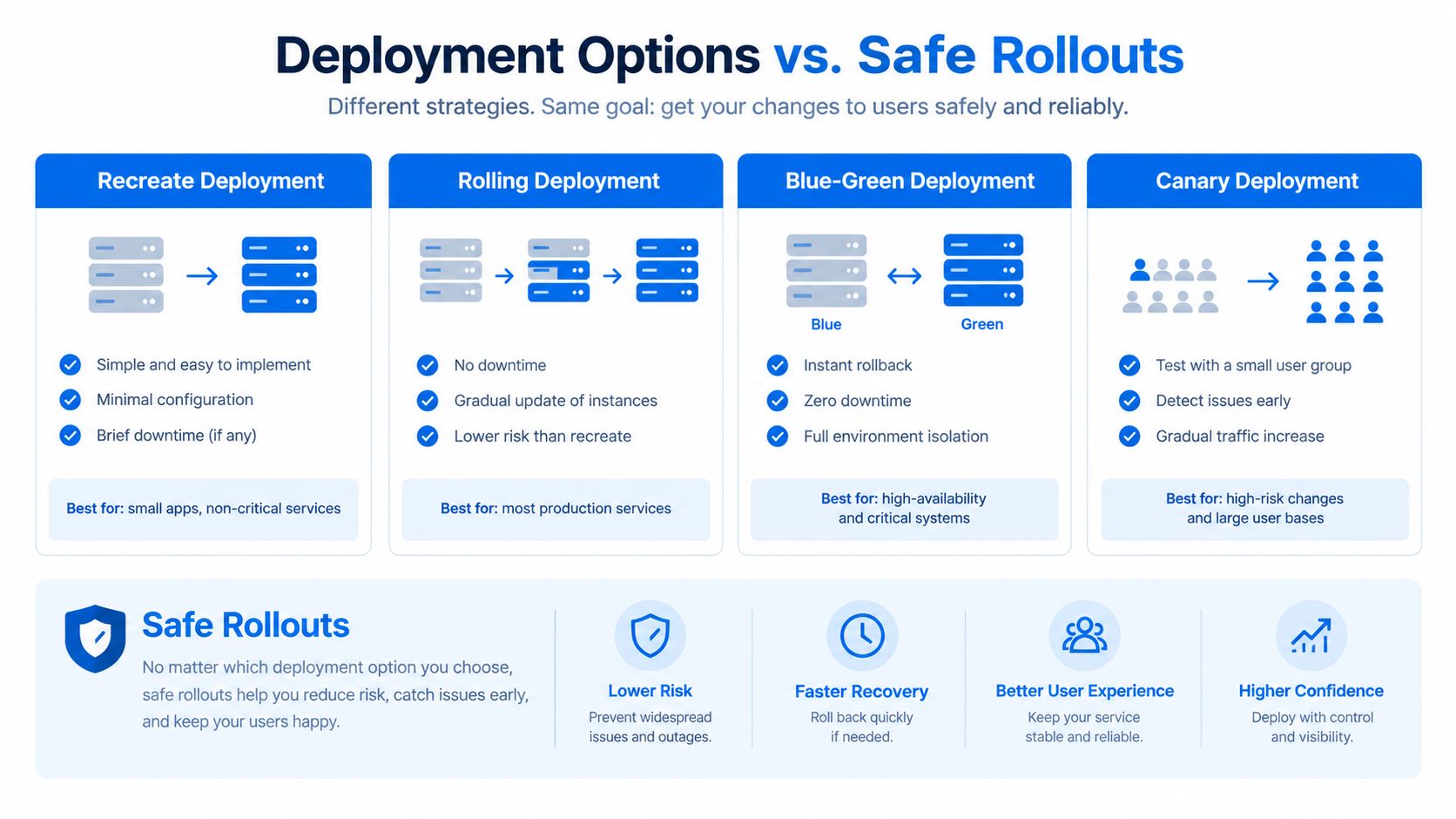
Where you enforce matters as much as what you enforce. Edge deployment gives you early interception and broad coverage. In-app middleware gives you the deepest business context. Cloud-native integration sits in the middle, usually trading some latency and architectural simplicity for less direct control.
Pick the layer that matches the decision
If the control needs to stop traffic before it reaches your app, edge or CDN-level enforcement is the natural fit. If the decision depends on application state, such as cart contents, refund history, or account age, middleware is usually better because it has more context. Cloud-platform integration works well when the organization wants centralized policy without rebuilding every service.
A useful partner mindset here is the same one you'd apply to a custom software development partner, because integration work is rarely just about dropping in a library. It's about fitting the control to existing release practices, observability, and app architecture without adding avoidable risk.
Use Observe mode before you block
The safest rollout path is observation first, enforcement second. In Observe mode, the system records suspected automation, decision outcomes, and likely false positives without blocking traffic. That lets teams compare the proposed policy against real user behavior before they turn on active prevention.
That staging matters because abuse controls can fail in two directions. Too loose, and fraud gets through. Too strict, and legitimate conversion drops. Observe mode gives you a way to tune the policy against actual traffic, not assumptions.
Rollout rule: never promote a rule to blocking until you've reviewed what it would have done to legitimate completions.
For teams protecting signups and checkouts, the practical sequence is simple. Start close to the request origin if you can, keep business logic in the application, and use observation data to decide where enforcement belongs. That combination keeps latency manageable and makes rollback easier when the policy needs refinement.
Implementation Checklist and Monitoring KPIs
A layered control only works if the implementation is disciplined. Teams often wire up the proof collection and forget to define how decisions are made, or they enable blocking before they've measured false positives. That creates either blind spots or outages.
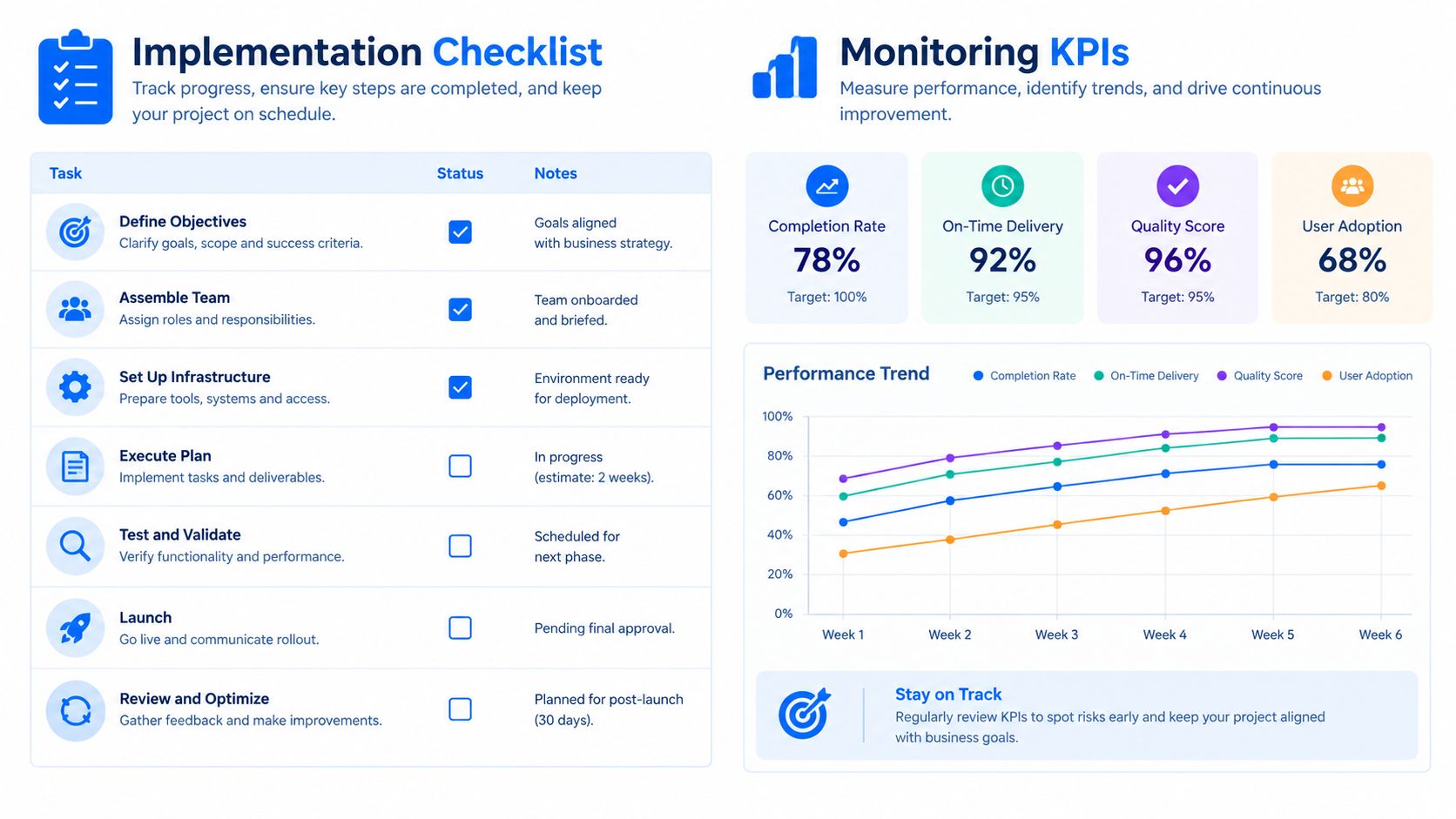
Practical rollout checklist
- Map the high-value actions first. Signups, logins, password recovery, checkout, refunds, and inventory reservation should be explicit use cases, not generic “protected routes.”
- Instrument business outcomes. Capture whether the action completed, failed, or was challenged, and tie that to account and session context.
- Add client-side proof collection. Keep it invisible to users, and make sure the browser evidence can be tied to the right request.
- Verify on the server. Never trust a client claim without server-side validation.
- Start in Observe mode. Review decisions, false positives, and completion rates before you block anything.
- Promote policies gradually. Move the highest-confidence rules into enforcement first, then tighten from there.
KPIs that matter
The best KPI is usually not raw blocked traffic. It's the relationship between abuse reduction and legitimate completion. If you block more bad requests but also reduce successful signups or checkouts, the policy needs work.
Track these outcomes together:
- Challenge rate: how often users or sessions get additional scrutiny.
- Block rate: how often traffic is denied after verification and policy evaluation.
- False positive rate: how often legitimate activity is interrupted.
- Completion rate: whether real customers still finish the workflow.
- Escalation quality: whether suspicious cases are being flagged for the right team.
If your metrics show that blocks are rising while completions stay stable, the policy is probably doing useful work. If completions fall sharply, the problem is likely in your thresholds, your proof validation, or your operation mapping. Good monitoring keeps those trade-offs visible before they become revenue problems.
Addressing Common Operational Questions
The same questions come up every time teams add browser verification and layered rate controls. What about webhooks? What about monitoring agents? What happens if a verification service gets slow? The right answer depends on whether the traffic is human-facing, machine-to-machine, or operationally critical.
Legitimate automation still needs a path
Webhooks, scheduled jobs, monitoring agents, and partner integrations should not be forced through the same controls as human checkout traffic. They need separate rules, separate identities, and separate baselines. If you treat every non-browser client as suspicious, you'll end up breaking infrastructure that keeps the business running.
The cleaner approach is to classify traffic by purpose. Human actions get browser proof and operation-level scrutiny. Trusted machine clients get different keys, tighter scopes, and stricter allowlists. That separation keeps the policy understandable for developers and safer for security teams.
Session continuity and service degradation
Session continuity gets tricky when proof is tied to a browser context. In practice, the answer is to keep verification short-lived and server-side where possible, then re-check only when the action is high risk. That reduces unnecessary friction while still making replay harder.
If a verification dependency slows down, teams should fail closed for the most sensitive actions and fail open only where business risk is low and well understood. That decision has to be explicit before rollout, not improvised during an incident. The worst outcome is an unplanned policy bypass because the system wasn't designed for partial failure.
Don't let a fragile control become the single point of failure for the checkout path.
The teams that handle this well rehearse it. They test what happens when proof is missing, stale, or mismatched, and they define the fallback path ahead of time. That preparation keeps the control useful under load instead of turning it into another outage source.
If you're protecting signups, logins, or checkout flows from automated abuse, MANDATE gives you invisible browser verification with server-side validation so you can distinguish legitimate users from automation without CAPTCHAs. Visit MANDATE to see how it fits into layered API abuse protection, and use Observe mode to tune enforcement before you block anything.