
A signup page can look ordinary while an automated browser fills in the form, establishes a session, and moves toward checkout. The requests may come from a browser that loads JavaScript and follows the same steps as a customer, not a simple script fetching public pages. For engineering teams, that changes the defensive question: not only what content is being collected, but whether an important action is valid, fresh, and authorized when the server receives it.
Artificial intelligence web scraping makes it easier to interpret pages, adapt to changing interfaces, and maintain automated collection workflows. It doesn't create a single new attack, and it doesn't make every scraper dangerous. The practical defense is to separate permitted collection of public pages from actions that change server state, then use layered controls to verify those actions without treating browser evidence as proof of human identity.
Why AI Web Scraping Changes Website Risk
Consider a synthetic scenario. An automated browser opens a signup page, fills in plausible details, and submits the form. Later, it signs in and reaches checkout. The session looks normal at a glance, but the site still has to decide whether to accept each state-changing request.
AI changes the effort required to keep that workflow running. A system can interpret page structure, adjust when a button or form changes, and follow natural-language instructions to collect data or move through a site. The security challenge isn't identifying an unusual user agent. It's deciding which actions are allowed, and whether a request represents a valid, current operation.

A systematic review screened 976 records and identified 91 high-quality studies on large-language-model applications to web scraping and crawling. Of those studies, 76, or approximately 83.5%, appeared in 2024 or 2025. That is a bibliographic indicator of research activity, not a measurement of all real-world scraping or a share of internet traffic, as described in the systematic review of AI-assisted web scraping and crawling.
Separate reading pages from changing state
A crawler that reads public product descriptions poses a different operational risk from a browser automation flow that creates accounts, changes account details, redeems a promotion, or submits an order. Public collection raises questions about policy, permissions, and resource use. A state-changing action also raises questions about authorization, replay, and whether the server's current business conditions still allow the operation.
Teams tracking website bot traffic and its security implications should make that distinction explicit in their route inventory. A bot label can help describe traffic, but it can't establish that an action is authorized or that its details remain valid.
Practical rule: Apply crawler policy to collection, and validate application state before accepting an action. Neither control substitutes for the other.
Browser-origin evidence can contribute to a decision about scripted behavior. It doesn't establish who is at the keyboard, and it can't guarantee that every automated browser will be stopped. The useful goal is narrower: protect legitimate workflows by checking the action and its context, while avoiding friction that doesn't improve the decision.
How Artificial Intelligence Web Scraping Works
A conventional crawler requests a page, and a parser extracts fields using rules such as a known page structure or a selector tied to a particular element. That approach can be fast and predictable, but it breaks when a site changes markup, moves information, or renders important content after the initial request.
AI-assisted systems add flexible interpretation to that process. A large language model (LLM) is a model trained to work with language and other inputs, such as page text or structured content. It can be instructed to find a product name, price, and availability even when those details appear in a layout the scraper hasn't encountered before. Some systems can also suggest extraction code or help revise it after a page change.
From instructions to browser actions
A browser agent is software that controls a browser to move through pages and interact with elements such as links, forms, and buttons. Unlike a crawler limited to fetching public HTML, an agent may be able to work through JavaScript-driven interfaces or maintain a session as it moves through. Those capabilities can support legitimate tasks, but they also mean that the security boundary can't be defined solely by whether a request resembles a basic page fetch.
Supervised learning uses examples paired with correct answers to teach a model to recognize patterns. Labeling is the work of assigning those examples their intended meaning, such as marking which text is a price or which button submits a form. A scraper might use labeled examples to improve extraction across page variations, then use an LLM to interpret a new page or propose a repair when an extraction rule fails.
For practitioners comparing approaches, a guide to AI web scraping tools can help clarify the kinds of products and methods available. The choice of tool doesn't change the need to check that collection is permitted, that extracted values are sound, and that any application action follows the site's security and business rules.
Research activity isn't web-wide traffic
The growth in published research shows increasing technical attention to AI-assisted scraping, not how much of the internet is being scraped. Model-assisted extraction still depends on accessible pages, available data, and the interfaces a scraper can reach. It can also produce incorrect or incomplete fields when a page is ambiguous.
For website owners, the operational point is that flexible interpretation doesn't remove the need for predictable controls. Public-page collection should be governed by appropriate policy and resource limits. Browser actions that alter accounts, orders, or reservations need server-side checks that are tied to the current request and current application state.
Where Models Add Capability and Where Rules Still Matter
The scraping pipeline involves more than extracting text. A system may discover pages, identify fields, interpret documents, interact with forms, label examples, and recover from failed navigation. AI can help with the flexible parts, but a model's interpretation shouldn't become the final authority for data quality or application decisions.
Discovery finds pages or records worth processing. Extraction maps page content into fields. Navigation moves through links or forms. Repair adapts when a layout or interaction changes. Labeling creates examples that help the system recognize the intended content. Each stage has a different failure mode, so teams should check the output at the point where errors matter.
For example, a synthetic catalog scraper is asked to collect product names, listed prices, and stock status. A model identifies those fields on a page after the layout changes and proposes values in the expected schema. A deterministic schema check can still reject a missing stock field or a price that isn't in the expected format. A separate freshness check can flag a value that may no longer reflect the current page.
Flexible extraction still needs deterministic checks
A model can find a likely price, but it can confuse a sale price with a previous price or mistake a shipping amount for the item price. A schema check can verify field types and required values. It can't, by itself, establish that the page is current or that the source was authorized for collection.
For that reason, a controlled pipeline should distinguish interpretation from acceptance. The model proposes what a field means. Rules verify whether the result fits the expected format and business context. Where a downstream action could affect an account or purchase, the application must still validate authorization and transaction details.
The infrastructure impact deserves separate attention. Cloudflare reported that raw GPTBot requests increased 147% between July 2024 and July 2025, while Meta-ExternalAgent requests increased 843% over the same period. Those figures describe Cloudflare's measurements, not a universal rate across the web, as stated in its report on changes in AI crawler activity.
A model can make extraction more adaptable. It can't make an unverified value authoritative.
Teams should measure the practical effect at the request and route level: whether a request is authenticated, whether a session continues, how often the endpoint is called, and whether the response is cached or resource-intensive. That evidence helps distinguish ordinary public-page crawling from activity that puts load on sensitive or costly workflows.
Ethics and Legal Boundaries for AI-Enabled Collection
A common assumption is that robots.txt can settle the question of whether a site is protected from scraping. It can communicate a site's crawler policy, but it doesn't authenticate a request, enforce access control, or prevent an automated browser from reaching a state-changing endpoint.
The distinction matters because a request to read a public page is not the same as an attempt to create an account, reset a password, place an order, reserve inventory, or redeem a promotion. An engineering team should classify these activities separately rather than treating all automated traffic as one category.
Make policy explicit, then enforce access separately
For crawlers that identify themselves, robots.txt and related directives can express which areas the site permits or asks them not to collect. Those instructions can support transparency and help compliant crawlers respect a site's stated preferences. They aren't a security boundary: a disguised or noncompliant client may ignore them.
In the Q4 2024 State of the Bots report, AI bot activity bypassing robots.txt grew by more than 40% quarter over quarter in the report's monitored sample. The figures describe that dataset, not the whole web, but they show why a directive shouldn't be mistaken for enforcement, as reported in the Q4 2024 State of the Bots report.
Policy and access control do different jobs. A crawler directive communicates expectations. Authentication and authorization determine what the application will allow.
Use a documented decision process
Before collecting or permitting collection, teams should be able to answer practical questions:
- Purpose: What is the collection meant to accomplish, and which pages or fields are necessary?
- Access: Is the content public, or does access require an account or another permission?
- Method: Does the activity respect the site's published rules, and does it avoid evading technical restrictions?
- Impact: Could the request pattern place avoidable load on a service or interfere with a state-changing workflow?
- Data handling: Are retention, access, and deletion practices appropriate to the collected information?
These questions support responsible engineering, but they aren't legal advice. Legal teams should review jurisdiction-specific obligations and terms, particularly where personal data or restricted content is involved. Engineers can support that review by documenting the collection purpose, minimizing what is gathered, setting retention controls, and avoiding unnecessary request volume.
The goal isn't to label every crawler as malicious or to assume that publicly accessible data is automatically free to collect. It's to define permitted collection clearly and protect non-public data and important application actions using controls designed for those risks.
Defend Browser-Originated Actions in Layers
No single control answers every security question. Crawler directives communicate policy. Authentication and authorization decide whether an identity can perform an operation. Rate limits restrict volume. Idempotency prevents duplicate effects from retries. Browser-origin verification can add evidence about whether a request came through an expected browser flow.
| Control | Primary failure addressed | What it does not establish |
|---|---|---|
| Crawler directives | Identified crawlers collecting pages against stated preferences | That a request is authentic or that other clients will comply |
| Authentication and authorization | An unauthenticated or unauthorized request reaching protected functionality | That an authorized session is fresh, non-automated, or acting on current transaction details |
| Rate limiting | Excessive request volume against an account, session, network, or endpoint | That requests below the limit are legitimate |
| Idempotency | A legitimate retry creating duplicate effects | That the first request was authorized or free from automation |
| Browser-origin verification | Missing or invalid evidence associated with the expected browser flow | Human identity, full bot detection, or correct business authorization |
Combine volume controls with action checks
An IP-only limit is a useful starting point, but it can miss distributed activity. Session-only limits can be bypassed when cookies are cleared. OWASP recommends applying limits across IP, session or cookie, authenticated identity, and endpoint, and notes those limitations of IP- and session-based controls. It also recommends token-bucket or sliding-window algorithms rather than relying only on fixed-window counters, as described in the OWASP anti-automation guidance.
A token bucket allows a controlled burst while limiting the longer-term request rate. A sliding window tracks requests over a moving period instead of resetting all counts at a fixed boundary. Either approach can help control volume, but the limits should reflect the endpoint and the expected legitimate use.
Idempotency solves a different problem. It gives the application a way to recognize a retry of the same intended operation, so a network retry doesn't create a second order or reservation. Browser verification and server-side state checks address whether the action is fresh and appropriate to accept. Those safeguards complement authentication, authorization, transaction validation, and any relevant payment-provider fraud controls.
For teams investigating how browser-originated actions can be abused through backend endpoints, API abuse against browser-based workflows is a useful related topic. The important design choice is to avoid relying on one signal. A request that passes a rate limit can still be unauthorized, and a valid browser signal can't replace the application's own business rules.
None of these controls proves that a person is operating the browser or guarantees that every real-browser agent will be stopped. Their value comes from addressing different failures together, with enforcement focused on actions where the impact justifies it.
Protect Signups Logins and Checkout Without CAPTCHAs
Start with one action, such as checkout, rather than applying enforcement to every route. Identify the browser and service callers that legitimately reach the endpoint, then define the successful outcome precisely: for example, a valid order is created once, for the current account and current cart, after the required checks pass.
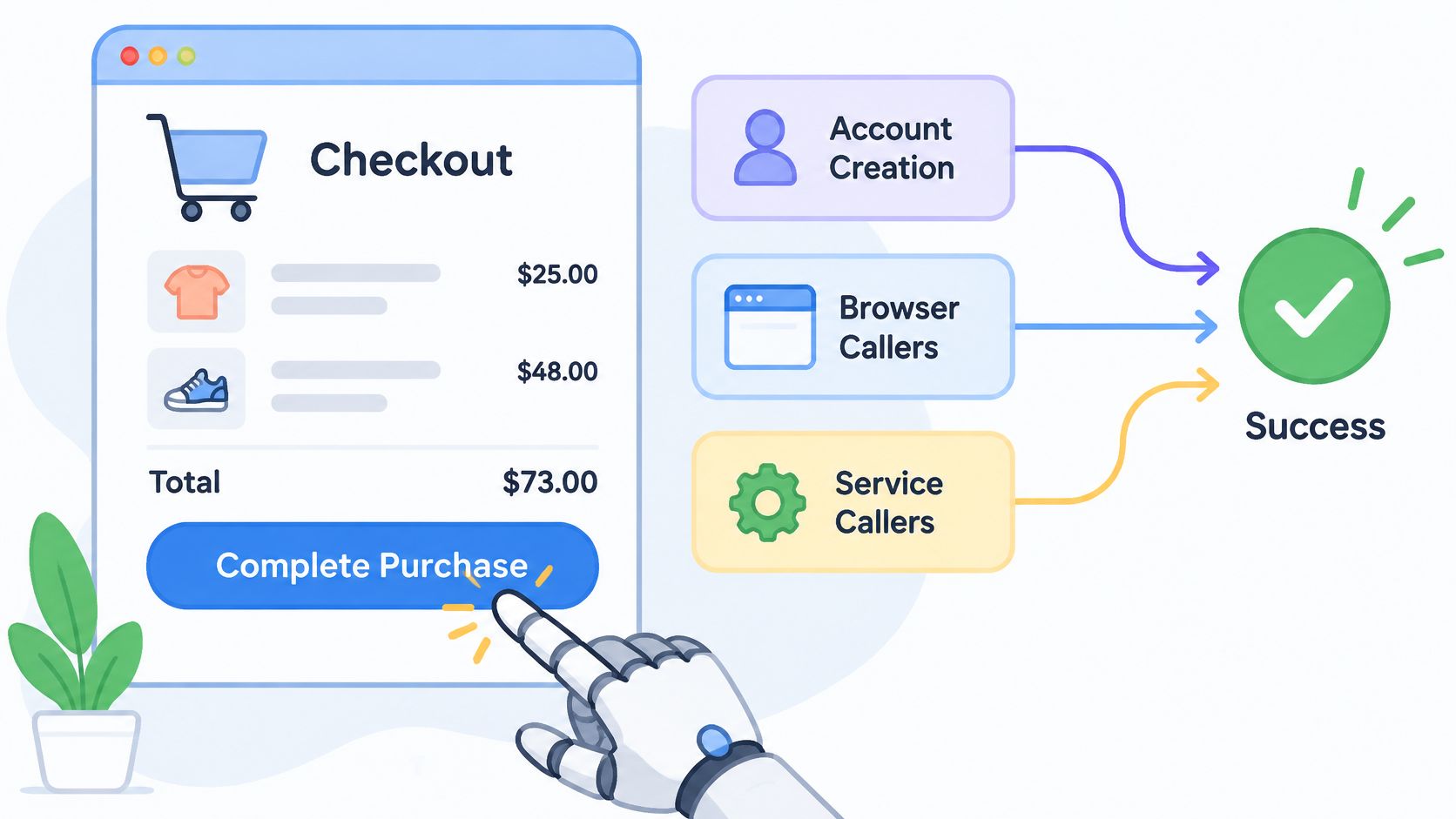
A sound checkout flow checks the user's authorization, the cart and payment details, the current price, and whether inventory is still available. An idempotency key lets the server recognize a retry of the same intended operation, while a new request with changed transaction details requires appropriate validation. Neither check should be treated as evidence that the browser action itself is fresh.
Bind proof to a fresh transaction context
Replay protection means preventing a previously valid proof or request from being reused to perform an operation again. NIST describes replay resistance as relying on a random nonce. Applied to a website action, the server can issue a short-lived transaction context or challenge, require proof tied to that context, and reject proof that has already been consumed. The application must still validate authorization, transaction details, and business rules, as explained in NIST's guidance on replay resistance.
For an implementation that uses browser-origin verification, the browser can collect proof and a hosted server-side check can confirm whether that proof is valid for the current server state before the application accepts the action. Credentials should be short-lived and opaque, and the application should continue to perform its own authorization and transaction checks. This approach can protect browser-originated actions without CAPTCHA puzzles or checkboxes, but it shouldn't be described as proof of human identity.
Observe before enforcing
First, observe grouped evidence for the selected action and review its impact on legitimate users. Separate a proposed decision from an enforced decision, and check whether verification errors or application failures are being confused with abusive activity. Then enable a narrowly scoped policy and monitor the actual business outcome.
Login and account recovery need their own safeguards. Multi-factor authentication (MFA) adds a second authentication factor and is identified by OWASP as the strongest general defense against password-based attacks. OWASP also cites Microsoft's estimate that MFA could have prevented 99.9% of account compromises in its credential-stuffing prevention guidance. Browser verification can add another signal, but it complements MFA and graduated rate limits rather than replacing them.
For teams evaluating browser verification for anti-bot protection, the key questions are operational: what action is being protected, what server state must be current, and how can the rollout distinguish a proposed rejection from an applied intervention? Those answers should be defined before the policy is enforced.
A Practical Checklist for Safer AI Scraping Defense
A useful review starts with route classification. Public pages, authenticated routes, and state-changing actions shouldn't share one undifferentiated bot policy. A product page can have crawler rules and resource limits. Account creation, login, recovery, checkout, reservations, and promotion redemption need checks appropriate to their effects.
Checklist for engineering review
- Classify routes: Mark public collection routes separately from authenticated and state-changing endpoints.
- Record request context: Track authentication status, session continuity, request rate, cache status, response size, and downstream business events.
- Set crawler policy: Publish clear directives for identified crawlers, while keeping access control in the application.
- Limit by endpoint and identity: Use appropriate per-IP, session, account, and endpoint limits instead of treating a single key as sufficient.
- Validate each action: Check authorization, transaction details, business rules, and current server state before accepting a protected operation.
- Bind proof to freshness: Use a short-lived context for important actions and reject proof that has already been consumed.
- Protect retries: Apply idempotency to operations where a repeated delivery could create duplicate effects.
- Review rollout outcomes: Distinguish a proposed rejection, a verification error, an applied intervention, and a failed business operation.
A hosted verification flow can check current server state before an application accepts a protected action. MANDATE describes hosted server-side verification as its normal integration path; local cryptographic verification is limited to an offline emergency tier and legacy compatibility. Teams considering broader application controls can also use a guide to security assessment tools for enterprises to help structure a review, while validating every proposed control against the application's actual architecture.
For a rollout that uses Observe mode, keep the categories distinct: a proposed decision is not an enforced decision, and an operational error isn't automatically evidence of abuse. Review grouped evidence and legitimate-user impact before enabling a policy for a selected action. No combination of controls guarantees complete protection, but these checks give engineering teams a defensible way to reduce replay and scripted abuse without confusing public crawling with action integrity.
MANDATE protects high-value browser actions from replay, token theft, and scripted abuse without CAPTCHAs, using short-lived proof and hosted server-side verification of current state. Review its approach to protecting signups, logins, and checkout, then visit MANDATE to assess whether it fits a narrowly scoped action in your application.