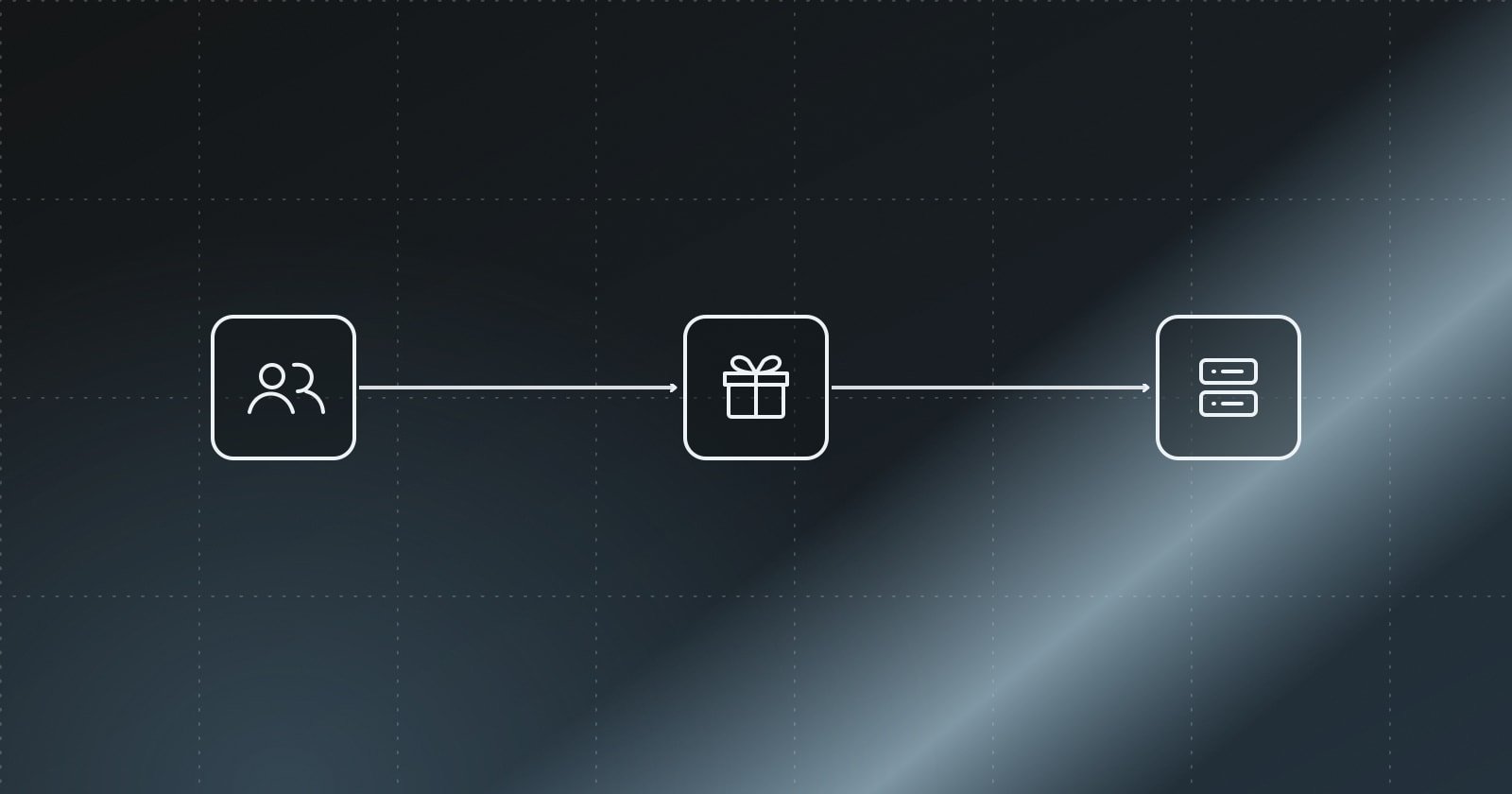
Free trial abuse is repeated or deceptive use of trial access that breaks a product’s eligibility rules. A team might see new accounts repeatedly redeem the same offer or scripted signups consume expensive features. The engineering task is to enforce a clear eligibility rule while preserving access for legitimate evaluators.
Define the entitlement being protected: one trial per eligible account, organization, or other clearly stated unit. For example, a SaaS product might grant one trial to each organization, while an event platform might limit one promotional ticket allotment per eligible buyer. Those rules need different data and different exception paths. Billing mistakes and cancellation complaints need their own investigation; they are not evidence that a customer deliberately abused a trial. The related promotion-abuse guide covers eligibility and redemption controls.
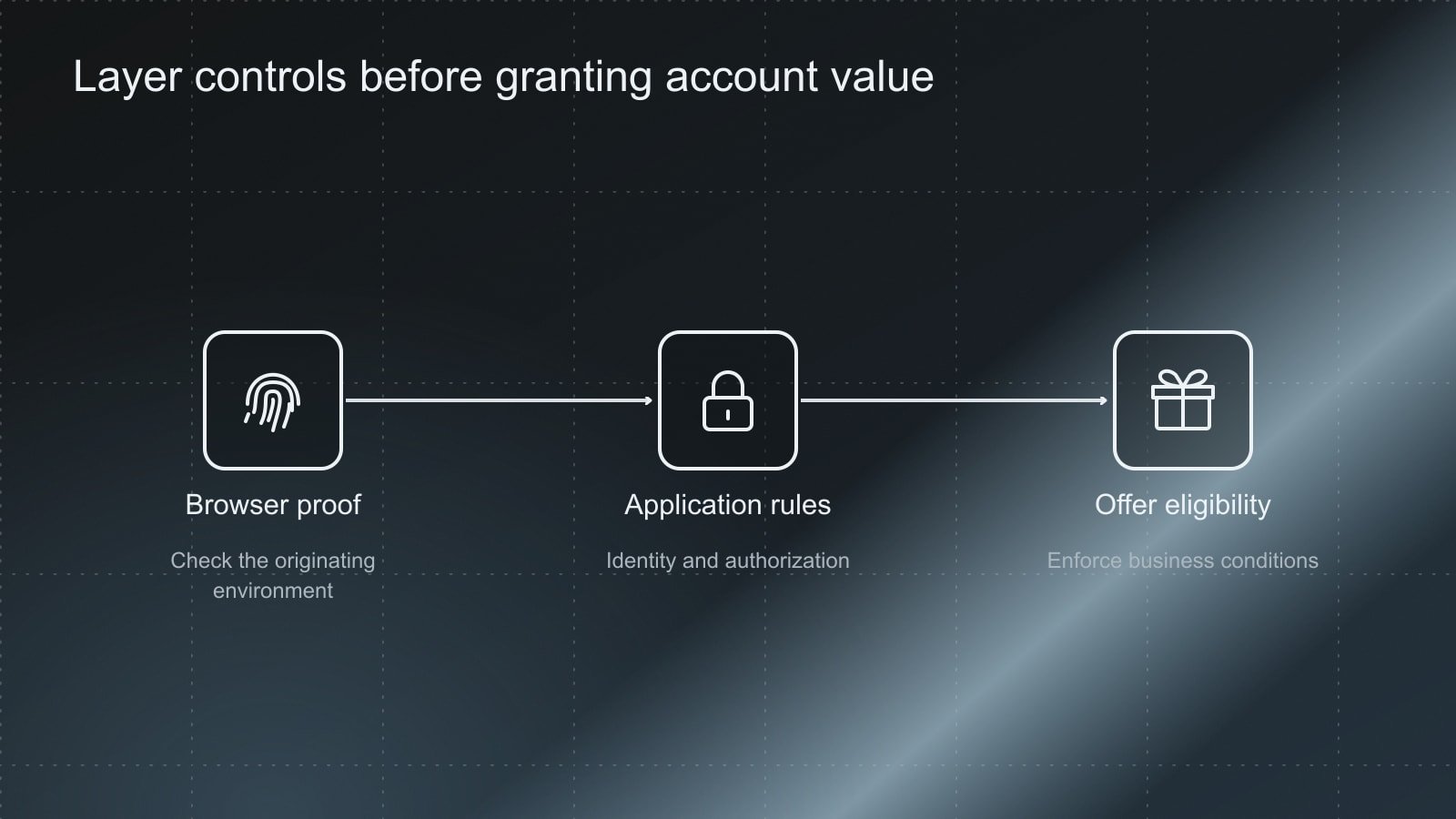
The practical response is layered and action-specific. Protect the signup, redemption, and checkout actions that matter most, measure abuse as a first-party policy problem, and avoid broad blocks that punish legitimate repeat users such as households, workplaces, and evaluators comparing tools. The playbook below moves from policy and instrumentation to verification, rollout, enforcement, and incident response.
What Free Trial Abuse Actually Costs You
Track the costs your own team can verify: repeated trial redemptions, metered feature usage, support-reviewed eligibility disputes, and legitimate users affected by restrictions. A lower trial-to-paid conversion rate alone does not establish deliberate abuse. It could also reflect a pricing change, a different acquisition channel, or a trial that does not give evaluators enough time to reach value.
For a SaaS product, a confirmed repeat trial might consume compute, API calls, storage, or support time. For a ticketing offer, the cost might be promotional inventory that another eligible buyer could have used. Record the cost in the unit the business actually manages, such as reviewed duplicate redemptions or metered usage associated with those cases. Avoid assigning every trial expense to abuse simply because the account did not convert.
Separate abuse from confusion
Separate confirmed eligibility violations from billing confusion, ordinary evaluation, and shared environments. Use support-reviewed cases and application records to label those outcomes. A refund or cancellation request alone is not an abuse label.
Consider three accounts created from one office network. They might be three employees evaluating the same tool, one person repeatedly obtaining an account-level trial, or an organization legitimately testing separate teams. The IP address does not distinguish those cases. A reviewer needs the stated offer terms, account relationships, redemption history, and, where appropriate, a documented exception. Keep an unknown category when the evidence does not support either a confirmed violation or a legitimate-use label.
Write down the trial terms, renewal notices, and cancellation path independently of the abuse policy. Clear billing behavior and trial eligibility are separate product responsibilities; browser verification cannot decide either policy for the business. If the offer says one trial per organization, explain how subsidiaries, contractors, and prior trials are handled before building an automated denial around that wording.
Working definition: free trial abuse is repeated or deceptive redemption of trial access in violation of an explicit eligibility rule. Define that rule before selecting detection signals.
Focus controls on actions, not on vague suspicion
That definition matters because legitimate repeat users do exist. A household may share a payment method. A company may run trials from a corporate network. A buyer may test several tools before choosing one. If you block every repeated signup, policy enforcement becomes a conversion tax.
The better frame is to protect specific high-value actions: signup, trial redemption, account recovery, checkout, and promotion redemption. A new account with no trial request may deserve a different response from an account attempting to activate a scarce or expensive entitlement. Likewise, viewing a pricing page should not carry the same policy weight as submitting the request that grants trial credits.
Tie each control to the action and its potential cost. For example, observe all trial-creation requests, apply a tighter policy at credit redemption, and retain a separate idempotency check where the entitlement is granted. This makes the rule easier to explain and rollback. It also fits a first-party policy-abuse problem model, which is where teams get cleaner decisions than from a blanket fraud label.
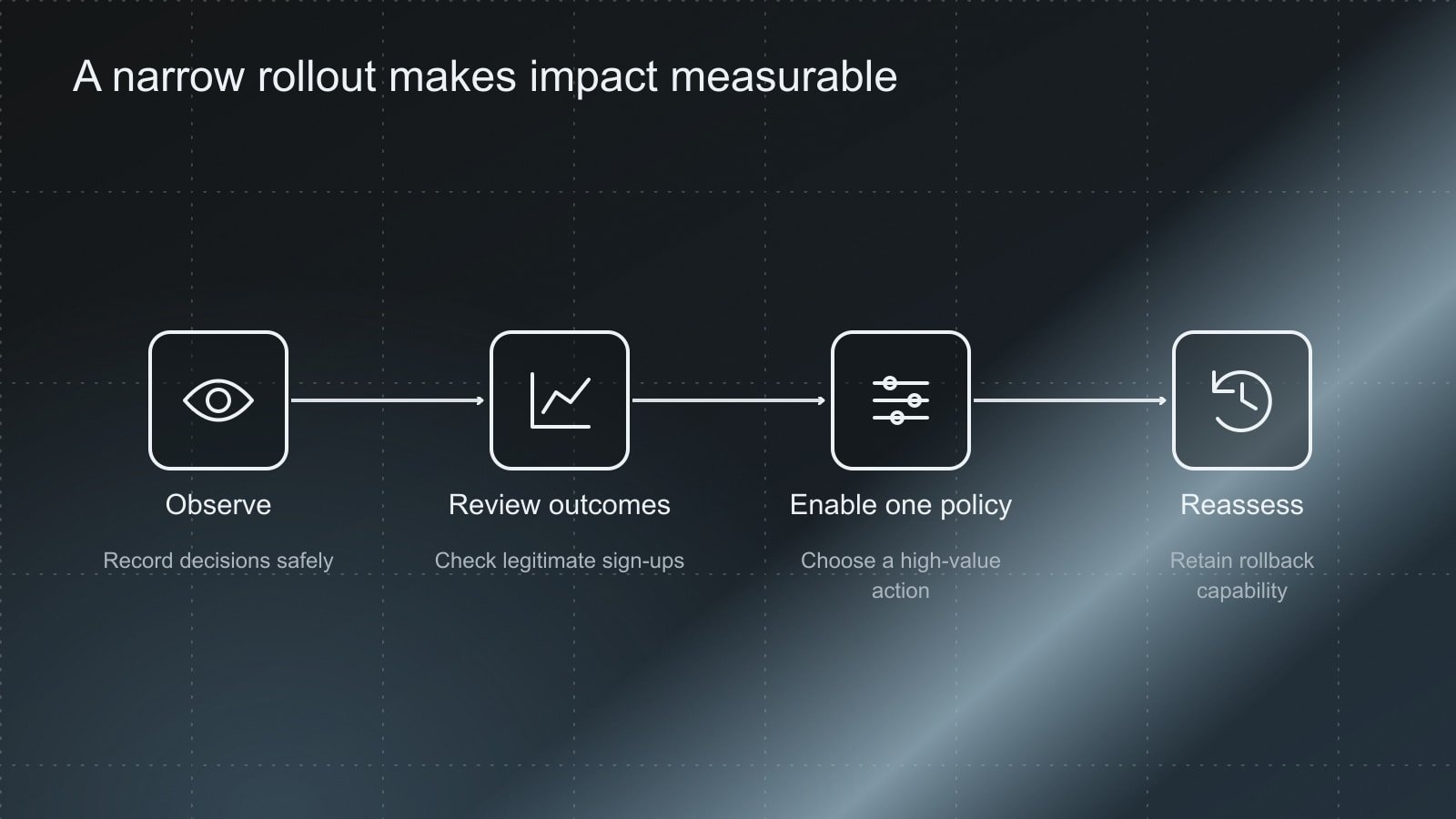
The rollout should stay reversible. Start with the actions where confirmed abuse consumes the most value, observe legitimate evaluators, then enforce a narrow policy only when reviewed evidence supports it. Measure completion and abuse outcomes after the change. If the trial has several value-granting steps, protect the one that actually creates the entitlement rather than assuming the first signup screen is enough.
Detection Signals Worth Instrumenting First
The first rollout decision is the unit of analysis. Some teams should measure by signup, others by account, trial, or expensive action. The wrong choice makes the numbers noisy and the review queue impossible to trust. Counting five retries as five abusive trials, for example, exaggerates the problem if all five attempts refer to one intended redemption.
Define both the attempt and the outcome. An attempt is a request to perform the protected action. An outcome records whether the application accepted, denied, held, or failed that request, and whether an entitlement was ultimately granted. Keep a stable reference to the business event so reviewers can follow retries without mistaking them for separate successes.
Build the baseline from confirmed cases
A useful baseline starts with confirmed duplicate-trial cases, legitimate repeat users, support-reviewed exceptions, and payment outcomes. That lets the team compare real abusive trials with normal user behavior instead of guessing from raw failures. Instrumenting the right fields early also gives analytics and backend teams something concrete to work with.
Before changing the policy, choose a review window and sample from more than one outcome group: accepted trials, suspicious-looking attempts, technical verification failures, and support escalations. A sample that includes only denied traffic cannot tell you how often the same signals appear in legitimate usage. Record who assigned each label and what evidence supported it so a later reviewer can revisit uncertain calls.
Capture these event-level fields:
- Pseudonymous account and browser identifiers: enough to link related attempts without turning the system into a profile of the person. Limit access and retention to what the review process needs.
- Signup and activation timestamps: useful for spotting rapid sequence behavior and distinguishing a burst of retries from attempts spread across multiple trial periods.
- Coarse network-risk categories: keep this at the level of risk grouping, not hard identity. A shared corporate network should not automatically become a denial reason.
- Trial-history links: tie the current attempt to prior redemptions and record which eligibility rule would make that relationship relevant.
- Feature-usage velocity: help distinguish real evaluation from idle or scripted signups. Compare usage against the product’s normal onboarding path rather than assuming that fast usage is always suspect.
- Denial or review outcomes: record what the system did, not just what it saw. Include an exception or appeal outcome when a reviewer reverses a proposed decision.
The point is not to guess from one signal. It is to keep enough evidence to compare attempts over time and across related accounts. Document which team owns each field, how long it is retained, and how reviewers can correct a mistaken association. Data that cannot be interpreted or challenged will make enforcement harder, not easier.
Treat signals as candidates, not verdicts
A new domain combined with disposable-email indicators, sub-200-millisecond form completion, and a bot-like user agent is a candidate signal, not proof. Each element can happen for legitimate reasons. New domains are normal for startups. Fast completions happen with autofill and power users. User agents can be messy, modified, or hidden by privacy tools.
A useful review question is: What competing explanation could produce this same pattern? For a rapid signup, check whether the flow supports autofill. For several accounts at one IP address, check whether the network belongs to an office or shared access point. For linked trial histories, check whether the prior redemption belongs to the same policy unit. The stronger the intervention, the more important it is to resolve those alternatives.
Practical rule: no single signal should be treated as a final decision if it can also appear in legitimate behavior.
That's why teams should avoid over-weighting IP address alone, email domain alone, or card BIN alone. People share workplaces, families, mobile carriers, and privacy-preserving tools. A detector that treats those overlaps as abuse will find plenty of false positives and very little trust.
The strongest next step is to group evidence across related attempts, then hand only the most defensible cases to enforcement. For example, repeated redemptions tied to the same documented eligibility unit are more actionable than several unrelated signups from one office. For a deeper view on bot-style abuse signals, the bot-attacks guide is a useful companion read for teams building the first instrumentation pass.
How Invisible Browser Verification Fits the Stack
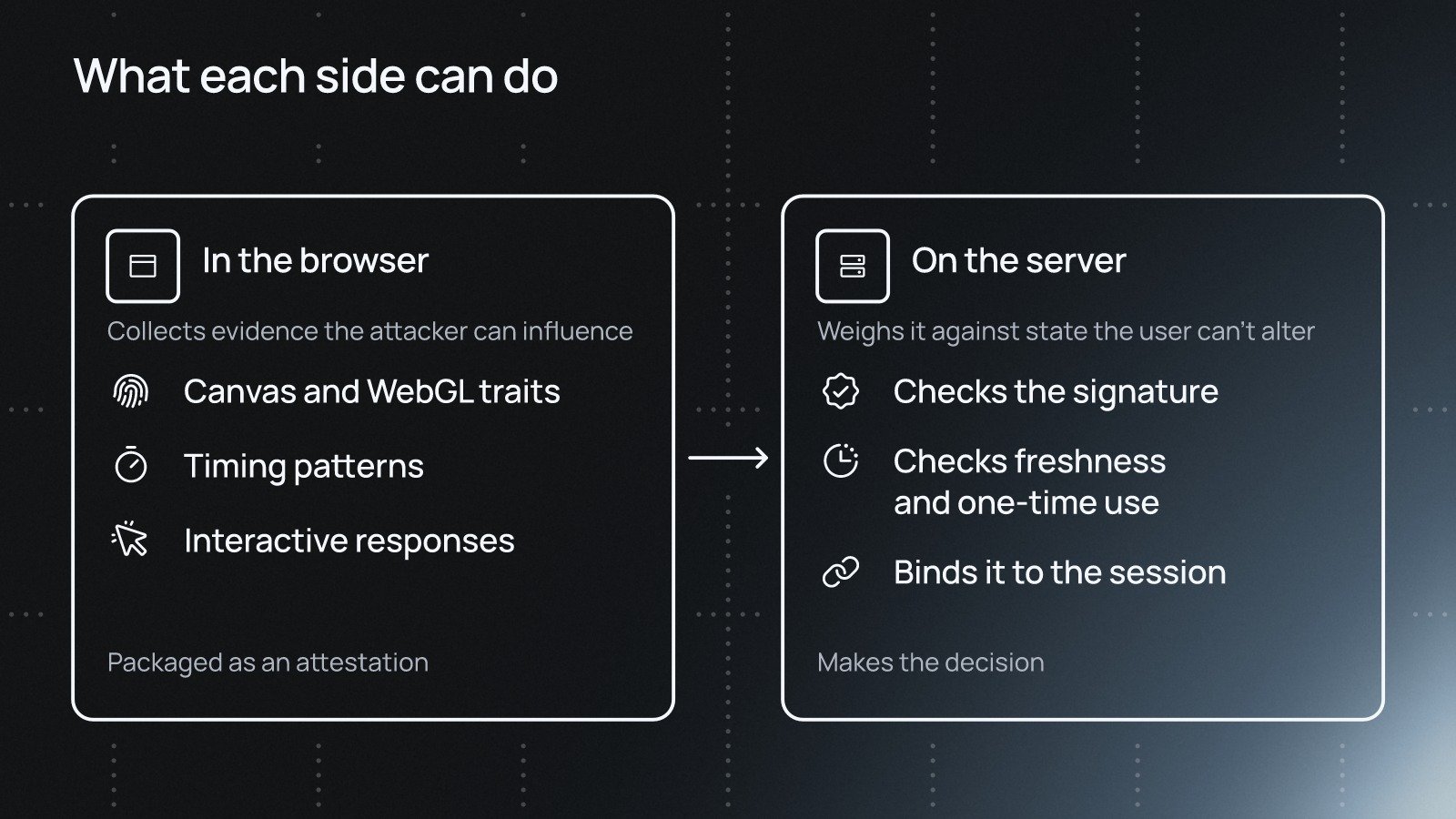
Browser verification belongs in the request lifecycle before the app accepts a protected action, not as a replacement for the rest of the stack. The browser collects evidence, the server checks current state, and the app decides whether the signup, redemption, or checkout action can proceed.
In a trial flow, that means placing the check where the application is about to grant access, not merely on a page view. The server can then consider the verification result alongside the authenticated account, the offer terms, existing entitlements, and the idempotency key for that business operation. A successful browser check should never silently grant a second trial if the account or organization is ineligible.
Hosted verification is the normal path
The clean design is simple. A browser script gathers evidence about the browser context, the server verifies it, and the application keeps the credentials opaque and short-lived. That makes replay and token theft harder to reuse across unrelated requests, while still keeping the decision close to the action that matters.
Think of verification as one step in a server-owned transaction. When the protected request arrives, the application checks that the proof applies to the intended action, handles stale or repeated submissions, and makes its own authorization and eligibility decision. The final entitlement update should remain atomic so two concurrent requests cannot both grant the same trial.
Hosted server-side verification is the normal integration path because it lets the service check current policy state before accepting the action. That matters for trial redemption and similar flows, where the important question is not just “does this browser look familiar?” but “should this action be accepted right now?”
The client-versus-server decision guide is worth reading when teams decide where a policy check should live in the request path. During implementation, test ordinary refreshes, double-clicks, expired proofs, and a browser that cannot complete verification. Those are separate cases and should produce intentional application behavior rather than an ambiguous failure.
What browser evidence does not answer
Browser verification is not proof of human identity. It is not a replacement for authentication, authorization, transaction validation, idempotency, or payment-provider controls. It answers a narrower question, whether the current browser context looks acceptable for this action.
That distinction keeps the design honest. A valid browser can still belong to an abusive account. A real user can still need a retry. A verified action can still need rate limiting, breached-password screening, or payment checks. A support agent approving an eligibility exception is also making a business-policy decision, not changing what the browser evidence means.
Local cryptographic verification belongs only in an offline emergency tier or legacy compatibility scenario. It is not the normal operating mode for a modern signup or redemption flow. For online enforcement, the server should remain the source of truth about whether the action is currently allowed. If a verification service is unavailable, the application needs a documented fallback appropriate to the cost of that action; it should not accidentally interpret a technical error as proof of abuse.
Browser evidence should reduce uncertainty, not become the only thing standing between a request and a protected action.
Choosing an Edge, Cloud, or Middleware Deployment
The integration point should be the application action that grants trial access. The table below compares general architecture options, not a list of shipped MANDATE deployment modes. Check current product documentation before selecting an integration.
Begin with the context the decision needs. If eligibility depends on organization membership or an existing subscription, a check outside the application cannot make the full business decision by itself. If the immediate problem is large volumes of clearly unwanted traffic hitting a public endpoint, an earlier gate may reduce work before the request reaches the origin. Teams can combine layers, but each layer needs a defined job.
Deployment options at a glance
| Deployment | Where it runs | Best fit | Rollback path |
|---|---|---|---|
| Edge | Before the request reaches the origin app | Fast rejection of obvious abuse on high-volume public actions; keep account-specific eligibility in the app | Disable the edge rule or move it back to Observe mode |
| Cloud | Hosted verification step called from the application | Teams that want the policy decision near the app while keeping the decision server-side | Turn off the policy call or bypass the policy branch |
| Middleware | Between the application and a downstream service | Actions where business logic needs the verification result before a deeper workflow continues | Remove the middleware hop or switch it to observe-only handling |
The decision is mostly about blast radius. Edge deployment can reduce origin load quickly, but it gives the app less room to inspect business context. Cloud verification keeps the business logic close to the decision, which helps when trial eligibility depends on account state. Middleware sits between those options and works best when a downstream service should not be called until policy passes.
For example, a public signup endpoint might use an early, conservative traffic rule while the application decides whether an organization is eligible for a trial. In a ticketing flow, the final inventory or promotion redemption should still be checked against the offer rules when the reservation is made. An upstream pass does not reserve inventory or establish eligibility.
Choose rollback as part of the design
Rollback matters because the first production rule is rarely the final one. A team that can disable a single policy branch or revert a middleware hop will ship faster than a team that needs a major app change to back out a bad rule. That is also why the rollout should start in Observe mode before anything is enforced.
Write down what rollback changes and what it does not. Turning off a proposed-abuse rule should not disable ordinary authentication or accidentally grant duplicate entitlements. Assign someone who can perform the revert, verify the setting changed, and inspect the next set of protected requests. If an upstream rule and an application rule are both active, name the rollback owner for each.
For a staged rollout and rollback checklist, use Observe before enforce. Test retries, shared networks, proof failures, and the application’s trial-eligibility decision separately.
The right choice is usually the one that keeps the policy decision as close as possible to the protected action while preserving a clean rollback path. If the business logic already knows whether a trial is eligible, cloud or middleware can be the better fit. If the goal is to reject obvious abuse before it burns origin capacity, edge is usually the first place to look.
Tuning Observe Mode Before You Enforce Anything
In Observe mode, collect the verification result and record what the proposed policy would do while the application continues its existing acceptance behavior. Authentication, authorization, trial eligibility, and other existing controls remain in force. Measure verification latency and errors as well as policy outcomes.
Before starting the window, define what evidence would justify moving forward. That might include reviewed examples of policy violations, a manageable exception queue, and no unexplained drop in legitimate completion. Observe mode is not just a countdown to enforcement; it is a chance to discover whether the proposed rule distinguishes the right cases at all.
Use a real rollout boundary
The rollout boundary should be a route and method, not “protect the API.” A good boundary might be the POST that creates a trial account, or the redemption action that grants the trial. That keeps review and tuning focused on the exact business event under protection.
Document the request's place in the flow. If the POST only creates an unactivated account and a later call grants trial credits, observing the first route alone may miss the expensive outcome. Conversely, protecting both routes without joining their events could count one evaluator twice. Record route, method, protected action, eligibility unit, and the event that confirms the entitlement was granted.
A synthetic example, for illustration only: during a two-week Observe window on a signup route, an application-owned review log records several trial attempts that appear related. It records proposed rejections while the application continues its existing handling. Reviewers check whether those attempts are coordinated abuse or a legitimate shared environment. This illustrates a review process, not an observed customer result or a promise about a specific dashboard screen.
In that example, reviewers might find that one cluster belongs to a team evaluating a shared workspace, while another repeatedly redeems an offer tied to the same eligibility unit. Those two outcomes should receive different labels and should lead to different policy decisions, even if both clusters initially looked similar.
Read the dashboard like a decision log
The dashboard should keep these states separate:
- Proposed rejection: the policy thinks the action should be blocked. Review whether the underlying case actually violates the eligibility rule.
- Verification error: the browser proof or policy check failed in a technical way. Investigate integration or availability before treating it as user behavior.
- Applied intervention: the application denied or held the protected action under an explicit policy. MANDATE’s browser verification adds no CAPTCHA or user-facing challenge.
- Failed business operation: the app could not complete the signup or redemption for its own reasons, such as a separate eligibility check or transaction failure.
Those are not the same thing, and collapsing them into one “blocked” number hides what needs fixing. A rising verification error rate means a technical issue. A rising proposed rejection count may mean the rule is useful, or that traffic composition has changed. A rising failed business operation count could point to an unrelated app bug. Join the policy result to the final application outcome before drawing conclusions.
Watch the legitimate-user column before tightening
The review cadence should always include legitimate-user impact. Shared offices, schools, VPN-heavy teams, and privacy-conscious users are the first places false positives show up. If the legitimate-user column starts to move, the threshold is too aggressive or the signal mix is too broad.
Review support tickets and completed actions alongside the proposed blocks. If several eligible users appeal a shared-network decision, changing a threshold may be safer than adding a broad exception for that network. If reviewers cannot explain why a proposed rejection is correct, leave the rule in Observe mode and gather better evidence.
Review discipline: tighten only after the team can explain why a proposed rejection is happening and why a real user would not reasonably match the same pattern.
That keeps enforcement reversible and keeps support from inheriting a mess that engineering can't explain.
Enforcement Rules, Metrics, and Incident Response
Enforcement should stay narrow at first. The goal is not to stop every conceivable trial abuse path on day one. The goal is to block the clearest policy violations without damaging legitimate access. Start with one documented rule on one protected action, then review its effect before expanding coverage.
Match the action to the response
Keep the application’s response explicit: accept an eligible request, reject a confirmed eligibility violation, or send an uncertain case to an application-owned review path. Browser verification does not prove human identity and should not introduce a CAPTCHA, puzzle, or interstitial.
For example, an account that has already redeemed its allowed trial might receive an eligibility explanation and a route to support if the record is wrong. A request whose browser verification fails for technical reasons might instead follow the application's documented failure policy. Do not give both users the same message or count both as confirmed abuse. For time-sensitive ticket inventory, decide in advance whether an uncertain case can be held for review or must be declined without reserving stock.
Rate limits per source and per account still belong in the stack. So does breached-password screening for sign-in flows, and idempotency for trial redemption or checkout so retries do not create duplicate outcomes. Browser verification adds evidence, but it does not replace those controls. When several checks apply, log which one produced the final response so an on-call engineer can diagnose it.
Track post-enforce metrics that matter
The most useful post-enforce metrics are operational, not vanity metrics:
- Completion rate for legitimate users: tells the team whether real users can still finish the protected action. Compare like-for-like routes and acquisition sources where possible.
- False-positive review volume: shows how much manual work the policy creates, including successful appeals and overturned decisions.
- Time to revert: measures whether the on-call owner can back out a bad rule quickly, including the time to confirm that normal traffic recovered.
- Reviewed abusive redemptions after enforcement: use labeled first-party cases; do not treat all successful signups as legitimate or all denied attempts as abuse.
- Technical failure rate: keep proof and integration errors separate from policy denials so outages do not masquerade as enforcement success.
A policy that looks strong but slows valid users is a bad trade. So is a policy that barely catches anything but creates a lot of review work. The best sign is a narrower queue with a clear path for exceptions. Compare the post-enforce period to the Observe baseline, and note other changes such as marketing campaigns or offer updates that could affect the comparison.
Write the incident path before enforcement
Every enforceable rule needs an owner, a revert step, and a short policy template in the runbook. That prevents the common failure mode where a security rule goes live, support starts escalating, and nobody knows who can safely roll it back.
A simple template helps:
- Owner: named on-call engineer or security lead, plus the team that can resolve eligibility exceptions.
- Trigger: what metric or complaint opens the incident, such as a verification-error spike or a cluster of eligible users unable to redeem.
- Action: switch the rule back to Observe or disable the branch, while leaving unrelated eligibility and authorization controls intact.
- Review: inspect grouped evidence, recent policy changes, and legitimate-user impact before re-enabling.
- Follow-up: record the cause, any affected entitlements, and whether users need an application-level correction or support reply.
Run through a hypothetical bad rollout before launch. If a legitimate organization cannot start a trial, support should know where to send the case, engineering should know which rule to revert, and the owner should be able to tell whether a denied entitlement needs to be granted after review. This exercise reveals gaps that a dashboard alone will not show.
A good abuse rule is one that can be explained, measured, and reverted without a meeting.
Rollout Checklist and What to Keep Doing
The rollout sequence should be boring on purpose. First define the unit of analysis. Then build a labeled baseline. Then instrument the fields. Then choose the deployment. Then run Observe mode. Then enforce one narrow rule. Then assign an owner and a revert path. Then measure what happens to legitimate users.
Use this checklist before switching on enforcement:
- Policy: Can a reviewer state who is eligible, which prior redemption matters, and how exceptions work?
- Event model: Can the team distinguish attempts, retries, granted entitlements, technical errors, and final application decisions?
- Evidence: Have confirmed violations and legitimate lookalikes both been reviewed?
- Integration: Does verification run on the protected action, with business eligibility and idempotency checked separately?
- Rollout: Is there an Observe baseline, an owner, a rollback step, and a way to measure legitimate completion?
- Support: Can a wrongly denied user reach an exception path, and can the team correct the entitlement if needed?
Keep the other controls in place. Authentication, authorization, payment-provider controls where relevant, and business idempotency remain application responsibilities. Define trial eligibility and enforce its redemption atomically so retries or concurrent requests do not grant duplicate entitlements. See the worked example of idempotency and replay protection for the distinction between those controls.
No control set prevents every real-browser agent or every eligibility violation. Evaluate confirmed abusive redemptions, legitimate completion, verification errors, and support-reviewed exceptions separately. Use those outcomes to decide whether a policy helps. Revisit the policy when trial terms, pricing, distribution channels, or ticket inventory rules change: a signal that worked for one offer may be wrong for the next.
MANDATE Verify provides invisible browser verification for high-value actions using hosted checks against live server-side state. Review the current integration guide and start with one supported action in Observe mode. The application continues to own trial eligibility and business authorization.